

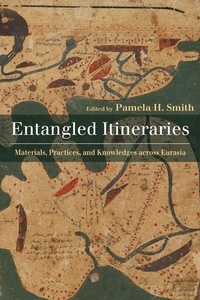
Entangled Itineraries
Materials, Practices, and Knowledges across Eurasia
Will be published approx. on 30. April 2019
Book
Hardback
408 pages
978-0-8229-6577-0 (ISBN)
Description
Trade flowed across Eurasia, around the Indian Ocean, and over the Mediterranean for millennia, but in the early modern period, larger parts of the globe became connected through these established trade routes. Knowledge, embodied in various people, materials, texts, objects, and practices, also moved and came together along these routes in hubs of exchange where different social and cultural groups intersected and interacted.
Entangled Itineraries traces this movement of knowledge across the Eurasian continent from the early years of the Common Era to the nineteenth century, following local goods, techniques, tools, and writings as they traveled and transformed into new material and intellectual objects and ways of knowing. Focusing on nonlinear trajectories of knowledge in motion, this volume follows itineraries that weaved in and out of busy, crowded cosmopolitan cities in China; in the trade hubs of Kucha and Malacca; and in centers of Arabic scholarship, such as Reyy and Baghdad, which resonated in Bursa, Assam, and even as far as southern France. Contributors explore the many ways in which materials, practices, and knowledge systems were transformed and codified as they converged, swelled, at times disappeared, and often reemerged anew.
Entangled Itineraries traces this movement of knowledge across the Eurasian continent from the early years of the Common Era to the nineteenth century, following local goods, techniques, tools, and writings as they traveled and transformed into new material and intellectual objects and ways of knowing. Focusing on nonlinear trajectories of knowledge in motion, this volume follows itineraries that weaved in and out of busy, crowded cosmopolitan cities in China; in the trade hubs of Kucha and Malacca; and in centers of Arabic scholarship, such as Reyy and Baghdad, which resonated in Bursa, Assam, and even as far as southern France. Contributors explore the many ways in which materials, practices, and knowledge systems were transformed and codified as they converged, swelled, at times disappeared, and often reemerged anew.
Reviews / Votes
One of the many pleasures this volume offers is the community of scholars it represents. . . . The successful outcome proves that however difficult it might seem to write histories spanning cultural and linguistic zones, and however far out of their comfort zones scholars may be, collaborations do work and produce important volumes such as this one. * Technology and Culture * Entangled Itineraries-with its breadth of topics; its attention to movement, exchange, translation, adaptation; its experimental mobilization of new heuristic concepts; and its expansive perspectives-opens up new frontiers in the study of human knowledge. It promises to provoke a major and positive reassessment in the field of history of science and will excite students and faculty in a variety of fields. An ambitious, necessary, and vital collection. -- Federico Marcon, Princeton University "Led by the insight that objects, ideas, and cultures are known through the 'relational fields' that they activate in migrating among places and times, this book is a sustained meditation on the versatility of matter. The authors have brought an astonishing range of knowledge and skills to bear on the unacknowledged cosmopolitan character of words, things, and values as we know them from one place or another on the Eurasian continent: really existing multiculturalism. Every chapter contains its pearl, but the sum of them is that future work on cultural exchange must begin from Entangled Itineraries." -- Haun Saussy, University of Chicago This well-organized symposium volume is a timely contribution to the field of world history. Instead of proposing yet another all-encompassing mega-framework that aims at organizing every era obsessively, the book presents several approaches and examples to study the 'itineraries' of materials, practices, and knowledge while engaging other existing analytical categories. * Journal of World History *More details
Language
English
Place of publication
Pittsburgh PA
United States
Target group
Professional and scholarly
Product notice
sewn/stitched
Cloth over boards
Illustrations
67 b&w illustrations
Dimensions
Height: 237 mm
Width: 162 mm
Thickness: 35 mm
Weight
697 gr
ISBN-13
978-0-8229-6577-0 (9780822965770)
Copyright in bibliographic data and cover images is held by Nielsen Book Services Limited or by the publishers or by their respective licensors: all rights reserved.
Schweitzer Classification
Other editions
Additional editions
E-Book
05/2019
NYU Press
€43.99
Available for download
Person
Pamela H. Smith is Seth Low Professor of History and founding director of the Center for Science and Society at Columbia University where she teaches history of early modern Europe and the history of science.