

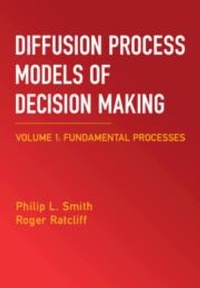
Diffusion Process Models of Decision Making: Volume 1
Fundamental Processes
Published on 13. November 2025
Book
Hardback
552 pages
978-1-009-65268-1 (ISBN)
Description
Diffusion decision models are widely used to characterize the cognitive and neural processes involved in making rapid decisions about objects and events in the environment. These decisions, which are made hundreds of times a day without prolonged deliberation, include recognition of people and things as well as real-time decisions made while walking or driving. Diffusion models assume that the processes involved in making such decisions are noisy and variable and that noisy evidence is accumulated until there is enough for a decision. This volume provides the first comprehensive treatment of the theory, mathematical foundations, numerical methods, and empirical applications of diffusion process models in psychology and neuroscience. In addition to the standard Wiener diffusion model, readers will find a detailed, unified treatment of the cognitive theory and the neural foundations of a variety of dynamic diffusion process models of two-choice, multiple choice, and continuous outcome decisions.
Reviews / Votes
'This is the first volume of a pair that will become the definitive books on diffusion process models of decision making. This book provides an outstanding introduction to the theory, both clear and rigorous, written by the leading experts in the field. A 'must buy' for every decision scientist.' Jerome Busemeyer, Distinguished Professor of Psychological and Brain Sciences, Indiana University Bloomington 'Philip Smith and Roger Ratcliff are the leading world researchers on evidence accumulation modeling, and have produced a definitive survey of the many variants of diffusion models and their respective merits. Every researcher in every field who would like to explain their response time and accuracy data with an evidence accumulation process should have this book on their shelves, and use it extensively.' Richard Shiffrin, Distinguished and Luther Dana Waterman Professor, Indiana University Bloomington 'This two-volume set on what is arguably the most compelling account of human information processing is an instant classic that will prove to be an indispensable guide for future generations of cognitive scientists. It is an absolute triumph.' Eric-Jan Wagenmakers, Professor at the Department of Psychological Methods, University of AmsterdamMore details
Language
English
Place of publication
Cambridge
United Kingdom
Illustrations
Worked examples or Exercises
Dimensions
Height: 260 mm
Width: 183 mm
Thickness: 34 mm
Weight
1221 gr
ISBN-13
978-1-009-65268-1 (9781009652681)
Copyright in bibliographic data and cover images is held by Nielsen Book Services Limited or by the publishers or by their respective licensors: all rights reserved.
Schweitzer Classification
Other editions
Additional editions
Philip L. Smith | Roger Ratcliff
Diffusion Process Models of Decision Making: Volume 1
Fundamental Processes
Book
11/2025
Cambridge University Press
€57.40
Shipment within 15-20 days
Persons
Philip L. Smith has published numerous articles on mathematical models of decision processes and is the developer of the circular diffusion model of continuous-outcome decisions. He has served as a former Editor-in-Chief of the Journal of Mathematical Psychology and was awarded the Society for Mathematical Psychology's 2002 Outstanding Paper Award for his research on diffusion process models.
Content
Preface; 1. Overview; 2. Basic concepts and data; 3. Sequential-sampling models of decision making; 4. Obtaining predictions for diffusion models; 5. Empirical assessment of sequential-sampling models; 6. Time-varying diffusion models, I. Time pressure, urgency, collapsing boundaries, and optimality; 7. Diffusion models for time-controlled processing tasks; 8. Time-varying diffusion models, II. Detection and simple RT; 9. Diffusion processes driven by time-varying stimulus representations in visual working memory; 10. Neural diffusion models, I. Network and dynamical system models; 11. Neural diffusion models, II. Poisson shot noise and related models; 12. Diffusion models for continuous-outcome decision tasks; 13. Response confidence; 14. EZ and moment models, multialternative decisions, and expanded judgment tasks; References; Index.