

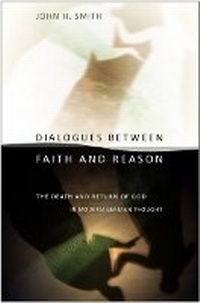
Dialogues Between Faith and Reason
The Death and Return of God in Modern German Thought
Published on 15. October 2011
Book
Paperback/Softback
328 pages
978-0-8014-7762-1 (ISBN)
Description
The contemporary theologian Hans Kueng has asked if the "death of God," proclaimed by Nietzsche as the event of modernity, was inevitable. Did the empowering of new forms of rationality in Western culture beginning around 1500 lead necessarily to the reduction or privatization of faith? In Dialogues between Faith and Reason, John H. Smith traces a major line in the history of theology and the philosophy of religion down the "slippery slope" of secularization-from Luther and Erasmus, through Idealism, to Nietzsche, Heidegger, and contemporary theory such as that of Derrida, Habermas, Vattimo, and Asad. At the same time, Smith points to the persistence of a tradition that grew out of the Reformation and continues in the mostly Protestant philosophical reflection on whether and how faith can be justified by reason. In this accessible and vigorously argued book, Smith posits that faith and reason have long been locked in mutual engagement in which they productively challenge each other as partners in an ongoing "dialogue."
Smith is struck by the fact that although in the secularized West the death of God is said to be fundamental to the modern condition, our current post-modernity is often characterized as a "postsecular" time. For Smith, this means not only that we are experiencing a broad-based "return of religion" but also, and more important for his argument, that we are now able to recognize the role of religion within the history of modernity. Emphasizing that, thanks to the logos located "in the beginning," the death of God is part of the inner logic of the Christian tradition, he argues that this same strand of reasoning also ensures that God will always "return" (often in new forms). In Smith's view, rational reflection on God has both undermined and justified faith, while faith has rejected and relied on rational argument. Neither a defense of atheism nor a call to belief, his book explores the long history of their interaction in modern religious and philosophical thought.
Smith is struck by the fact that although in the secularized West the death of God is said to be fundamental to the modern condition, our current post-modernity is often characterized as a "postsecular" time. For Smith, this means not only that we are experiencing a broad-based "return of religion" but also, and more important for his argument, that we are now able to recognize the role of religion within the history of modernity. Emphasizing that, thanks to the logos located "in the beginning," the death of God is part of the inner logic of the Christian tradition, he argues that this same strand of reasoning also ensures that God will always "return" (often in new forms). In Smith's view, rational reflection on God has both undermined and justified faith, while faith has rejected and relied on rational argument. Neither a defense of atheism nor a call to belief, his book explores the long history of their interaction in modern religious and philosophical thought.
Reviews / Votes
"Dialogues between Faith and Reason is a terrific book. It presents complicated ideas and histories in an extremely open, clear fashion and it makes those ideas speak to pressing issues facing the world today. It is beautifully written, conceptually powerful, and an authentic invitation to dialogue." -- Kenneth Reinhard, UCLA "Equally at home in German literature, intellectual history, and philosophy, John H. Smith offers a learned and lucid study in the history of ideas. He narrates many ironic turns in the dialectic of faith and reason, exploring a set of engaging questions and making transparent a variety of complex positions that allow us to learn not only about, but also from, the great German thinkers who helped to form our current debates about the presence and absence of God." -- Mark W. Roche, University of Notre DameMore details
Language
English
Place of publication
Ithaca
United States
Product notice
Paperback (trade)
Dimensions
Height: 235 mm
Width: 155 mm
Thickness: 19 mm
Weight
454 gr
ISBN-13
978-0-8014-7762-1 (9780801477621)
Copyright in bibliographic data and cover images is held by Nielsen Book Services Limited or by the publishers or by their respective licensors: all rights reserved.
Schweitzer Classification
Other editions
Additional editions
John H. Smith
Dialogues Between Faith and Reason
The Death and Return of God in Modern German Thought
E-Book
10/2011
Cornell University Press
€33.99
Available for download
Person
John H. Smith is Professor of German at the University of California, Irvine. He is the author of Dialectics of the Will: Freedom, Power, and Understanding in Modern French and German Thought and The Spirit and Its Letter: Traces of Rhetoric in Hegel's Philosophy of Bildung.
Content
Introduction: Logos, Religion, and Rationality
1. Erasmus vs. Luther: Philo-logos vs. Faith
2. God and the Logos of Scientific Calculation (Descartes, Spinoza, Leibniz, Pascal)
3. Kant: The Turn to Ethics as Logos
4. Hegel: Logos as Spirit (Geist)
5. Logos and Its Others: Feeling, the Abyss, Willing, and Kritik (Schleiermacher, Schelling, Schopenhauer, Feuerbach)
6. Nietzsche: Logos against Itself and the Death of God
7. Being after the Death of God: Heidegger from Theo- to Onto-logos
8. Dialectical Theology (Gogarten, Barth, Bultmann)
9. "Atheistic" and Dialogical Jewish Theologies of the Other (Rosenzweig and Buber)
10. Fides et Ratio: "Right Reason" and Europe in Contemporary Catholic
Thought (Benedict XVI)Bibliography
Index
1. Erasmus vs. Luther: Philo-logos vs. Faith
2. God and the Logos of Scientific Calculation (Descartes, Spinoza, Leibniz, Pascal)
3. Kant: The Turn to Ethics as Logos
4. Hegel: Logos as Spirit (Geist)
5. Logos and Its Others: Feeling, the Abyss, Willing, and Kritik (Schleiermacher, Schelling, Schopenhauer, Feuerbach)
6. Nietzsche: Logos against Itself and the Death of God
7. Being after the Death of God: Heidegger from Theo- to Onto-logos
8. Dialectical Theology (Gogarten, Barth, Bultmann)
9. "Atheistic" and Dialogical Jewish Theologies of the Other (Rosenzweig and Buber)
10. Fides et Ratio: "Right Reason" and Europe in Contemporary Catholic
Thought (Benedict XVI)Bibliography
Index