

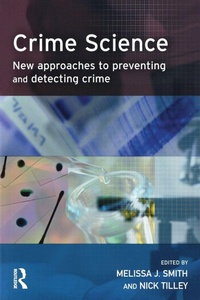
Crime Science
New approaches to preventing and detecting crime
Published on 1. February 2005
Book
Paperback/Softback
240 pages
978-1-84392-089-2 (ISBN)
Description
This book provides an introduction to crime science, setting out its essentials. It provides a major statement of the nature and aspirations of crime science, and presents a series of case studies providing examples, in different settings, of the approach in action, ranging from preventing crime within correctional institutions to the use of techniques such as DNA fast tracking for burglary.
More details
Series
Language
English
Place of publication
Cullompton
United Kingdom
Publishing group
Taylor & Francis Ltd
Target group
College/higher education
Professional and scholarly
Dimensions
Height: 234 mm
Width: 156 mm
Thickness: 13 mm
Weight
374 gr
ISBN-13
978-1-84392-089-2 (9781843920892)
Copyright in bibliographic data and cover images is held by Nielsen Book Services Limited or by the publishers or by their respective licensors: all rights reserved.
Schweitzer Classification
Other editions
Additional editions
Melissa Smith | Nick Tilley
Crime Science
E-Book
06/2013
1st Edition
Willan Publishing
€55.49
Available for download
Melissa Smith | Nick Tilley
Crime Science
E-Book
06/2013
1st Edition
Willan Publishing
€55.49
Available for download
Book
02/2005
Willan Publishing
€165.90
Shipment within 3-4 weeks
Persons
Melissa J. Smith works within the Jill Dando Institute of Crime Science, University College London, UK.
Nick Tilley is Professor of Security and Crime Science at the Jill Dando Institute of Crime Science, University College London, UK. He is also Professor Emeritus of Sociology at Nottingham Trent University, UK.
Nick Tilley is Professor of Security and Crime Science at the Jill Dando Institute of Crime Science, University College London, UK. He is also Professor Emeritus of Sociology at Nottingham Trent University, UK.
Content
Introduction Part 1: Background 1. Defining crime science Part 2: Theory and Methodology 2. How to police the future: scanning for scientific and technological innovations which generate potential threats and opportunities in crime, policing and crime reduction 3. Cost-benefit analysis for crime science: making cost benefit analysis useful through a portfolio of outcomes Part 3: Case Studies in Preventive Crime Science 4. Reducing prison disorder through situational prevention: the Glen Parva experience 5. Driving down crime at motorway service areas 6. Vehicle excise duty evasion in the UK 7. Predicting the future or summarising the past? Crime mapping as anticipation Part 4: Case Studies in Crime Science for Detection 8. DNA fast-tracking 9. Cognition and detection: reluctant bedfellows?