

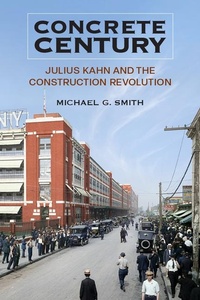
Concrete Century
Julius Kahn and the Construction Revolution
Published on 19. August 2024
Book
Paperback/Softback
284 pages
978-0-472-03974-6 (ISBN)
Description
At the turn of the 20th century, industrial manufacturing was expanding dramatically while factory buildings remained fire-prone relics of an earlier age. That is, until a 28-year-old civil engineer finally achieved what engineers around the world had unsuccessfully attempted. Working in his brother's basement in Detroit, Julius Kahn invented the first practical and scientific method of reinforcing concrete with steel bars, which finally made it possible to construct strong, fireproof buildings. After Kahn founded a company in 1903 to manufacture and sell his reinforcement bars, his system of construction became the most widely used throughout the world.
Drawing upon Kahn's personal correspondence, architectural drawings, company records, and contemporary news and journal articles, Michael G. Smith reveals how this man-whose family had immigrated to the US to escape antisemitism in Germany-played an important role in the rise of concrete. Concrete not only turned the tide against widespread destruction of buildings by fire, it also paved the way for our modern economy. Concrete Century will delight readers intrigued by architecture and construction technology alike with the true origin story of modern concrete buildings.
Drawing upon Kahn's personal correspondence, architectural drawings, company records, and contemporary news and journal articles, Michael G. Smith reveals how this man-whose family had immigrated to the US to escape antisemitism in Germany-played an important role in the rise of concrete. Concrete not only turned the tide against widespread destruction of buildings by fire, it also paved the way for our modern economy. Concrete Century will delight readers intrigued by architecture and construction technology alike with the true origin story of modern concrete buildings.
Reviews / Votes
"Julius Kahn is one of the unsung heroes of America's industrial expansion. Working with his brother, architect Albert Kahn, Julius perfected the building material known as reinforced concrete to enable titans like Henry Ford to build modern factories worldwide. Michael Smith tells Julius's story in fascinating detail." -- John Gallagher, author of Yamasaki in Detroit: A Search for Serenity "We live in a world of reinforced concrete, but rarely think about the origins of this industrial innovation. Michael G. Smith's definitive history of this technology and the life of its principal inventor, Julius Kahn, who fostered a twentieth-century construction revolution, is superbly documented and well-written. It is an important addition to the historiography of America." -- Mike O. Smith, Alene and Graham Landau Archivist, Detroit Jewish News Foundation "Author Smith (architectural historian) takes us on a detailed journey in Concrete Century, tracking how Julius Kahn, along with his architect-brother Albert, were able to change the building industry for the better with their method of perfecting reinforced concrete-a system that diminished the widespread destruction of buildings and eventually became popular throughout the world, even to this day. . . Recommended." * R. P. Meden, Choice * "This book is perfect for lovers of architecture and engineering." * Michigan History Magazine * "Aside from being a first-rate history of a construction revolution, perhaps Smith's singular achievement of Concrete Century is to bring the story of Julius out of relative obscurity. And it is a most interesting story, indeed." * Mike Smith, The Detroit Jewish News * "[T]hanks to Smith's wide array of primary sources, the ease with which he pieces together historical events from these sources, the engaging prose, and his gentle guidance of the reader along several fascinating digressions, the book remains a compelling biography of Julius Kahn and his role in the construction revolution in the United States." * Robby Fivez, H-Soz-Kult *More details
Language
English
Place of publication
United States
Publishing group
The University of Michigan Press
Product notice
Paperback (trade)
Unsewn / adhesive bound
Illustrations
34 images
Dimensions
Height: 218 mm
Width: 150 mm
Thickness: 20 mm
Weight
476 gr
ISBN-13
978-0-472-03974-6 (9780472039746)
Copyright in bibliographic data and cover images is held by Nielsen Book Services Limited or by the publishers or by their respective licensors: all rights reserved.
Schweitzer Classification
Person
Michael G. Smith is an architectural historian and the author of Designing Detroit: Wirt Rowland and the Rise of Modern American Architecture (2017).
Content
Acknowledgments List of Figures
Chapter 1 - Industry on Fire
Chapter 2 - Kahn and Kahn
Chapter 3 - Experimental Methods
Chapter 4 - A Breakthrough
Chapter 5 - Stress and Innovation
Chapter 6 - Seeking Profit
Chapter 7 - Growth
Chapter 8 - Big Changes for a Big Industry
Chapter 9 - Fatal Mistakes
Chapter 10 - Bridge to the Future
Chapter 11 - Tested by Conflagration
Chapter 12 - Dominating the Market
Conclusion
Chapter 1 - Industry on Fire
Chapter 2 - Kahn and Kahn
Chapter 3 - Experimental Methods
Chapter 4 - A Breakthrough
Chapter 5 - Stress and Innovation
Chapter 6 - Seeking Profit
Chapter 7 - Growth
Chapter 8 - Big Changes for a Big Industry
Chapter 9 - Fatal Mistakes
Chapter 10 - Bridge to the Future
Chapter 11 - Tested by Conflagration
Chapter 12 - Dominating the Market
Conclusion