

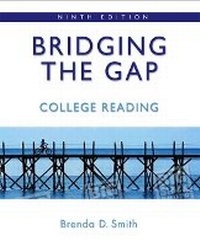
Bridging the Gap
College Reading
9th Edition
Published on 26. April 2007
Book
Paperback/Softback
672 pages
978-0-321-44602-2 (ISBN)
Description
Bridging the Gap was the first book to focus on how to read college textbooks. This college-level focus has since evolved to connect textbook readings to academic and everyday reading sources and represent three bridges of reading: text-to-text, text-to-world, and text-to-self.
More details
Edition
9th edition
Language
English
Place of publication
United States
Publishing group
Pearson Education (US)
Target group
Professional and scholarly
Dimensions
Height: 254 mm
Width: 203 mm
Weight
1191 gr
ISBN-13
978-0-321-44602-2 (9780321446022)
Copyright in bibliographic data and cover images is held by Nielsen Book Services Limited or by the publishers or by their respective licensors: all rights reserved.
Schweitzer Classification
Other editions
New editions
Book
03/2009
9th Edition
Longman Inc
€66.22
Article is exhausted; no reprint
Content
An Overview of Bridging the Gap.
1. Active Learning.
What Is Active Learning?
What Is Cognitive Psychology?
How Does the Brain Screen Messages?
Is Divided Attention Effective?
Can Tasks Become Automatic?
Automatic Aspects of Reading.
Cognitive Styles
Multiple Intelligences: There is More than One Way to be Smart
What Is Concentration?
Poor Concentration: Causes and Cures.
External Distractions.
Internal Distractions.
Reader's Tip: Improving Concentration.
Successful Academic Behaviors.
Reader's Tip: Managing E-Mail Efficiently.
Summary Points.
Selection 1: Computer Science.
Contemporary Focus: "Police in India to Monitor Cybercafes" from the Associated Press.
"Security and Privacy for Computers and the Internet" by H. L. Capron.
Search the Net.
Concept Prep for Computer Science.
Selection 2: Psychology.
Contemporary Focus:
"Critical-Period Hypothesis" by James V. McConnell.
Search the Net
Concept Prep for Psychology.
Selection 3: Health.
Contemporary Focus:
"Steroids" by Rebecca J. Donatelle
Search the Net.
2. Vocabulary.
Remembering New Words.
Using Context Clues.
Definition or Synonym.
Elaborating Details.
Examples.
Comparison.
Contrast.
Antonyms.
Limitations of Context Clues.
Multiple Meanings of a Word.
Understanding the Structure of Words.
Using a Dictionary.
Word Origins.
Using a Glossary.
Using a Thesaurus.
Using Analogies.
Reader's Tip: Categories of Analogy Relationships.
Easily Confused Words.
Recognizing Acronyms.
Recognizing Transitional Words.
Reader's Tip: Signals for Transition.
Summary Points.
Search the Net
Vocabulary Booster: Over, Under, Around and Through
3. Strategic Reading and Study.
What is Strategic Reading?
What are the Stages of Reading?
Stage 1: Previewing.
Signposts for Answering Preview Questions.
Reader's Tip: Asking Questions Before Reading.
Preview to Activate Schemata.
Stage 2: Integrating Knowledge While Reading.
Expanding Knowledge.
Integrating Ideas: How Do Good Readers Think?
Reader's Tip: Using Thinking Strategies While Reading.
Metacognition.
Reader's Tip: Developing a Metacognitive Sense for Reading.
Stage 3: Recalling for Self-Testing.
Recall by Writing.
Reader's Tip: Recalling After Reading.
How to Recall.
Summary Points.
Selection 1: History.
Contemporary Focus:
Concept Prep for History.
Selection 2: Sociology.
Contemporary Focus:
"Unity in Diversity" by Donald Light, Jr., and Suzanne Keller.
Concept Prep for Anthropology.
Selection 3: Business.
Contemporary Focus:
"On the Front Lines of the Service Sector" by John R. Walker
Search the Net
4. Main Idea.
What is a Topic?
What is a Main Idea?
What are Supporting Details?
Distinguishing Topics, Main Ideas, and Details: A Closer Look.
Main Idea Strategies.
"Informed" Expert Readers.
"Uninformed" Expert Readers.
Using Main Idea Strategies with Sentences.
Questioning for the Main Idea.
Stated Main Ideas.
Reader's Tip: Finding the Main Idea.
What are Major and Minor Details?
Reader's Tip: Signals for Significance.
Unstated Main Ideas.
Determining Unstated Main Ideas in Sentences.
Interpreting the Main Idea of Longer Selections.
Reader's Tip: Getting the Main Idea of Longer Selections.
Summary Writing: A Main Idea Skill.
Why Summarize?
Reader's Tip: How to Summarize.
Summary Points.
Selection 1: Psychology.
Contemporary Focus: "Centers Strive to Break Cycle of Violence" from the Herald-Dispatch .
"Monkey Love" by James V. McConnell.
Concept Prep for Psychology.
Selection 2: Short Story
Contemporary Focus:
"On the Sidewalk Bleeding," by Evan Hunter.
Concept Prep for Literature.
Selection 3: Criminal Justice.
Contemporary Focus:
"Female Police Officer," by Joseph J. Senna and Larry J. Siegel
Concept Prep for Criminal Justice.
Search the Net
Vocabulary Booster: Who's Who in Medicine?
5. Patterns of Organization.
Textbook Organization.
What Do Transitional Words Do?
Reader's Tip: Signal Words for Transition.
Patterns of Organization in Textbooks.
Simple Listing.
Definition.
Description.
Time Order or Sequence.
Contrast.
Comparison.
Comparison and Contrast.
Cause and Effect.
Classification.
Addition.
Summary.
Location or Spatial Order.
Generalization and Example.
Reader's Tip: Patterns of Organization and Signal Words.
Mixed Organizational Patterns.
Summary Points.
Selection 1: Narrative.
Contemporary Focus:
"What I Did for Love" by Macarena del Rocio Hernandez.
Search the Net.
Selection 2: History.
Contemporary Focus:
"Women in History" by Leonard Pitt.
Search the Net.
Concept Prep for Art History.
Selection 3: Business.
Contemporary Focus: "Low Carb Pizza Options" from The Omaha World Herald .
"Why is Papa John's Rolling in the Dough?" by Courtland Bovee, John Thill, Barbara Schatzman.
Search the Net.
Concept Prep for Business.
Vocabulary Booster: What's In, What's Out? What's Hot, What's Not?
6. Organizing Textbook Information.
The Demands of College Study.
Building Knowledge Networks.
Methods of Organizing Textbook Information.
Annotating.
Reader's Tip: How to Annotate.
Notetaking.
Reader's Tip: How to Take Notes.
Outlining.
Reader's Tip: Avoiding Pitfalls in Outlining.
Mapping.
Reader's Tip: How to Map.
Summary Points.
Selection 1: Communications.
Contemporary Focus: "Media-Promoted Morals Cloud Judgment" from The Sentry .
"Influence of Magazines" by John Vivian.
Search the Net.
Concept Prep for Communication.
Selection 2: Allied Health.
Contemporary Focus: "Signs of Stress" from the Kansas CityStar .
"Nutrition, Health, and Stress" by Barbara Brehm.
Concept Prep for Health.
Vocabulary Booster: The Sun, The Moon, The Stars.
Concept Prep for Health.
Selection 3: Criminal Justice.
Contemporary Focus:
"Electronic Monitoring" by Joseph J. Senna and Larry J. Siegel
Search the Net
7. Inference.
What Is an Inference?
Connotation of Words.
Figurative Language.
Idioms.
Similes.
Metaphors.
Literary Analogies.
Hyperbole.
Personification.
Verbal Irony.
Figurative Language and Implied Meaning in Poetry.
Inferences from Facts.
Appropriate and Inappropriate Inferences.
Implied Meaning.
Prior Knowledge and Implied Meaning.
Expanding Prior Knowledge.
Drawing Conclusions.
Reader's Tip: Making Inferences.
Summary Points.
Selection 1: Short Story.
Contemporary Focus:
"A Dip in the Poole," by Bill Pronzini
Search the Net.
Concept Prep for Philosophy and Literature.
Selection 2: Short Story.
Contemporary Focus:
"Witches' Loaves" by O. Henry.
Selection 3: Narrative Nonfiction.
Contemporary Focus: "Remembering a Civil Rights Hero" from The Dartmouth .
"Learning to Read: Malcolm X," from The Autobiography of Malcolm X as told to Alex Haley.
Search the Net.
Concept Prep for Political Science.
Vocabulary Booster: Can I Get that in Writing?
8. Point of View.
Is a Textbook Influenced by the Author's Point of View?
What Is the Author's Point of View?
What Is the Reader's Point of View?
What Is a Fact and What Is an Opinion?
Reader's Tip: Questioning to Uncover Bias.
What Is the Author's Purpose?
What Is the Author's Tone?
Reader's Tip: Recognizing an Author's Tone.
Editorial Cartoons.
Summary Points.
Selection 1: Essay.
Contemporary Focus:
"What is the Quarterlife Crisis?" by Alexandra Robbins and Abby Wilner
Search the Net.
Selection 2: Communications
Contemporary Focus:
"Gender Gap in Cyberspace" by Deborah Tannen
Search the Net.
Selection 3: Sociology
Contemporary Focus
"The Big Win: Life after the Lottery" by James Henslin
Search the Net.
Vocabulary Booster.
9. Critical Thinking.
What Is Thinking?
What Is Critical Thinking?
Applying Skills to Meet College Goals.
Reader's Tip: How to Think Critically.
Barriers to Critical Thinking.
Recognizing an Argument.
Steps in Analyzing an Argument.
Step 1: Identify the Position on the Issue.
Step 2: Identify Support for the Argument.
Reader's Tip: Categories of Support for Arguments.
Step 3: Evaluate the Support.
Step 4: Evaluate the Argument.
Inductive and Deductive Reasoning.
Applying the Four-Step Format for Critical Thinking:
An Example.
Explanation of the Steps.
Creative and Critical Thinking.
Summary Points.
Selection 1: Essay.
Contemporary Focus:
"The Importance of Being Beautiful" by Sidney Katz.
Selection 2: Essay.
Contemporary Focus:
"Study Links Cell Phones to Brain Damage" by Elizabeth Svodoba.
Selection 3: Essay.
Contemporary Focus:
"How Boys Become Men" by Jon Katz.
Vocabulary Booster: Lights, Camera, Action!
10. Graphic Illustrations.
What Graphics Do.
Diagrams.
Reader's Tip: How to Read Graphic Material.
Tables.
Maps.
Pie Graphs.
Bar Graphs.
Cumulative Bar Graphs.
Line Graphs.
Flowcharts.
Summary Points.
Selection 1: Economics.
Contemporary Focus:
"The Prince of Monaco" by E. Gene Frankland
Search the Net
Concept Prep for Economics.
Vocabulary Booster: Play It Again, Sam
Selection 2: Science
Contemporary Focus
"Effects of Earthquakes" by
Search the Net
Selection 3: Sociology
Contemporary Focus
"Technology and the Environment" by John J. Macionis
Search the Net.
11. Rate Flexibility.
Why Is Rate Important?
What Is Your Reading Rate?
How Fast Should You Read?
Rate Variations and Prior Knowledge.
Techniques for Faster Reading.
Concentrate.
Stop Regressing.
Expand Fixations.
Monitor Subvocalization.
Preview.
Use Your Pen as a Pacer.
Push and Pace.
Skimming.
Reader's Tip: Techniques for Skimming.
Scanning.
Reader's Tip: Techniques for Scanning.
Summary Points.
Vocabulary Booster: Foreign Terms.
12. Test Taking.
Can Being Test Wise Improve Your Score?
Strategies for Mental and Physical Awareness.
Before Taking a Test.
Reader's Tip: Preparing for a Test.
During the Test.
After the Test.
Strategies for Standardized Reading Tests.
Read to Comprehend the Passage as a Whole.
Anticipate What Is Coming Next.
Read Rapidly, But Don't Allow Yourself to Feel Rushed.
Read with Involvement to Learn and Enjoy.
Self-Test for the Main Idea.
Recognizing the Major Question Types.
Main Idea.
Details.
Implied Meaning.
Purpose.
Strategies for Multiple-Choice Items.
Consider All Alternatives Before Choosing an Answer.
Anticipate the Answer and Look for Something Close to It.
Avoid Answers with 100 Percent Words.
Consider Answers with Qualifying Words.
Choose the Intended Answer Without Overanalyzing.
True Statements Must Be True Without Exception.
If Two Options Are Synonymous, Eliminate Both.
Study Similar Options to Determine the Differences.
Use Logical Reasoning If Two Answers Are Correct.
Look Suspiciously at Directly Quoted Pompous Phrases.
Simplify Double Negatives by Canceling Out Both.
Use Can't-Tell Responses If Clues Are Insufficient.
Validate True Responses on "All of the Following Except.
Note Oversights on Hastily Constructed Tests.
Strategies for Content Area Exams.
Multiple-Choice Items.
Short-Answer Items.
Essay Questions.
Reader's Tip: Key Words in Essay Questions.
Locus of Control.
Summary Points.
Appendix: ESL: Making Sense of Figurative Language and Idioms.
Glossary.
Index.
1. Active Learning.
What Is Active Learning?
What Is Cognitive Psychology?
How Does the Brain Screen Messages?
Is Divided Attention Effective?
Can Tasks Become Automatic?
Automatic Aspects of Reading.
Cognitive Styles
Multiple Intelligences: There is More than One Way to be Smart
What Is Concentration?
Poor Concentration: Causes and Cures.
External Distractions.
Internal Distractions.
Reader's Tip: Improving Concentration.
Successful Academic Behaviors.
Reader's Tip: Managing E-Mail Efficiently.
Summary Points.
Selection 1: Computer Science.
Contemporary Focus: "Police in India to Monitor Cybercafes" from the Associated Press.
"Security and Privacy for Computers and the Internet" by H. L. Capron.
Search the Net.
Concept Prep for Computer Science.
Selection 2: Psychology.
Contemporary Focus:
"Critical-Period Hypothesis" by James V. McConnell.
Search the Net
Concept Prep for Psychology.
Selection 3: Health.
Contemporary Focus:
"Steroids" by Rebecca J. Donatelle
Search the Net.
2. Vocabulary.
Remembering New Words.
Using Context Clues.
Definition or Synonym.
Elaborating Details.
Examples.
Comparison.
Contrast.
Antonyms.
Limitations of Context Clues.
Multiple Meanings of a Word.
Understanding the Structure of Words.
Using a Dictionary.
Word Origins.
Using a Glossary.
Using a Thesaurus.
Using Analogies.
Reader's Tip: Categories of Analogy Relationships.
Easily Confused Words.
Recognizing Acronyms.
Recognizing Transitional Words.
Reader's Tip: Signals for Transition.
Summary Points.
Search the Net
Vocabulary Booster: Over, Under, Around and Through
3. Strategic Reading and Study.
What is Strategic Reading?
What are the Stages of Reading?
Stage 1: Previewing.
Signposts for Answering Preview Questions.
Reader's Tip: Asking Questions Before Reading.
Preview to Activate Schemata.
Stage 2: Integrating Knowledge While Reading.
Expanding Knowledge.
Integrating Ideas: How Do Good Readers Think?
Reader's Tip: Using Thinking Strategies While Reading.
Metacognition.
Reader's Tip: Developing a Metacognitive Sense for Reading.
Stage 3: Recalling for Self-Testing.
Recall by Writing.
Reader's Tip: Recalling After Reading.
How to Recall.
Summary Points.
Selection 1: History.
Contemporary Focus:
Concept Prep for History.
Selection 2: Sociology.
Contemporary Focus:
"Unity in Diversity" by Donald Light, Jr., and Suzanne Keller.
Concept Prep for Anthropology.
Selection 3: Business.
Contemporary Focus:
"On the Front Lines of the Service Sector" by John R. Walker
Search the Net
4. Main Idea.
What is a Topic?
What is a Main Idea?
What are Supporting Details?
Distinguishing Topics, Main Ideas, and Details: A Closer Look.
Main Idea Strategies.
"Informed" Expert Readers.
"Uninformed" Expert Readers.
Using Main Idea Strategies with Sentences.
Questioning for the Main Idea.
Stated Main Ideas.
Reader's Tip: Finding the Main Idea.
What are Major and Minor Details?
Reader's Tip: Signals for Significance.
Unstated Main Ideas.
Determining Unstated Main Ideas in Sentences.
Interpreting the Main Idea of Longer Selections.
Reader's Tip: Getting the Main Idea of Longer Selections.
Summary Writing: A Main Idea Skill.
Why Summarize?
Reader's Tip: How to Summarize.
Summary Points.
Selection 1: Psychology.
Contemporary Focus: "Centers Strive to Break Cycle of Violence" from the Herald-Dispatch .
"Monkey Love" by James V. McConnell.
Concept Prep for Psychology.
Selection 2: Short Story
Contemporary Focus:
"On the Sidewalk Bleeding," by Evan Hunter.
Concept Prep for Literature.
Selection 3: Criminal Justice.
Contemporary Focus:
"Female Police Officer," by Joseph J. Senna and Larry J. Siegel
Concept Prep for Criminal Justice.
Search the Net
Vocabulary Booster: Who's Who in Medicine?
5. Patterns of Organization.
Textbook Organization.
What Do Transitional Words Do?
Reader's Tip: Signal Words for Transition.
Patterns of Organization in Textbooks.
Simple Listing.
Definition.
Description.
Time Order or Sequence.
Contrast.
Comparison.
Comparison and Contrast.
Cause and Effect.
Classification.
Addition.
Summary.
Location or Spatial Order.
Generalization and Example.
Reader's Tip: Patterns of Organization and Signal Words.
Mixed Organizational Patterns.
Summary Points.
Selection 1: Narrative.
Contemporary Focus:
"What I Did for Love" by Macarena del Rocio Hernandez.
Search the Net.
Selection 2: History.
Contemporary Focus:
"Women in History" by Leonard Pitt.
Search the Net.
Concept Prep for Art History.
Selection 3: Business.
Contemporary Focus: "Low Carb Pizza Options" from The Omaha World Herald .
"Why is Papa John's Rolling in the Dough?" by Courtland Bovee, John Thill, Barbara Schatzman.
Search the Net.
Concept Prep for Business.
Vocabulary Booster: What's In, What's Out? What's Hot, What's Not?
6. Organizing Textbook Information.
The Demands of College Study.
Building Knowledge Networks.
Methods of Organizing Textbook Information.
Annotating.
Reader's Tip: How to Annotate.
Notetaking.
Reader's Tip: How to Take Notes.
Outlining.
Reader's Tip: Avoiding Pitfalls in Outlining.
Mapping.
Reader's Tip: How to Map.
Summary Points.
Selection 1: Communications.
Contemporary Focus: "Media-Promoted Morals Cloud Judgment" from The Sentry .
"Influence of Magazines" by John Vivian.
Search the Net.
Concept Prep for Communication.
Selection 2: Allied Health.
Contemporary Focus: "Signs of Stress" from the Kansas CityStar .
"Nutrition, Health, and Stress" by Barbara Brehm.
Concept Prep for Health.
Vocabulary Booster: The Sun, The Moon, The Stars.
Concept Prep for Health.
Selection 3: Criminal Justice.
Contemporary Focus:
"Electronic Monitoring" by Joseph J. Senna and Larry J. Siegel
Search the Net
7. Inference.
What Is an Inference?
Connotation of Words.
Figurative Language.
Idioms.
Similes.
Metaphors.
Literary Analogies.
Hyperbole.
Personification.
Verbal Irony.
Figurative Language and Implied Meaning in Poetry.
Inferences from Facts.
Appropriate and Inappropriate Inferences.
Implied Meaning.
Prior Knowledge and Implied Meaning.
Expanding Prior Knowledge.
Drawing Conclusions.
Reader's Tip: Making Inferences.
Summary Points.
Selection 1: Short Story.
Contemporary Focus:
"A Dip in the Poole," by Bill Pronzini
Search the Net.
Concept Prep for Philosophy and Literature.
Selection 2: Short Story.
Contemporary Focus:
"Witches' Loaves" by O. Henry.
Selection 3: Narrative Nonfiction.
Contemporary Focus: "Remembering a Civil Rights Hero" from The Dartmouth .
"Learning to Read: Malcolm X," from The Autobiography of Malcolm X as told to Alex Haley.
Search the Net.
Concept Prep for Political Science.
Vocabulary Booster: Can I Get that in Writing?
8. Point of View.
Is a Textbook Influenced by the Author's Point of View?
What Is the Author's Point of View?
What Is the Reader's Point of View?
What Is a Fact and What Is an Opinion?
Reader's Tip: Questioning to Uncover Bias.
What Is the Author's Purpose?
What Is the Author's Tone?
Reader's Tip: Recognizing an Author's Tone.
Editorial Cartoons.
Summary Points.
Selection 1: Essay.
Contemporary Focus:
"What is the Quarterlife Crisis?" by Alexandra Robbins and Abby Wilner
Search the Net.
Selection 2: Communications
Contemporary Focus:
"Gender Gap in Cyberspace" by Deborah Tannen
Search the Net.
Selection 3: Sociology
Contemporary Focus
"The Big Win: Life after the Lottery" by James Henslin
Search the Net.
Vocabulary Booster.
9. Critical Thinking.
What Is Thinking?
What Is Critical Thinking?
Applying Skills to Meet College Goals.
Reader's Tip: How to Think Critically.
Barriers to Critical Thinking.
Recognizing an Argument.
Steps in Analyzing an Argument.
Step 1: Identify the Position on the Issue.
Step 2: Identify Support for the Argument.
Reader's Tip: Categories of Support for Arguments.
Step 3: Evaluate the Support.
Step 4: Evaluate the Argument.
Inductive and Deductive Reasoning.
Applying the Four-Step Format for Critical Thinking:
An Example.
Explanation of the Steps.
Creative and Critical Thinking.
Summary Points.
Selection 1: Essay.
Contemporary Focus:
"The Importance of Being Beautiful" by Sidney Katz.
Selection 2: Essay.
Contemporary Focus:
"Study Links Cell Phones to Brain Damage" by Elizabeth Svodoba.
Selection 3: Essay.
Contemporary Focus:
"How Boys Become Men" by Jon Katz.
Vocabulary Booster: Lights, Camera, Action!
10. Graphic Illustrations.
What Graphics Do.
Diagrams.
Reader's Tip: How to Read Graphic Material.
Tables.
Maps.
Pie Graphs.
Bar Graphs.
Cumulative Bar Graphs.
Line Graphs.
Flowcharts.
Summary Points.
Selection 1: Economics.
Contemporary Focus:
"The Prince of Monaco" by E. Gene Frankland
Search the Net
Concept Prep for Economics.
Vocabulary Booster: Play It Again, Sam
Selection 2: Science
Contemporary Focus
"Effects of Earthquakes" by
Search the Net
Selection 3: Sociology
Contemporary Focus
"Technology and the Environment" by John J. Macionis
Search the Net.
11. Rate Flexibility.
Why Is Rate Important?
What Is Your Reading Rate?
How Fast Should You Read?
Rate Variations and Prior Knowledge.
Techniques for Faster Reading.
Concentrate.
Stop Regressing.
Expand Fixations.
Monitor Subvocalization.
Preview.
Use Your Pen as a Pacer.
Push and Pace.
Skimming.
Reader's Tip: Techniques for Skimming.
Scanning.
Reader's Tip: Techniques for Scanning.
Summary Points.
Vocabulary Booster: Foreign Terms.
12. Test Taking.
Can Being Test Wise Improve Your Score?
Strategies for Mental and Physical Awareness.
Before Taking a Test.
Reader's Tip: Preparing for a Test.
During the Test.
After the Test.
Strategies for Standardized Reading Tests.
Read to Comprehend the Passage as a Whole.
Anticipate What Is Coming Next.
Read Rapidly, But Don't Allow Yourself to Feel Rushed.
Read with Involvement to Learn and Enjoy.
Self-Test for the Main Idea.
Recognizing the Major Question Types.
Main Idea.
Details.
Implied Meaning.
Purpose.
Strategies for Multiple-Choice Items.
Consider All Alternatives Before Choosing an Answer.
Anticipate the Answer and Look for Something Close to It.
Avoid Answers with 100 Percent Words.
Consider Answers with Qualifying Words.
Choose the Intended Answer Without Overanalyzing.
True Statements Must Be True Without Exception.
If Two Options Are Synonymous, Eliminate Both.
Study Similar Options to Determine the Differences.
Use Logical Reasoning If Two Answers Are Correct.
Look Suspiciously at Directly Quoted Pompous Phrases.
Simplify Double Negatives by Canceling Out Both.
Use Can't-Tell Responses If Clues Are Insufficient.
Validate True Responses on "All of the Following Except.
Note Oversights on Hastily Constructed Tests.
Strategies for Content Area Exams.
Multiple-Choice Items.
Short-Answer Items.
Essay Questions.
Reader's Tip: Key Words in Essay Questions.
Locus of Control.
Summary Points.
Appendix: ESL: Making Sense of Figurative Language and Idioms.
Glossary.
Index.