

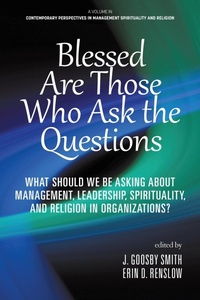
Blessed are Those Who Ask the Questions
What Should We Be Asking About Management, Leadership, Spirituality, and Religion in Organizations?
Published on 23. March 2021
Book
Paperback/Softback
348 pages
978-1-64802-430-6 (ISBN)
Description
Today's organizational environment is characterized by high levels of cross-cultural, cross-national, and cross-religious communication, conflict, collaboration, and commerce. This environment produces myriad encounters between individuals who embrace different ideologies, religions and spiritual practices. As such, unanswered (and even unasked) questions about management, spirituality, and religion abound. This book, seeks to advance our understanding by asking the big questions.
Blessed are Those Who Ask the Questions: What Should We be Asking About Management, Spirituality, and Religion in Organizations? is intended to be provocative in nature. Its chapters address novel ways that leadership, organizations, and organizational stakeholders mutually impact each other by their similarities and differences in religious, spiritual, and ideological traditions, cultures, and practices. Interdisciplinary in nature and firmly grounded in scholarly literature, this book identifies and maps out bold new trajectories for advancing the study of management spirituality, and religion (including but going far beyond Western, Christian conceptualizations of religion). Sometimes universal, sometimes quite specific, this volume identifies unexplored, underexplored, or unresolved issues in the field and proposes new streams of research. Diverse conceptual, empirical, theoretical, and critical treatments that honor a variety of inquiry styles and research methods push the boundaries of MSR research.
Blessed are Those Who Ask the Questions: What Should We be Asking About Management, Spirituality, and Religion in Organizations? is intended to be provocative in nature. Its chapters address novel ways that leadership, organizations, and organizational stakeholders mutually impact each other by their similarities and differences in religious, spiritual, and ideological traditions, cultures, and practices. Interdisciplinary in nature and firmly grounded in scholarly literature, this book identifies and maps out bold new trajectories for advancing the study of management spirituality, and religion (including but going far beyond Western, Christian conceptualizations of religion). Sometimes universal, sometimes quite specific, this volume identifies unexplored, underexplored, or unresolved issues in the field and proposes new streams of research. Diverse conceptual, empirical, theoretical, and critical treatments that honor a variety of inquiry styles and research methods push the boundaries of MSR research.
More details
Series
Language
English
Place of publication
United States
Publishing group
Emerald Publishing Inc
Target group
Professional and scholarly
Dimensions
Height: 234 mm
Width: 156 mm
Thickness: 19 mm
Weight
529 gr
ISBN-13
978-1-64802-430-6 (9781648024306)
Copyright in bibliographic data and cover images is held by Nielsen Book Services Limited or by the publishers or by their respective licensors: all rights reserved.
Schweitzer Classification
Other editions
Additional editions
J. Goosby Smith
Blessed Are Those Who Ask the Questions
What Should We Be Asking About Management, Leadership, Spirituality, and Religion in Organizations?
E-Book
01/2021
1st Edition
Information Age Publishing
from
€62.33
Available for download
Persons
J. Goosby Smith, The Citadel.
Erin D. Renslow, The Citadel.
Erin D. Renslow, The Citadel.
Content
Foreword; J. Goosby Smith.
Chapter 1. Is God Greater Than Tenure? Quintus R. Jett.
Chapter 2. Can Work Be Redeemed Through Play? (Or Why Is Playing Not an Option); Raymond Carr.
Chapter 3. Is the Spirit "Missing" in the Discourse of Management, Spirituality & Religion? Shoaib Ul-Haq.
Chapter 4. Inspiring Inclusion: What is the Evidence for a Faith-Based Approach to Leadership Development? Valerie L. Myers.
Chapter 5. What Happens When Classical Hollywood Narrative and American Mythos Converge? Joi Carr.
Chapter 6. Should Transformational Leadership Theory Include an Ethics Component? Insights From the Cupbearer to the King; Tom Clark.
Chapter 7. What are the Biblical Roots of Servant Leadership? Michael J. Mlynarczyk.
Chapter 8. The Strategy of Spirituality: How Best Can Spiritual Leadership and Spirituality at Work Support and Sustain Organizational Strategy? A Christian Perspective; Richard Peters and Joe Ricks.
Chapter 9. Motivation or Justification: How Is Religiosity Used in the Decision to Engage in Environmental Sustainability Practices? Shalei V. K. Simms and Dorothy M. Kirkman.
Chapter 10. Is Today's Focus on Innovation Enticing Global Managers Away From Religious and Spiritual Principles? Matthew Guah.
Chapter 11. (What's) the Matter With Babel? Daniel Q. Vass-Goosby.
Chapter 12. Religious and Wealthy: Can One Be Both? Miles K. Davis and Clifford F. Thies.
Chapter 13. How Can an Understanding of and Acknowledgment of the Effects of Sin and Evil Inform Solutions to Organizational and Societal Problems? Larry G. Daniel.
Chapter 14. How Can the Newest Global Religion-the Baha'i Faith-Impact the Future of Business? Payam Zamani.
Chapter 15. Nuns to Nones? Revisiting Management, Spirituality, and Religion in the Workplace for the New Generation; Latha Poonamallee.
About the Contributors.
Chapter 1. Is God Greater Than Tenure? Quintus R. Jett.
Chapter 2. Can Work Be Redeemed Through Play? (Or Why Is Playing Not an Option); Raymond Carr.
Chapter 3. Is the Spirit "Missing" in the Discourse of Management, Spirituality & Religion? Shoaib Ul-Haq.
Chapter 4. Inspiring Inclusion: What is the Evidence for a Faith-Based Approach to Leadership Development? Valerie L. Myers.
Chapter 5. What Happens When Classical Hollywood Narrative and American Mythos Converge? Joi Carr.
Chapter 6. Should Transformational Leadership Theory Include an Ethics Component? Insights From the Cupbearer to the King; Tom Clark.
Chapter 7. What are the Biblical Roots of Servant Leadership? Michael J. Mlynarczyk.
Chapter 8. The Strategy of Spirituality: How Best Can Spiritual Leadership and Spirituality at Work Support and Sustain Organizational Strategy? A Christian Perspective; Richard Peters and Joe Ricks.
Chapter 9. Motivation or Justification: How Is Religiosity Used in the Decision to Engage in Environmental Sustainability Practices? Shalei V. K. Simms and Dorothy M. Kirkman.
Chapter 10. Is Today's Focus on Innovation Enticing Global Managers Away From Religious and Spiritual Principles? Matthew Guah.
Chapter 11. (What's) the Matter With Babel? Daniel Q. Vass-Goosby.
Chapter 12. Religious and Wealthy: Can One Be Both? Miles K. Davis and Clifford F. Thies.
Chapter 13. How Can an Understanding of and Acknowledgment of the Effects of Sin and Evil Inform Solutions to Organizational and Societal Problems? Larry G. Daniel.
Chapter 14. How Can the Newest Global Religion-the Baha'i Faith-Impact the Future of Business? Payam Zamani.
Chapter 15. Nuns to Nones? Revisiting Management, Spirituality, and Religion in the Workplace for the New Generation; Latha Poonamallee.
About the Contributors.