

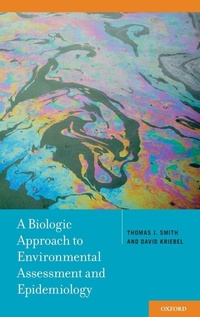
A Biologic Approach to Environmental Assessment and Epidemiology
1st Edition
Published on 29. July 2010
Book
Hardback
448 pages
978-0-19-514156-6 (ISBN)
Description
Environmental chemical hazards are a highly contentious topic in modern life. Nearly every nation on earth has faced its own environmental crises, and also shares perspectives on the possibility of global catastrophes. Of the many global concerns we face, the environmental issue is unique in many ways. The greatest of these is the fundamental scientific nature of the issue, and the extent to which our opinions are formed based on high-level scientific inquiry and assessment.
The two key fields of study on this issue, environmental epidemiology and exposure assessment, are still given separate names because of their separate historical roots and scientific traditions, but are seen increasingly as inseparable aspects of the same basic investigation. In this book, Thomas J. Smith and David Kriebel assert that important advances in the quantification of environmental risks can only come through a true synthesis of the two fields. They have built a common biologic model of exposure, physiologic response, and disease, a synthesis of the various existing models which serves to both simplify and improve the application of environmental epidemiology and exposure assessment to current and future environmental chemical risks.
When exposure assessor and epidemiologist agree from the start on the model for their study, the conceptual framework for the study they design and the analyses they carry out are much more likely to yield useful exposure-risk information. An explicit biologic model of the apparent processes linking exposure to disease should form the basis for any study seeking to quantify risk from environmental chemicals.
The two key fields of study on this issue, environmental epidemiology and exposure assessment, are still given separate names because of their separate historical roots and scientific traditions, but are seen increasingly as inseparable aspects of the same basic investigation. In this book, Thomas J. Smith and David Kriebel assert that important advances in the quantification of environmental risks can only come through a true synthesis of the two fields. They have built a common biologic model of exposure, physiologic response, and disease, a synthesis of the various existing models which serves to both simplify and improve the application of environmental epidemiology and exposure assessment to current and future environmental chemical risks.
When exposure assessor and epidemiologist agree from the start on the model for their study, the conceptual framework for the study they design and the analyses they carry out are much more likely to yield useful exposure-risk information. An explicit biologic model of the apparent processes linking exposure to disease should form the basis for any study seeking to quantify risk from environmental chemicals.
Reviews / Votes
This is must reading. I would agree with their tongue-in-cheek assertion that their discussion of assessments must move beyond John Snow's work in epidemiiology of 150 years ago. Theirs is a brilliant step in the right direction. * Doody's Notes *More details
Language
English
Place of publication
New York
United States
Target group
Professional and scholarly
Students, researchers, epidemiologists involved in environmental assessment.
Illustrations
80 Abbildungen
80 illus
Dimensions
Height: 240 mm
Width: 161 mm
Thickness: 28 mm
Weight
831 gr
ISBN-13
978-0-19-514156-6 (9780195141566)
Copyright in bibliographic data and cover images is held by Nielsen Book Services Limited or by the publishers or by their respective licensors: all rights reserved.
Schweitzer Classification
Other editions
Additional editions
Thomas J. Smith | David Kriebel
A Biologic Approach to Environmental Assessment and Epidemiology
E-Book
06/2010
1st Edition
OUP eBook
€72.49
Available for download
Persons
Thomas J. Smith, Ph.D., CIH, is Professor of Industrial Hygiene at the Harvard School of Public Health.
David Kriebel, Sc.D., is Professor of Work Environment at the School of Health and Environment of the University of Massachusetts Lowell.
David Kriebel, Sc.D., is Professor of Work Environment at the School of Health and Environment of the University of Massachusetts Lowell.
Content
Chapter 1. Introduction - Relating Disease to Exposure.
Section A. Exposure and Disease in Individuals
Chapter 2. Characteristics of Exposure
Chapter 3. Exposure Characterization for Epidemiology
Chapter 4. Personal Exposure-Tissue Concentration Relationships
Chapter 5. Biomarkers as Indicators of Exposure
Chapter 6. Disease Process Models
Section B. Exposure and Disease in Populations
Chapter 7. Epidemiologic Evaluation of Environmental Hazards
Chapter 8. Uncertainty in Measuring Risk
Chapter 9. Dosimetry in Epidemiology
Section C. Practical Applications of Disease Process Models
Chapter 10. Modeling Proportional Disease Processes
Chapter 11. Effects of Ammonia and Ozone on Respiratory Symptoms: Examples of Reversible Proportional Disease Processes
Chapter 12. Neurobehavioral Effects of Mercury and Popcorn Workers' Lung: Examples of Irreversible Proportional Diseases Processes
Chapter 13. Modeling Discrete Disease Processes
Chapter 14. Asthma & Indoor Air, Dermatitis & Metalworking Fluids: Examples of Discrete Reversible Disease Processes
Chapter 15. Irreversible Discrete Processes
Chapter 16. Where Do We Go From Here?
Section A. Exposure and Disease in Individuals
Chapter 2. Characteristics of Exposure
Chapter 3. Exposure Characterization for Epidemiology
Chapter 4. Personal Exposure-Tissue Concentration Relationships
Chapter 5. Biomarkers as Indicators of Exposure
Chapter 6. Disease Process Models
Section B. Exposure and Disease in Populations
Chapter 7. Epidemiologic Evaluation of Environmental Hazards
Chapter 8. Uncertainty in Measuring Risk
Chapter 9. Dosimetry in Epidemiology
Section C. Practical Applications of Disease Process Models
Chapter 10. Modeling Proportional Disease Processes
Chapter 11. Effects of Ammonia and Ozone on Respiratory Symptoms: Examples of Reversible Proportional Disease Processes
Chapter 12. Neurobehavioral Effects of Mercury and Popcorn Workers' Lung: Examples of Irreversible Proportional Diseases Processes
Chapter 13. Modeling Discrete Disease Processes
Chapter 14. Asthma & Indoor Air, Dermatitis & Metalworking Fluids: Examples of Discrete Reversible Disease Processes
Chapter 15. Irreversible Discrete Processes
Chapter 16. Where Do We Go From Here?