

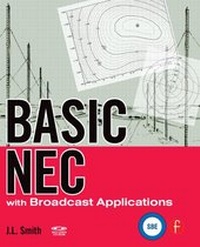
Basic NEC with Broadcast Applications
Published on 4. April 2008
Book
Paperback/Softback
304 pages
978-0-240-52280-7 (ISBN)
Description
Basic NEC with Broadcast Applications addresses computer modeling of MF directional broadcast antennas and illustrates the assets and liabilities of the Numerical Electromagnetic Code (NEC). The book's "how to" approach reveals the fundamentals of NEC operation, teaches broadcast applications and shows the reader how to use NEC-2 to: model non-radiating networks, verify calculations, detune unused towers, design top-loaded and skirted antennas, minimize coding by moving and duplicating structures, and much more! Complete with CD, the book is an invaluable toolkit with software necessary for the design and analysis of broadcast antenna arrays.
More details
Language
English
Place of publication
United States
Target group
College/higher education
Consulting engineers, broadcast technicians, manufacturing engineers and students
ISBN-13
978-0-240-52280-7 (9780240522807)
Copyright in bibliographic data and cover images is held by Nielsen Book Services Limited or by the publishers or by their respective licensors: all rights reserved.
Schweitzer Classification
Other editions
Additional editions
J.L. Smith
Basic NEC with Broadcast Applications
E-Book
10/2020
1st Edition
Routledge
€205.99
Available for download
J.L. Smith
Basic NEC with Broadcast Applications
E-Book
10/2020
1st Edition
Routledge
€205.99
Available for download
J.L. Smith
Basic NEC with Broadcast Applications
Book
03/2008
1st Edition
Focal Press
€193.50
Shipment within 15-20 days
Person
J.L. Smith holds a B.S. in Physics from the University of Houston and an M.S. in Engineering from Southern Methodist University. Through his career, Mr. Smith held the usual positions in research and development beginning his career at KTRH in Houston, Texas in 1946, joining Collins Radio Company in 1956 where he was Department Head, Research and Development, then Manager, Broadcast Systems Engineering. Mr. Smith has been active in FCC matters having filed the first petition advocating automatic unattended operation of FM broadcast transmitters. He participated in the coordination of international broadcasting through his service on CCIR Study Group 10, authored over 50 technical papers and has published Basic Mathematics with Electronics Applications (Macmillan Company 1972) and (Interference Control Technologies 1993.) J.L. Smith is now retired in Covington, LA where he devotes much of his time to analytical research pertaining to AM directional antennas.
Content
Chapter 1 - The Array Adjustment Process (11pp) This chapter uses the concept of local and global minima to explain why the results of NEC2 computer modeling need not be exact to be beneficial. It also gives a preview of the analysis process. 1.1 The Nature of NEC21.2 The Directional Antenna Adjustment Process1.3 Local and Global Minima1.4 The Role of NEC21.5 Analysis Overview1.6 Additional NEC2 Benefits1.7 Software RequirementsChapter 2 ? NEC2 Fundamentals (27pp) This chapter covers the basic use of NEC2. It teaches how to write the input file, the types of input files, naming conventions, how to run bnec.exe and how to read and interpret the output file.2.1 The NEC2 Engine2.2 NEC2 Operation2.3 Creating the Input File2.3.1 Naming the files2.3.2 Data Commands2.3.3 Data Command Types2.3.4 An Input File Illustration2.3.5 Comment Commands2.3.6 Geometry Commands2.3.7 Program Control Commands2.4 Reading the Output File2.4.1 The Header2.4.2 Structure Specification2.4.3 Segmentation Data2.4.4 Data Lines, Frequency, Loading and Environment Data2.4.5 Antenna Input Parameters2.4.6 Currents and Locations2.4.7 Current Moments2.4.8 Power Budget2.4.9 Radiation Pattern2.5 Exercise 2Chapter 3 - Modeling the Radiator (20pp) This chapter covers the various NEC2 model configurations that can be used to represent the radiating tower, the rules that apply to modeling and exciting the tower. It also introduces a viewing program to verify tower coding.3.1 Modeling Guidelines3.2 Guideline Summary3.2.1 Modeling the Radiator3.2.2 Modeling the Voltage Source3.3 Tower Configurations3.3.1 Single Wire Configuration3.3.2 4-wire Configuration3.3.3 2-wire Configuration3.3.4 Lattice Configuration3.3.4.1 Coding the Lattice Configuration3.3.4.2 Simplified Lattice Model3.4 Viewing the Tower Configuration3.5 Exercise 3Chapter 4 ? Array Geometry (15pp) This chapter converts the coordinate system used by NEC2 to a system consistent with the coordinate system normally used by the broadcast community. In addition it teaches how a multi-tower array is modelled and establishes a notation for multi-tower arrays. 4.1 The Coordinate System4.2 Array Geometry ? An Example4.3 The Array Input File4.4 Exercise 4Chapter 5 ? Loads, Networks and Transmission Lines (15pp) This chapter tells how to create a lumped impedance load in a NEC2 wire segment. It also shows how to use non-radiating networks in NEC2 and how to calculate the Y-parameters for those networks plus it shows typical uses for networks. A similar treatment is given for transmission lines.5.1 Modeling Impedance Loads5.2 Modeling non-radiating networks5.2.1 Typical Networks5.2.2 Typical Network Applications5.2.3 General Guidelines for Networks5.3 Modeling Transmission Lines5.4 Network Output File Listing5.4.1 Network Description5.4.2 Network Source and Load Impedance 5.4.3 Network Input Parameters5.5 Exercise 5Chapter 6 ? Calculating Base Drive Voltages