

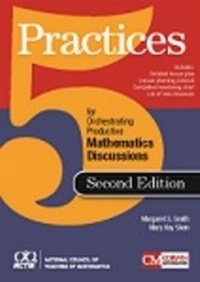
5 Practices for Orchestrating Productive Mathematics Discussions
2nd Edition
Published on 30. May 2018
Book
Paperback/Softback
149 pages
978-1-68054-016-1 (ISBN)
Description
Provides a model for facilitating discussions in mathematics classrooms based on the thinking of students. The model-anticipating, monitoring, selecting, sequencing and connecting-focuses on planning prior to the lesson and, in so doing, limits the amount of improvisation required during the lesson. This new edition is situated within current educational context (e.g., CCSSM and Principles to Actions) and offers details on how to plan for and engage students in K - grade 12 classrooms in discussions that advance the learning of all students in the classroom. Included are a detailed lesson plan, lesson planning protocol, completed monitoring chart, and a list of task resources.
What's new?
Guidance on what is involved in anticipating, including elaboration on assessing and advancing questions
Details on what is involved in anticipating, including elaboration on assessing and advancing questions
Expanded lesson planning discussion
Situated in the current educational context of the Common Core State Standards for Mathematics and NCTM's Principles to Actions, 5 Practices 2nd edition remains relevant for K - grade 12 mathematics teachers and the coaches, teacher educators, professional developers, and supervisors that support them.
What's new?
Guidance on what is involved in anticipating, including elaboration on assessing and advancing questions
Details on what is involved in anticipating, including elaboration on assessing and advancing questions
Expanded lesson planning discussion
Situated in the current educational context of the Common Core State Standards for Mathematics and NCTM's Principles to Actions, 5 Practices 2nd edition remains relevant for K - grade 12 mathematics teachers and the coaches, teacher educators, professional developers, and supervisors that support them.
More details
Edition
Second Edition
Language
English
Place of publication
Thousand Oaks
United States
Target group
Professional and scholarly
Edition type
New edition
Dimensions
Height: 229 mm
Width: 152 mm
Weight
360 gr
ISBN-13
978-1-68054-016-1 (9781680540161)
Copyright in bibliographic data and cover images is held by Nielsen Book Services Limited or by the publishers or by their respective licensors: all rights reserved.
Schweitzer Classification
Persons
Margaret (Peg) Smith is a Professor Emerita at University of Pittsburgh. Over the past two decades she has been developing research-based materials for use in the professional development of mathematics teachers. She has authored or coauthored over 90 books, edited books or monographs, book chapters, and peer-reviewed articles including the best seller Five Practices for Orchestrating Productive Discussions (co-authored with Mary Kay Stein). She was a member of the writing team for Principles to Actions: Ensuring Mathematical Success for All and she is a co-author of two new books (Taking Action: Implementation Effective Mathematics Teaching Practices Grades 6-8 & 9-12) that provide further explication of the teaching practices first describe in Principles to Actions. She was a member of the Board of Directors of the Association of Mathematics Teacher Educators (2001-2003; 2003 - 2005), of the National Council of Teachers of Mathematics (2006-2009), and of Teachers Development Group (2009 - 2017).
Content
Front Matter
Dedication
Acknowledgments
Preface
Introduction
Full access
Chapter 1 Introducing the Five Practices
Chapter 2 Laying the Groundwork: Setting Goals and Selecting Tasks
Chapter 3 Investigating the Five Practices in Action
Chapter 4 Getting Started: Anticipating Students' Responses and Monitoring Their Work
Chapter 5 Determining the Direction of the Discussion: Selecting, Sequencing, and Connecting Students' Responses
Chapter 6 Ensuring Active Thinking and Participation: Asking Good Questions and Holding Students Accountable
Chapter 7 Putting the Five Practices in a Broader Context of Lesson Planning
Chapter 8 Working in the School Environment to Improve Classroom Discussions
Chapter 9 The Five Practices: Lessons Learned and Potential Benefits
Appendix A Web-based Resources for Tasks and Lesson Plans
Appendix B Lesson Plan for Building a Playground Task
Appendix C Bag of Marbles Task Monitoring Chart
References
5 Practices: Professional Development Guide
Dedication
Acknowledgments
Preface
Introduction
Full access
Chapter 1 Introducing the Five Practices
Chapter 2 Laying the Groundwork: Setting Goals and Selecting Tasks
Chapter 3 Investigating the Five Practices in Action
Chapter 4 Getting Started: Anticipating Students' Responses and Monitoring Their Work
Chapter 5 Determining the Direction of the Discussion: Selecting, Sequencing, and Connecting Students' Responses
Chapter 6 Ensuring Active Thinking and Participation: Asking Good Questions and Holding Students Accountable
Chapter 7 Putting the Five Practices in a Broader Context of Lesson Planning
Chapter 8 Working in the School Environment to Improve Classroom Discussions
Chapter 9 The Five Practices: Lessons Learned and Potential Benefits
Appendix A Web-based Resources for Tasks and Lesson Plans
Appendix B Lesson Plan for Building a Playground Task
Appendix C Bag of Marbles Task Monitoring Chart
References
5 Practices: Professional Development Guide