

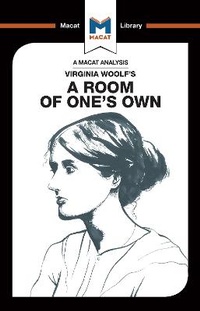
An Analysis of Virginia Woolf's A Room of One's Own
1st Edition
Published on 15. July 2017
Book
Hardback
96 pages
978-1-912302-91-8 (ISBN)
Description
A Room of One's Own is a very clear example of how creative thinkers connect and present things in novel ways.
Based on the text of a talk given by Virginia Woolf at an all-female Cambridge college, Room considers the subject of 'women and fiction.' Woolf's approach is to ask why, in the early 20th century, literary history presented so few examples of canonically 'great' women writers. The common prejudices of the time suggested this was caused by (and proof of) women's creative and intellectual inferiority to men. Woolf argued instead that it was to do with a very simple fact: across the centuries, male-dominated society had systematically prevented women from having the educational opportunities, private spaces and economic independence to produce great art. At a time when 'art' was commonly considered to be a province of the mind that had no relation to economic circumstances, this was a novel proposal. More novel, though, was Woolf's manner of arguing and proving her contentions: through a fictional account of the limits placed on even the most privileged women in everyday existence. An impressive early example of cultural materialism, A Room of One's Own is an exemplary encapsulation of creative thinking.
Based on the text of a talk given by Virginia Woolf at an all-female Cambridge college, Room considers the subject of 'women and fiction.' Woolf's approach is to ask why, in the early 20th century, literary history presented so few examples of canonically 'great' women writers. The common prejudices of the time suggested this was caused by (and proof of) women's creative and intellectual inferiority to men. Woolf argued instead that it was to do with a very simple fact: across the centuries, male-dominated society had systematically prevented women from having the educational opportunities, private spaces and economic independence to produce great art. At a time when 'art' was commonly considered to be a province of the mind that had no relation to economic circumstances, this was a novel proposal. More novel, though, was Woolf's manner of arguing and proving her contentions: through a fictional account of the limits placed on even the most privileged women in everyday existence. An impressive early example of cultural materialism, A Room of One's Own is an exemplary encapsulation of creative thinking.
More details
Series
Language
English
Place of publication
London
United Kingdom
Dimensions
Height: 198 mm
Width: 129 mm
Weight
340 gr
ISBN-13
978-1-912302-91-8 (9781912302918)
Copyright in bibliographic data and cover images is held by Nielsen Book Services Limited or by the publishers or by their respective licensors: all rights reserved.
Schweitzer Classification
Other editions
Additional editions
Tim Smith-Laing | Fiona Robinson
An Analysis of Virginia Woolf's A Room of One's Own
E-Book
07/2017
Routledge
€8.99
Available for download
Tim Smith-Laing | Fiona Robinson
An Analysis of Virginia Woolf's A Room of One's Own
E-Book
07/2017
Routledge
€8.99
Available for download
Tim Smith-Laing | Fiona Robinson
An Analysis of Virginia Woolf's A Room of One's Own
Book
07/2017
1st Edition
Macat International Limited
€12.50
Shipment within 3-4 weeks
Persons
Dr Tim Smith-Laing took his DPhil at Merton College, Oxford, and has held positions at Jesus College, Oxford, and Sciences Politiques in Paris.
Dr. Fiona Robinson holds a PhD in early twentieth-century English literature from Yale University.
Dr. Fiona Robinson holds a PhD in early twentieth-century English literature from Yale University.
Content
Ways In to the Text Who was Virginia Woolf? What does A Room of One's Own Say? Why does A Room of One's Own Matter? Section 1: Influences Module 1: The Author and the Historical Context Module 2: Academic Context Module 3: The Problem Module 4: The Author's Contribution Section 2: Ideas Module 5: Main Ideas Module 6: Secondary Ideas Module 7: Achievement Module 8: Place in the Author's Work Section 3: Impact Module 9: The First Responses Module 10: The Evolving Debate Module 11: Impact and Influence Today Module 12: Where Next? Glossary of Terms People Mentioned in the Text Works Cited