

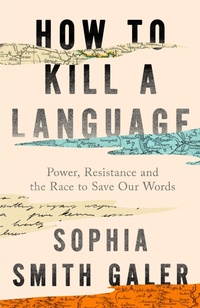
How to Kill a Language
Power, Resistance and the Race to Save Our Words
Published on 7. May 2026
Book
Hardback
304 pages
978-0-00-872372-9 (ISBN)
Description
'Moving, beautiful and important' FINANCIAL TIMES
'Punchy and persuasive' SUNDAY TIMES
As Sophia Smith Galer's Nonna lay dying, she realised it wasn't just a beloved grandmother she was losing - it was the language she spoke, too. From Northern Italy, she spoke a dialet that Sophia, like so many children and grandchildren of migrants, can understand but can't speak. With the death of the language, Sophia would lose a culture, a history, an inheritance - a whole world.
This tragedy reaches far beyond her family. Globally we are witnessing an unprecedented mass extinction event. By the end of this century half of the world's 7000 languages will be gone, killed by war, climate breakdown, migration, nationalism or neglect, along with the vital knowledge that they have sustained for centuries.
Award-winning journalist Smith Galer has journeyed across continents and generations to report from this disappearing world. From Ghana to Greece, Ecuador to Oman, California to the UK, she meets people experiencing this loss at first hand - but also campaigners and linguists who prove that a multilingual future is still possible. Her travels ultimately lead her back to where she began: to Italy, and the tiny mountainside village where the church bells still ring out for her Nonna.
How to Kill a Language is an impassioned investigation into a hidden global crisis, and a call to speak, read and write the languages of our world, before it's too late.
'An extremely moving, passionate plea' CAL FLYN
'Beautiful, thought-provoking, and compelling' SUSIE DENT
'Punchy and persuasive' SUNDAY TIMES
As Sophia Smith Galer's Nonna lay dying, she realised it wasn't just a beloved grandmother she was losing - it was the language she spoke, too. From Northern Italy, she spoke a dialet that Sophia, like so many children and grandchildren of migrants, can understand but can't speak. With the death of the language, Sophia would lose a culture, a history, an inheritance - a whole world.
This tragedy reaches far beyond her family. Globally we are witnessing an unprecedented mass extinction event. By the end of this century half of the world's 7000 languages will be gone, killed by war, climate breakdown, migration, nationalism or neglect, along with the vital knowledge that they have sustained for centuries.
Award-winning journalist Smith Galer has journeyed across continents and generations to report from this disappearing world. From Ghana to Greece, Ecuador to Oman, California to the UK, she meets people experiencing this loss at first hand - but also campaigners and linguists who prove that a multilingual future is still possible. Her travels ultimately lead her back to where she began: to Italy, and the tiny mountainside village where the church bells still ring out for her Nonna.
How to Kill a Language is an impassioned investigation into a hidden global crisis, and a call to speak, read and write the languages of our world, before it's too late.
'An extremely moving, passionate plea' CAL FLYN
'Beautiful, thought-provoking, and compelling' SUSIE DENT
Reviews / Votes
'Punchy and persuasive ... speaking an endangered language is an act of defiance and connection - of love' SUNDAY TIMES 'Moving, beautiful and important ... The narrative grips from the outset ... The driving spirit of How to Kill a Language is, despite its title, not death, but life' FINANCIAL TIMES 'A rallying cry against linguistic extinction ... This is a necessary book, with a message that English speakers need to hear' NEW STATESMAN 'Urgent and timely ... what animates it above all is the curiosity and pleasure of language learning - a curiosity that is its own form of hope' THE TELEGRAPH 'An essential voice' THE GUARDIAN 'Galer casts a bright light on the massive linguistic diversity that the world seems set to lose ... Every language that dies takes with it such fascinating stories' NEW YORK TIMES '[A] deep dive into 10 of the 7,000 languages predicted to be extinct by the turn of the century, spun here into a fascinating account' THE i PAPER 'Everyone should read this book. Impressively researched, full of empathy and a page-turner to boot' OLIA HERCULES 'An extremely moving, passionate plea. This fascinating book digs down into what it really means to translate, conserve, comprehend, colonise' CAL FLYN, author of Islands of Abandonment 'I have long marvelled at the work of Sophia Smith Galer ... she is a passionate advocate for language diversity - most recently in her fascinating new book' PANDORA SYKES 'Erudite, heart-wrenching ... a spirited reconsideration' PUBLISHERS WEEKLY 'Shines an intimate light on a pressing issue ... revealing the powerfully human stakes behind language death and revitalization' ADAM ALEKSIC, author of Algospeak 'Hits the intersection of language and power as few other books have' ROSS PERLIN, author of Language City 'This is the best book on language endangerment I have ever read. A love letter to languages ... both intellectually rigorous and yet profoundly moving' DAVID CRYSTAL, author of Language DeathMore details
Language
English
Place of publication
London
United Kingdom
Publishing group
HarperCollins Publishers
Dimensions
Height: 238 mm
Width: 157 mm
Thickness: 30 mm
Weight
508 gr
ISBN-13
978-0-00-872372-9 (9780008723729)
Copyright in bibliographic data and cover images is held by Nielsen Book Services Limited or by the publishers or by their respective licensors: all rights reserved.
Schweitzer Classification
Other editions
Additional editions
Book
05/2026
William Collins
€21.50
No shipping information available
E-Book
05/2026
William Collins
€15.49
Available for download
Person
Sophia Smith Galer is an award-winning journalist, author and content creator based in London. She won the British Journalism Award for Innovation of the Year for her work, as well as recognition on lists such as Forbes Under 30 and British Vogue's 25 Most Influential Women in the UK. She has reported across four continents for the BBC and VICE News; her videos have been seen more than 160 million times on TikTok and Instagram where she explores etymology, language rights and linguistics. She studied Spanish and Arabic at Durham University and her family speak Italian and a variety of Emilian.