

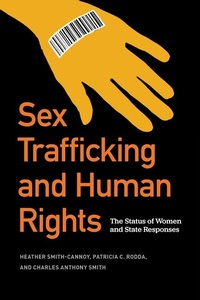
Sex Trafficking and Human Rights
The Status of Women and State Responses
Published on 1. September 2022
Book
Paperback/Softback
288 pages
978-1-64712-261-4 (ISBN)
Description
Case studies explore how women's rights shape state responses to sex trafficking and show how politically empowering women can help prevent and combat human trafficking
Human trafficking for the sex trade is a form of modern-day slavery that ensnares thousands of victims each year, disproportionately affecting women and girls. While the international community has developed an impressive edifice of human rights law, these laws are not equally recognized or enforced by all countries. Sex Trafficking and Human Rights demonstrates that state responsiveness to human trafficking is shaped by the political, social, cultural, and economic rights afforded to women in that state.
While combatting human trafficking is a multiscalar problem with a host of conflating variables, this book shows that a common theme in the effectiveness of state response is the degree to which women and girls are perceived as, and actually are, full citizens. By analyzing human trafficking cases in India, Thailand, Russia, Nigeria, and Brazil, they shed light on the factors that make some women and girls more susceptible to traffickers than others.
This important book is both a call to understanding and a call to action: if the international community and state governments are to responsibly and effectively combat human trafficking, they must center the equality of women in national policy.
Human trafficking for the sex trade is a form of modern-day slavery that ensnares thousands of victims each year, disproportionately affecting women and girls. While the international community has developed an impressive edifice of human rights law, these laws are not equally recognized or enforced by all countries. Sex Trafficking and Human Rights demonstrates that state responsiveness to human trafficking is shaped by the political, social, cultural, and economic rights afforded to women in that state.
While combatting human trafficking is a multiscalar problem with a host of conflating variables, this book shows that a common theme in the effectiveness of state response is the degree to which women and girls are perceived as, and actually are, full citizens. By analyzing human trafficking cases in India, Thailand, Russia, Nigeria, and Brazil, they shed light on the factors that make some women and girls more susceptible to traffickers than others.
This important book is both a call to understanding and a call to action: if the international community and state governments are to responsibly and effectively combat human trafficking, they must center the equality of women in national policy.
More details
Language
English
Place of publication
Washington, DC
United States
Target group
Professional and scholarly
US School Grade: College Graduate Student and over
Product notice
Paperback (trade)
Illustrations
Not illustrated
Dimensions
Height: 225 mm
Width: 151 mm
Thickness: 18 mm
Weight
382 gr
ISBN-13
978-1-64712-261-4 (9781647122614)
Copyright in bibliographic data and cover images is held by Nielsen Book Services Limited or by the publishers or by their respective licensors: all rights reserved.
Schweitzer Classification
Other editions
Additional editions
Heather Smith-Cannoy | Patricia C. Rodda | Charles Anthony Smith
Sex Trafficking and Human Rights
The Status of Women and State Responses
E-Book
09/2022
Georgetown University Press
€38.99
Available for download
Persons
Heather Smith-Cannoy is an associate professor of political science at Arizona State University. She directs the Global Human Rights Hub and the Social Justice and Human Rights program. She is the author of Insincere Commitments: Human Rights Treaties, Abusive States and Citizen Activism (Georgetown University Press, 2012).
Patricia C. Rodda is an assistant professor of international relations at Carroll University.
Charles Anthony Smith is a professor in political science and law at the University of California, Irvine. Beginning in July 2022, he will be the editor in chief for Political Research Quarterly.
Patricia C. Rodda is an assistant professor of international relations at Carroll University.
Charles Anthony Smith is a professor in political science and law at the University of California, Irvine. Beginning in July 2022, he will be the editor in chief for Political Research Quarterly.
Content
Preface
Acknowledgments
Introduction
1. A Gendered Approach to Sex Trafficking
2. A Global Perspective on Human Trafficking and Quantitative Analysis of Causes
3. India
4. Thailand
5. Russia
6. Nigeria
7. Brazil
Conclusion
References
Index
About the Authors
Acknowledgments
Introduction
1. A Gendered Approach to Sex Trafficking
2. A Global Perspective on Human Trafficking and Quantitative Analysis of Causes
3. India
4. Thailand
5. Russia
6. Nigeria
7. Brazil
Conclusion
References
Index
About the Authors