

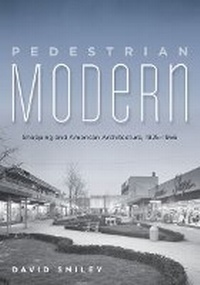
Pedestrian Modern
Shopping and American Architecture, 1925-1956
Will be published approx. on 1. July 2013
Book
Hardback
352 pages
978-0-8166-7929-4 (ISBN)
Description
Too close to the wiles and calculations of consumption, stores and shopping centers are generally relegated to secondary, pedestrian status in the history of architecture. And yet, throughout the middle decades of the twentieth century, stores and shopping centers were an important locus of modernist architectural thought and practice. Under the mantle of modernism, the merchandising problems and possibilities of main streets, cities, and suburbs became legitimate-if also conflicted-responsibilities of the architectural profession.
In Pedestrian Modern, David Smiley reveals how the design for places of consumption informed emerging modernist tenets. The architect was viewed as a coordinator and a site planner-modernist tropes particularly well suited to merchandising. Smiley follows this development from the twenties and thirties, when glass and transparency were equated with modernist rationality; to the forties, when cities and congestion presented considerable hurdles for shopping district design and, at the same time, when modern concerns about the pedestrian deeply affected city and neighborhood planning; to the early fifties, when both urban shopping districts and suburban shopping centers became large-scale modernist undertakings. Although interpreting the tools and principles of modernism, designs for shopping never quite shed the specter of consumption.
Tracing the history of architecture's relationship with retail environments during a time of significant transformation in urban centers and in open suburban landscapes, Smiley expands and qualifies the making of American modernism.
In Pedestrian Modern, David Smiley reveals how the design for places of consumption informed emerging modernist tenets. The architect was viewed as a coordinator and a site planner-modernist tropes particularly well suited to merchandising. Smiley follows this development from the twenties and thirties, when glass and transparency were equated with modernist rationality; to the forties, when cities and congestion presented considerable hurdles for shopping district design and, at the same time, when modern concerns about the pedestrian deeply affected city and neighborhood planning; to the early fifties, when both urban shopping districts and suburban shopping centers became large-scale modernist undertakings. Although interpreting the tools and principles of modernism, designs for shopping never quite shed the specter of consumption.
Tracing the history of architecture's relationship with retail environments during a time of significant transformation in urban centers and in open suburban landscapes, Smiley expands and qualifies the making of American modernism.
More details
Language
English
Place of publication
Minnesota
United States
Dimensions
Height: 254 mm
Width: 178 mm
ISBN-13
978-0-8166-7929-4 (9780816679294)
Copyright in bibliographic data and cover images is held by Nielsen Book Services Limited or by the publishers or by their respective licensors: all rights reserved.
Schweitzer Classification
Person
David Smiley teaches at the Graduate School of Architecture, Planning and Preservation at Columbia University.
Content
Contents
Preface and Acknowledgments
Introduction: Centers and Peripheries
1. The Store Problem
2. Machines for Selling
3. "Park and Shop"
4. Pedestrianization Takes Command
5. The Cold War Pedestrian
6. The Language of Modern Shopping
Conclusion: Pedestrian Modern Futures
Notes
Selected Bibliography
Index
Preface and Acknowledgments
Introduction: Centers and Peripheries
1. The Store Problem
2. Machines for Selling
3. "Park and Shop"
4. Pedestrianization Takes Command
5. The Cold War Pedestrian
6. The Language of Modern Shopping
Conclusion: Pedestrian Modern Futures
Notes
Selected Bibliography
Index