

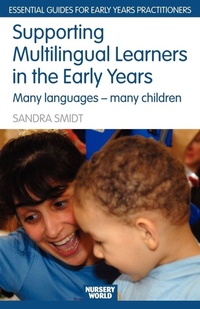
Supporting Multilingual Learners in the Early Years
Many Languages - Many Children
1st Edition
Published on 22. November 2007
Book
Paperback/Softback
152 pages
978-0-415-43801-8 (ISBN)
Description
Shortlisted for the Nasen Book that supports SEN and Disability Issues Award 2008
Are children who are exposed to more than one language from birth at an advantage or a disadvantage when starting school?
Supporting Multilingual Learners in the Early Years examines the theoretical, ideological and practical issues involved in the education of children speaking two or more languages coming to settings which are predominantly monolingual. The book examines current research and thinking about the advantages and disadvantages of being multilingual and tackles complex topics such as:
what being multilingual implies in terms of prior learning and why this matters in education
the importance of respect for diversity and encouraging children to be proud of their language and culture
practical ways to help young children acquire English
ways of working with parents who themselves have little or no English
the differences and difficulties involved in a child learning an additional language so early on in their lives
strategies for exploring the learning of multilingual learners and a review of the resources and activities that could help.
Sandra Smidt views multilingualism as a cognitive advantage and shows how Early Years practitioners can use interactive styles of learning to focus on the benefit that the many cultures and languages in the classroom can bring to children's learning and development.
Written in a highly accessible tone, this book offers practitioners a mix of practical case studies and examples in which theory is embedded and its importance explained. Students of early childhood education will also appreciate the author's carefully structured approach to the topic, as she includes summary boxes, glossaries and points for reflection in each chapter.
Are children who are exposed to more than one language from birth at an advantage or a disadvantage when starting school?
Supporting Multilingual Learners in the Early Years examines the theoretical, ideological and practical issues involved in the education of children speaking two or more languages coming to settings which are predominantly monolingual. The book examines current research and thinking about the advantages and disadvantages of being multilingual and tackles complex topics such as:
what being multilingual implies in terms of prior learning and why this matters in education
the importance of respect for diversity and encouraging children to be proud of their language and culture
practical ways to help young children acquire English
ways of working with parents who themselves have little or no English
the differences and difficulties involved in a child learning an additional language so early on in their lives
strategies for exploring the learning of multilingual learners and a review of the resources and activities that could help.
Sandra Smidt views multilingualism as a cognitive advantage and shows how Early Years practitioners can use interactive styles of learning to focus on the benefit that the many cultures and languages in the classroom can bring to children's learning and development.
Written in a highly accessible tone, this book offers practitioners a mix of practical case studies and examples in which theory is embedded and its importance explained. Students of early childhood education will also appreciate the author's carefully structured approach to the topic, as she includes summary boxes, glossaries and points for reflection in each chapter.
Reviews / Votes
'By looking in depth at the acquisition of language the book provides an insightful and interesting read for all practitioners, not just those directly concerned with supporting multilingual children.' - Early Years UpdateMore details
Series
Language
English
Place of publication
London
United Kingdom
Publishing group
Taylor & Francis Ltd
Target group
Professional and scholarly
Academic and Professional Practice & Development
Illustrations
18 s/w Tabellen
18 Tables, black and white
Dimensions
Height: 216 mm
Width: 140 mm
Thickness: 9 mm
Weight
211 gr
ISBN-13
978-0-415-43801-8 (9780415438018)
Copyright in bibliographic data and cover images is held by Nielsen Book Services Limited or by the publishers or by their respective licensors: all rights reserved.
Schweitzer Classification
Other editions
Additional editions
Book
11/2007
1st Edition
Routledge
€92.10
Shipment within 15-20 days
E-Book
11/2007
Routledge
€36.99
Available for download
E-Book
11/2007
Routledge
€36.99
Available for download
Person
Sandra Smidt was formerly Principal Lecturer in Early Childhood Education at the University of East London. She is now an educational consultant, working with the University of East London. Sandra's other books available from Routledge are A Guide to Early Years Practice (third edition, 2007); The Developing Child in the Twenty-First Century; and Observing, Assessing and Planning for Children in The Early Years: A Reader.
Content
1. Understanding Multilingualism 2. Language at Home and Beyond 3. Language and Identity 4. Learning a Language: Learning Another 5. Effective Classrooms or Settings for Bilingual Children: The Survival of First Language 6. Effective Classrooms for Bilingual Learners: Teaching English as an Additional Language 7. Assessing Bilingual Learners 8. Working with the Parents of Bilingual Children 9. Language and Thought Endnote: Bilingual Education: Why Should we Bother?