

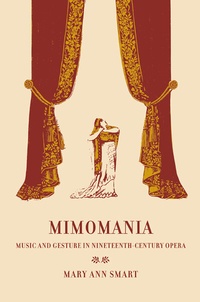
Mimomania
Music and Gesture in Nineteenth-Century Opera
1st Edition
Published on 10. March 2004
Book
Hardback
245 pages
978-0-520-23995-1 (ISBN)
Description
When Nietzsche dubbed Richard Wagner 'the most enthusiastic mimomaniac' ever to exist, he was objecting to a hollowness he felt in the music, a crowding out of any true dramatic impulse by extravagant poses and constant nervous movements. Mary Ann Smart suspects that Nietzsche may have seen and heard more than he realized. In "Mimomania" she takes his accusation as an invitation to listen to Wagner's music - and that of several of his near-contemporaries - for the way it serves to intensify the visible and the enacted. As Smart demonstrates, this productive fusion of music and movement often arises when music forsakes the autonomy so prized by the Romantics to function mimetically, underlining the sighs of a Bellini heroine, for instance, or the authoritarian footsteps of a Verdi baritone. "Mimomania" tracks such effects through readings of operas by Auber, Bellini, Meyerbeer, Verdi, and Wagner.
Listening for gestural music, we find resemblance in unexpected places: between the overwrought scenes of supplication in French melodrama of the 1820s and a cluster of late Verdi arias that end with the soprano falling to her knees, or between the mute heroine of Auber's "La Muette de Portici" and the solemn, almost theological pantomimic tableaux Wagner builds around characters such as Sieglinde or Kundry. "Mimomania" shows how attention to gesture suggests a new approach to the representation of gender in this repertoire, replacing aural analogies for voyeurism and objectification with a more specifically musical sense of how music can surround, propel, and animate the body on stage.
Listening for gestural music, we find resemblance in unexpected places: between the overwrought scenes of supplication in French melodrama of the 1820s and a cluster of late Verdi arias that end with the soprano falling to her knees, or between the mute heroine of Auber's "La Muette de Portici" and the solemn, almost theological pantomimic tableaux Wagner builds around characters such as Sieglinde or Kundry. "Mimomania" shows how attention to gesture suggests a new approach to the representation of gender in this repertoire, replacing aural analogies for voyeurism and objectification with a more specifically musical sense of how music can surround, propel, and animate the body on stage.
More details
Series
Edition
First Edition
Language
English
Place of publication
Berkerley
United States
Target group
Professional and scholarly
Product notice
Cloth over boards
Illustrations
8 b-w photographs, 34 music examples
Dimensions
Height: 229 mm
Width: 152 mm
Thickness: 19 mm
Weight
499 gr
ISBN-13
978-0-520-23995-1 (9780520239951)
Copyright in bibliographic data and cover images is held by Nielsen Book Services Limited or by the publishers or by their respective licensors: all rights reserved.
Schweitzer Classification
Other editions
Additional editions
E-Book
03/2004
1st Edition
Naval Institute Press
€31.49
Available for download
Person
Mary Ann Smart is Associate Professor in the Music Department at the University of California, Berkeley. She is the editor of Siren Songs: Representations of Gender and Sexuality in Opera (2000) and coeditor of Reading Critics Reading: Opera and Ballet Criticism in France from the Revolution to 1848 (2001).
Content
Acknowledgments Chapter 1. In Praise of Overstatement Chapter 2. Wagner's Cancan, Fenella's Leap: La Muette de Portici and Auber's Reality Effect Chapter 3. Bellini's Unseen Voices Chapter 4. "Every Word Made Flesh": Les Huguenots and the Incarnation of the Invisible Chapter 5. Uneasy Bodies: Verdi and Sublimation Chapter 6. Mimomania: Allegory and Embodiment in Wagner's Music Dramas Notes Index