

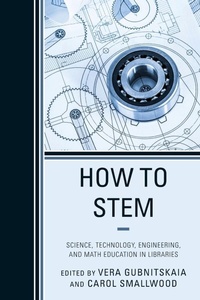
How to STEM
Science, Technology, Engineering, and Math Education in Libraries
Published on 5. December 2013
Book
Paperback/Softback
298 pages
978-0-8108-9273-6 (ISBN)
Description
During the past few years, groups like the President's Council of Advisors on Science and Technology, Center for Education have been placing great emphasis on the significance of STEM (science, technology, engineering, and math) education. In brief, the US is seen as falling behind the rest of the world in science and technology education. In response, the curricula have been revised in many educational institutions and school districts across the country. It is clear that for STEM to be successful, other community organizations, most particularly libraries, need to be closely involved in the process. Library staff realize the importance of getting involved in STEM education, but many have difficulty finding comprehensive information that will help them plan and successfully implement STEM direction in their organization. This book is designed to meet that need. It is timely and relevant. How to STEM: Science, Technology, Engineering, and Math Education in Libraries is by and for libraries who are involved in contributing efforts into advancing these subjects. It is organized in 9 parts including funding, grant writing, community partnerships, outreach, research, and examples of specific programming activities. Authors are drawn from the professional staffs of educational institutions, libraries, and non-profit organizations such as science museums.
The book contains eight parts, each emphasizing a different aspect of how to succeed with STEM. Part 1 emphasizes how hands-on activities that are both fun and educational can be used to further STEM awareness. Parts 2 and 3 contain chapters on the uniting of STEM with Information Literacy. Innovative collection development ideas are discussed in Part 4 and Part 5 focuses on research and publishing. Outreach is the theme of Part 6 and the programs described in these chapters offer an array of ways to connect with students of all ages. The final section of How to STEM: Science, Technology, Engineering, and Math Education in Libraries addresses the funding of these programs.
Librarians of all types will be pleased to discover easy-to-implement suggestions for collaborative efforts, many rich and diverse programming ideas, strategies for improving reference services and library instruction to speakers of English as a second language, marketing and promotional tips designed to welcome multicultural patrons into the library, and much more.
The book contains eight parts, each emphasizing a different aspect of how to succeed with STEM. Part 1 emphasizes how hands-on activities that are both fun and educational can be used to further STEM awareness. Parts 2 and 3 contain chapters on the uniting of STEM with Information Literacy. Innovative collection development ideas are discussed in Part 4 and Part 5 focuses on research and publishing. Outreach is the theme of Part 6 and the programs described in these chapters offer an array of ways to connect with students of all ages. The final section of How to STEM: Science, Technology, Engineering, and Math Education in Libraries addresses the funding of these programs.
Librarians of all types will be pleased to discover easy-to-implement suggestions for collaborative efforts, many rich and diverse programming ideas, strategies for improving reference services and library instruction to speakers of English as a second language, marketing and promotional tips designed to welcome multicultural patrons into the library, and much more.
Reviews / Votes
f you are considering developing a STEM program for your library, this book is an excellent place to start. Through this useful guide, the editors show how librarians are avidly involved in the national STEM education movement. The editors have organized 25 chapters into 8 parts, covering an array of STEM activities for libraries. The authors guide you through their projects, how they got started, and what choices they made. Drawing upon their first-hand experiences, they communicate both successes and pitfalls encountered along the way. . . .The book presents constructive ideas and methods to integrate quality STEM programs in an effective way. Librarians are featured as creators, innovators, and mentors in learning environments centered on creativity. This how-to resource is highly recommended for a wide audience of librarians who are sure to motivate future scientists, computer professionals, engineers, and mathematicians. * Technical Services Quarterly * Edited by Carol Smallwood, a prolific editor of works, in conjunction with Vera Gubnitskaia, a manager at the Orange County Library System, Florida, this work brings together 25 chapters organized into 8 sections: Range and Scope; Teaching; Information Literacy and Educational Support; Collection Development; Research and Publishing; Outreach; Partnerships; and Funding. Thirty-four public and academic librarians from the United States share their experiences and knowledge on how libraries can engage youth in science, technology, engineering, and math. The work provides exciting ideas to encourage engagement from preschoolers to college students. The chapters provides practical ideas that are completed with instructions, supply lists, related educational standards, and reading lists. Activity ideas include science activities for preschoolers, partnership programs featuring LEGO, and animation workshops for teens. Students and practitioners alike will benefit from these tips and tales from the trenches. * American Reference Books Annual * From pre-school to college, programs to funding, this timely collection of how to articles has something helpful for libraries of all kinds. It offers inspiration and ideas even for those not fully versed in STEM. -- Su Epstein, library director, Saxton B. Little Free Library, Columbia, Connecticut Best practice examples and constructive advice will inspire and support STEM in any library, helping to embed the librarian as an indispensible cog in this nationwide initiative. -- Leigh Woznick, library media specialist, Bridgewater-Raritan Middle School, Bridgewater, New Jersey The very comprehensive grant writing chapters for STEM grants are informative, enlightening, and useful in so many ways. -- Ann Paietta, director of Essex Free Library, Essex, Vermont Busy librarians will appreciate this timely idea book, which offers many solutions for helping patrons of all ages and experience levels to engage in science, technology, engineering and math at their libraries-even better, there are ideas here for every librarian's budget, no matter how tiny! -- Beth Neiman, youth services librarian, Carlsbad Public Library, Carlsbad, New Mexico A great resource for public and academic librarians who wish to incorporate STEM in their information literacy classes, library programming, events, and outreach. -- Mark Aaron Polger, instruction/reference librarian and information literacy instructor, College of Staten Island, CUNY, New York, New York From preschool through high school to providing support in project planning and grant writing, this anthology presents relevant chapters covering the broad spectrum of just about everything the librarian needs to know about STEM. -- Anna Ercoli Schnitzer, disability issues librarian, Taubman Health Sciences Library, University of Michigan, Ann Arbor Science, Technology, Engineering, and Math (STEM) is now a staple of educational planning and program evaluation. This book provides an excellent resource for teachers and librarians interested in the standards, applications, trick, traps, and assumptions of this education standard. -- Jonathan Frater, technical services librarian, Metropolitan College of New York I highly recommend this down to earth treatment of the subject. -- Sharon Britton, library director, Bowling Green State University-Firelands, Huron, Ohio Valuable insights from academic and public library practitioners on ways to make our hard and applied sciences collections more relevant to patrons of all ages. -- James B. Casey, retired director of Oak Lawn Public Library, Oak Lawn, IllinoisMore details
Language
English
Place of publication
United States
Publishing group
Bloomsbury Publishing Plc
Target group
Professional and scholarly
Illustrations
1 b/w illustration; 2 tables
Dimensions
Height: 229 mm
Width: 152 mm
Thickness: 18 mm
Weight
490 gr
ISBN-13
978-0-8108-9273-6 (9780810892736)
Copyright in bibliographic data and cover images is held by Nielsen Book Services Limited or by the publishers or by their respective licensors: all rights reserved.
Schweitzer Classification
Other editions
Additional editions
Carol Smallwood | Vera Gubnitskaia
How to STEM
Science, Technology, Engineering, and Math Education in Libraries
E-Book
12/2013
1st Edition
Rowman & Littlefield Publishers
€78.49
Available for download
Carol Smallwood | Vera Gubnitskaia
How to STEM
Science, Technology, Engineering, and Math Education in Libraries
E-Book
12/2013
1st Edition
Rowman & Littlefield Publishers
€78.49
Available for download
Persons
Carol Smallwood received a MLS from Western Michigan University, MA in History from Eastern Michigan University. Librarians as Community Partners: an Outreach Handbook; Bringing the Arts into the Library are recent ALA anthologies. Others are: Women on Poetry: Writing, Revising, Publishing and Teaching (McFarland, 2012); Marketing Your Library (McFarland, 2012); Library Services for Multicultural Patrons: Strategies to Encourage Library Use (Scarecrow Press, 2013). Her library experience includes school, public, academic, special, as well as administration and being a consultant; she's a poetry Pushcart nominee.
Vera Gubnitskaia, a manager at the Orange County Library System, Florida, obtained her library degrees from Moscow Institute of Culture (Russia) and Florida State University. Vera worked in public and academic libraries in Russia and USA. She co-edited Marketing You Library (McFarland 2012) and Continuing Education for Librarians (McFarland 2013). Her chapters appeared in the Librarians as Community Partners (ALA 2010) and in Library Management Tips that Work (ALA 2011). Her reviews were published by the Journal of International Women's Studies and Small Press Review.
Vera Gubnitskaia, a manager at the Orange County Library System, Florida, obtained her library degrees from Moscow Institute of Culture (Russia) and Florida State University. Vera worked in public and academic libraries in Russia and USA. She co-edited Marketing You Library (McFarland 2012) and Continuing Education for Librarians (McFarland 2013). Her chapters appeared in the Librarians as Community Partners (ALA 2010) and in Library Management Tips that Work (ALA 2011). Her reviews were published by the Journal of International Women's Studies and Small Press Review.
Content
Table of Contents
Foreword
Paula M. Storm
Preface
Vera Gubnitskaia and Carol Smallwood
Acknowledgements
Part IRange and Scope
WonderWorks: Preschoolers Playing with STEMCarissa Christner
Creating STEM Kits for Teen ProgramsKelly Czarnecki
Digging into Reading: A Worm's PerspectiveBarbara Fiehn and Jeanine M. Huss
The Maker Movement, STEM and Libraries: How Libraries Large and Small Can Support Hands-On Math and Science Learning in Their CommunitiesCynthia Houston
The STEM Kids Program and the FIRST (R) LEGO (R) League (FLL (R)) at the Grand Forks Public LibraryAaron Stefanich and Laura Munski
Part IITeaching
Animation Programs at the Evansville Vanderburgh Public LibraryMichael Cherry
How Not to Blow Up the Library: Planning and Facilitating a Homeschool Science Lab in Your BuildingFred Kirchner
Customizing the For-Credit Information Literacy Course for STEM MajorsRosalia Petralia and Kathy Turner
Part IIIInformation Literacy and Educational Support
Kid-ventions with the U.S. Patent LibraryBarbara J. Hampton
A Math Emporium ProjectNastasha Johnson and Tiffany B. Russell
The School Librarian Role in the FIRST (R) LEGO (R) League Team ProjectKarla Steege Krueger
STEMming From Scratch:STEM Library Services for High School Students Enrolled as University Students
Janna Mattson and Heather Groves Hannan
Part IVCollection Development
How to Get Science GoingKeary Bramwell
Graphic Novels Ignite Imagination in the SciencesMelanie E. Hughes and Gary Pinkston
Part VResearch and Publishing
Showcasing Scientific Research Output: New Audiences for Science LibrariesAlvin Hutchinson
Embedding Librarians into the STEM Publication ProcessAnne Rauh and Linda M. Galloway
Part VIOutreach
How NOT to Reinvent the STEM Wheel: Using Crowdsourcing and Community Partners Jennifer Hopwood
Girls' Night Out: STEM Programs for Girls OnlyKathleen J. Clauson
Celebrating Geographic Information Systems through GIS Day @ Your LibraryCarol Patterson McAuliffe
Fun is Learning: Making an Interactive Science Cafe SeriesKaren Lauritsen
Part VIIPartnerships
How to Make Library Workshops Popular with Science and Engineering Students Giovanna Badia
Learning About Future Stem CareersEileen G. Harrington
'Take it from the Top': Cultivating Relationships with STEM Faculty to Connect with StudentsShawn V. Lombardo and Barbara A. Shipman
Part VIIIFunding
Grant Writing to Support STEMSusan P. Cordell and Reenay R.H. Rogers
STEM on a Budget!Sarah Wright
About the Contributors
Index
Foreword
Paula M. Storm
Preface
Vera Gubnitskaia and Carol Smallwood
Acknowledgements
Part IRange and Scope
WonderWorks: Preschoolers Playing with STEMCarissa Christner
Creating STEM Kits for Teen ProgramsKelly Czarnecki
Digging into Reading: A Worm's PerspectiveBarbara Fiehn and Jeanine M. Huss
The Maker Movement, STEM and Libraries: How Libraries Large and Small Can Support Hands-On Math and Science Learning in Their CommunitiesCynthia Houston
The STEM Kids Program and the FIRST (R) LEGO (R) League (FLL (R)) at the Grand Forks Public LibraryAaron Stefanich and Laura Munski
Part IITeaching
Animation Programs at the Evansville Vanderburgh Public LibraryMichael Cherry
How Not to Blow Up the Library: Planning and Facilitating a Homeschool Science Lab in Your BuildingFred Kirchner
Customizing the For-Credit Information Literacy Course for STEM MajorsRosalia Petralia and Kathy Turner
Part IIIInformation Literacy and Educational Support
Kid-ventions with the U.S. Patent LibraryBarbara J. Hampton
A Math Emporium ProjectNastasha Johnson and Tiffany B. Russell
The School Librarian Role in the FIRST (R) LEGO (R) League Team ProjectKarla Steege Krueger
STEMming From Scratch:STEM Library Services for High School Students Enrolled as University Students
Janna Mattson and Heather Groves Hannan
Part IVCollection Development
How to Get Science GoingKeary Bramwell
Graphic Novels Ignite Imagination in the SciencesMelanie E. Hughes and Gary Pinkston
Part VResearch and Publishing
Showcasing Scientific Research Output: New Audiences for Science LibrariesAlvin Hutchinson
Embedding Librarians into the STEM Publication ProcessAnne Rauh and Linda M. Galloway
Part VIOutreach
How NOT to Reinvent the STEM Wheel: Using Crowdsourcing and Community Partners Jennifer Hopwood
Girls' Night Out: STEM Programs for Girls OnlyKathleen J. Clauson
Celebrating Geographic Information Systems through GIS Day @ Your LibraryCarol Patterson McAuliffe
Fun is Learning: Making an Interactive Science Cafe SeriesKaren Lauritsen
Part VIIPartnerships
How to Make Library Workshops Popular with Science and Engineering Students Giovanna Badia
Learning About Future Stem CareersEileen G. Harrington
'Take it from the Top': Cultivating Relationships with STEM Faculty to Connect with StudentsShawn V. Lombardo and Barbara A. Shipman
Part VIIIFunding
Grant Writing to Support STEMSusan P. Cordell and Reenay R.H. Rogers
STEM on a Budget!Sarah Wright
About the Contributors
Index