

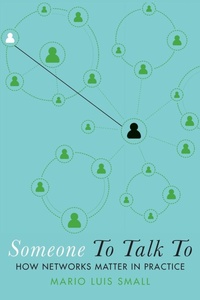
Someone To Talk To
How Networks Matter in Practice
Published on 25. October 2019
Book
Paperback/Softback
296 pages
978-0-19-009043-2 (ISBN)
Description
Winner of the James Coleman Award for Best Book from the Rationality and Society section of the American Sociological Society
Winner of the Outstanding Recent Contribution from the Social Psychology section of the American Sociological Association
Winner of the Best Publication Award from the Mental Health section of the American Sociological Association
Honorable Mention, PROSE Book Award, Cultural Anthropology and Sociology, from the Association of American Publishers
When people are facing difficulties, they often feel the need for a confidant. How do they decide on whom to rely? In Someone To Talk To, Mario Luis Small follows a group of graduate students as they cope with stress, overwork, self-doubt, failure, relationships, children, health care, and poverty. He unravels how they decide whom to turn to for support. And he then confirms his findings based on representative national data on adult Americans. Small shows that rather than consistently relying on their "strong ties," Americans often take pains to avoid close friends and family, as these relationships are both complex and fraught with expectations. In contrast, they often confide in "weak ties," as the need for understanding or empathy trumps their fear of misplaced trust. In fact, people may find themselves confiding in acquaintances and even strangers unexpectedly, without having reflected on the consequences. Amid a growing wave of big data and large-scale network analysis, Small returns to the basic questions of whom we connect with, how, and why, upending decades of conventional wisdom on how we should think about and analyze social networks.
Winner of the Outstanding Recent Contribution from the Social Psychology section of the American Sociological Association
Winner of the Best Publication Award from the Mental Health section of the American Sociological Association
Honorable Mention, PROSE Book Award, Cultural Anthropology and Sociology, from the Association of American Publishers
When people are facing difficulties, they often feel the need for a confidant. How do they decide on whom to rely? In Someone To Talk To, Mario Luis Small follows a group of graduate students as they cope with stress, overwork, self-doubt, failure, relationships, children, health care, and poverty. He unravels how they decide whom to turn to for support. And he then confirms his findings based on representative national data on adult Americans. Small shows that rather than consistently relying on their "strong ties," Americans often take pains to avoid close friends and family, as these relationships are both complex and fraught with expectations. In contrast, they often confide in "weak ties," as the need for understanding or empathy trumps their fear of misplaced trust. In fact, people may find themselves confiding in acquaintances and even strangers unexpectedly, without having reflected on the consequences. Amid a growing wave of big data and large-scale network analysis, Small returns to the basic questions of whom we connect with, how, and why, upending decades of conventional wisdom on how we should think about and analyze social networks.
Reviews / Votes
Small provides an excellent foray into the deeper social network question of who individuals talk to about issues important to them. Further, his critiques on commonly used methods are well founded and timely. I would highly recommend this book not just for social network analysts or sociologists but health professionals hoping to better understand the social influences that may impact health. * Tyler Prochnow, Baylor University, World Medical and Health Policy * In Someone To Talk To, Mario Small roots social network analysis in the messy, contradictory, and fortuitous nature of human interaction. In this important study, Small shows, both through up-close interviews with young adults undergoing major life changes and with general surveys of Americans, that we find the help we need from all sorts of people-those to whom we are close, those who are just acquaintances, and even those whom we have just met. This is a valuable correction to the often overly abstract literature on social networks." * Claude S. Fischer, University of California, Berkeley * The reality of who affects our lives through contact is much more complicated, messy, and sometimes even random than contemporary theory and methods suggest. This fascinating book taps into the complex, networked fabric of our lives, revealing ground truth." * Bernice Pescosolido, Indiana University * In Someone To Talk To, Mario Small brings relations to life as solutions to problems that people face when they need a hand or an ear. The net we cast as we struggle with our anxieties and concerns is as wide and subtle as this book, which reminds us that our interactions with others are much more delicate than the clumsy representation of ties in graphs would suggest." * Peter Bearman, Columbia University * Who you turn to when you want someone to talk to will surprise you. But whomever you talk to, you'll be talking about this book. It's extraordinary!" * Eldar Shafir, Princeton University * Refreshing. Someone To Talk To is very readable, yet reflects deep theoretical and methodical advances in sociology. I think this book is a winner both for its theoretical and methodological achievements." * Nan Lin, Duke University * Mario Small's book Someone to Talk To turns received wisdom on its head in several ways - reorienting us to the role of weak ties in contrast to strong ones, moving us beyond network structure to practices and norms embedded in the networks we inhabit, and focusing our attention on empathy and the ways in which we find it. The book is a tour de force." * Karen S. Cook, Stanford University *More details
Language
English
Place of publication
New York
United States
Target group
Professional and scholarly
Dimensions
Height: 234 mm
Width: 156 mm
Thickness: 17 mm
Weight
501 gr
ISBN-13
978-0-19-009043-2 (9780190090432)
Copyright in bibliographic data and cover images is held by Nielsen Book Services Limited or by the publishers or by their respective licensors: all rights reserved.
Schweitzer Classification
Person
Mario L. Small, Grafstein Professor of Sociology at Harvard University, is an expert on poverty, personal networks, cities, and social science methods. He is the author of Villa Victoria: The Transformation of Social Capital in a Boston Barrio and Unanticipated Gains: Origins of Network Inequality in Everyday Life.
Content
Preface
PART I: The Question
Introduction
1. Confidants
PART II: The First Year
2. Weak- Tie Confidants
3. Beyond Named Confidants
4. Incompatible Expectations
5. Relevance and Empathy
6. Because They Were There
PART III: Beyond Graduate Students
7. Empirical Generalizability
8. Theoretical Generalizability
A Final Word
PART IV: Appendices
Appendix A: Qualitative Analysis
Appendix B: Quantitative Analysis
Notes
References
Index
PART I: The Question
Introduction
1. Confidants
PART II: The First Year
2. Weak- Tie Confidants
3. Beyond Named Confidants
4. Incompatible Expectations
5. Relevance and Empathy
6. Because They Were There
PART III: Beyond Graduate Students
7. Empirical Generalizability
8. Theoretical Generalizability
A Final Word
PART IV: Appendices
Appendix A: Qualitative Analysis
Appendix B: Quantitative Analysis
Notes
References
Index