

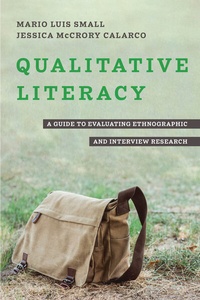
Qualitative Literacy
A Guide to Evaluating Ethnographic and Interview Research
1st Edition
Published on 23. August 2022
Book
Hardback
230 pages
978-0-520-39065-2 (ISBN)
Description
Suppose you were given two qualitative studies: one is a piece of empirically sound social science and the other, though interesting and beautifully written, is not. How would you tell the difference? Qualitative Literacy presents criteria to assess qualitative research methods such as in-depth interviewing and participant observation. Qualitative research is indispensable to the study of inequality, poverty, education, public health, immigration, the family, and criminal justice. Each of the hundreds of ethnographic and interview studies published yearly on these issues is scientifically either sound or unsound. This guide provides social scientists, researchers, students, evaluators, policy makers, and journalists with the tools needed to identify and evaluate quality in field research.
Reviews / Votes
"This book is a must-read for any researcher, even those who specialize in quantitative methods. . . .It aims to be a textbook but achieves much more." * EPIC - Ethnographic Praxis in Industry Community * "Qualitative Literacy: A Guide to Evaluating Ethnographic and Interview Research is a wonderful book that should be required reading for all graduate students in Sociology; indeed, it is a useful guide for any social science discipline that incorporates both quantitative and qualitative training." * Social Forces * "Qualitative Literacy... suggests a template through which scholars-building on extensive prior methodological research-might more holistically and collectively develop a framework to improve qualitative literacy across the social sciences." * Administrative Science Quarterly *More details
Edition
First Edition
Language
English
Place of publication
Berkerley
United States
Target group
Professional and scholarly
Product notice
Cloth over boards
Dimensions
Height: 210 mm
Width: 140 mm
Thickness: 20 mm
Weight
408 gr
ISBN-13
978-0-520-39065-2 (9780520390652)
Copyright in bibliographic data and cover images is held by Nielsen Book Services Limited or by the publishers or by their respective licensors: all rights reserved.
Schweitzer Classification
Other editions
Additional editions
Mario Luis Small | Jessica McCrory Calarco
Qualitative Literacy
A Guide to Evaluating Ethnographic and Interview Research
E-Book
08/2022
1st Edition
Naval Institute Press
€24.49
Available for download
Persons
Mario Luis Small is Quetelet Professor of Social Science at Columbia University. He is an expert on inequality, poverty, networks, and the relationship between qualitative and quantitative methods. His most recent books include Unanticipated Gains: Origins of Network Inequality in Everyday Life, Someone To Talk To: How Networks Matter in Practice, and Personal Networks: Classic Readings and New Directions in Egocentric Analysis.
Jessica McCrory Calarco is Associate Professor of Sociology at Indiana University. She is an expert on inequalities in family life and education, as well as on qualitative methods. She is the author of Negotiating Opportunities: How the Middle Class Secures Advantages in School and A Field Guide to Grad School: Uncovering the Hidden Curriculum.
Jessica McCrory Calarco is Associate Professor of Sociology at Indiana University. She is an expert on inequalities in family life and education, as well as on qualitative methods. She is the author of Negotiating Opportunities: How the Middle Class Secures Advantages in School and A Field Guide to Grad School: Uncovering the Hidden Curriculum.
Content
CONTENTS
Preface
Introduction
1 Cognitive Empathy
2 Heterogeneity
3 Palpability
4 Follow-Up
5 Self-Awareness
Conclusion
Acknowledgments
Appendix: A Note on Proposals
Notes
References
Index
Preface
Introduction
1 Cognitive Empathy
2 Heterogeneity
3 Palpability
4 Follow-Up
5 Self-Awareness
Conclusion
Acknowledgments
Appendix: A Note on Proposals
Notes
References
Index