

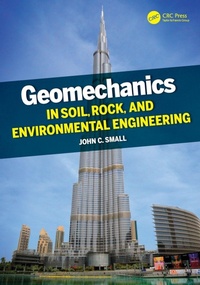
Geomechanics in Soil, Rock, and Environmental Engineering
In Soil, Rock, and Environmental Engineering
1st Edition
Published on 9. March 2016
Book
Paperback/Softback
541 pages
978-1-4987-3929-0 (ISBN)
Description
Utilizes both Computer- and Hand-Based Calculations...
Modern practice in geomechanics is becoming increasingly reliant on computer-based software, much of which can be obtained through the Internet. In Geomechanics in Soil, Rock, and Environmental Engineering the application of these numerical techniques is examined not only for soil mechanics, but also for rock mechanics and environmental applications.
... For Use in Complex Analysis
It deals with the modern analysis of shallow foundations, deep foundations, retaining structures, and excavation and tunneling. In recent years, the environment has become more and more important, and so it also deals with municipal and mining waste and solutions for the disposal and containment of the waste. Many fresh solutions to problems are presented to enable more accurate and advanced designs to be carried out.
A Practical Reference for Industry Professionals, This Illuminating Book:
Offers a broad range of coverage in soil mechanics, rock mechanics, and environmental engineering
Incorporates the author's more than 40 years of academic and practical design experience
Describes the latest applications that have emerged in the last ten years
Supplies references readily available online for futher research
Geomechanics in Soil, Rock, and Environmental Engineering
should appeal to students in their final undergraduate course in geomechanics or master's students, and should also serve as a useful reference to practitioners in the field of geomechanics, reflecting the author's background in both industry and academia.
Modern practice in geomechanics is becoming increasingly reliant on computer-based software, much of which can be obtained through the Internet. In Geomechanics in Soil, Rock, and Environmental Engineering the application of these numerical techniques is examined not only for soil mechanics, but also for rock mechanics and environmental applications.
... For Use in Complex Analysis
It deals with the modern analysis of shallow foundations, deep foundations, retaining structures, and excavation and tunneling. In recent years, the environment has become more and more important, and so it also deals with municipal and mining waste and solutions for the disposal and containment of the waste. Many fresh solutions to problems are presented to enable more accurate and advanced designs to be carried out.
A Practical Reference for Industry Professionals, This Illuminating Book:
Offers a broad range of coverage in soil mechanics, rock mechanics, and environmental engineering
Incorporates the author's more than 40 years of academic and practical design experience
Describes the latest applications that have emerged in the last ten years
Supplies references readily available online for futher research
Geomechanics in Soil, Rock, and Environmental Engineering
should appeal to students in their final undergraduate course in geomechanics or master's students, and should also serve as a useful reference to practitioners in the field of geomechanics, reflecting the author's background in both industry and academia.
Reviews / Votes
"... covers some topics which are not to be found in other texts, for example, the design of working platforms, foundations on fissured soils, and the material on excavation analysis including groundwater... suitable for more advanced undergraduate courses and post-graduate courses in geotechnical engineering."-Harry Poulos, Senior Consultant, Coffey International
"Small's text covers a broad range of information available to help assess the properties and strength of soil, rock, and environmental controls encountered in certain types of construction applications. In 12 chapters (some with associated appendixes), Small (emer., geotechnical engineering, Univ. of Sydney, Australia) covers the basic concepts and tests
used in soil mechanics, describes finite layer and finite element method mathematical techniques, presents site investigation requirements, and examines sample collection and lab and field testing methods. Information on analyses and considerations associated with shallow and deep foundations, slope stability, excavations, retaining structures, soil improvement, and geotechnical aspects related to disposal of municipal, industrial, and mining wastes are also provided. The last chapter presents methods needed for testing rock, along with the analyses and considerations recommended for construction in rock. Ample equations, figures, photographs, graphs, and tables fully support the text, as do generous references and a substantial index. The text assumes a fundamental knowledge of geomechanics and would benefit from a glossary. The strength of the text is in the broad coverage of the presented information; however, a few chapters lack meaningful introductions that would help provide a framework for their content."
-CHOICE, December 2016 "... covers some topics which are not to be found in other texts, for example, the design of working platforms, foundations on fissured soils, and the material on excavation analysis including groundwater... suitable for more advanced undergraduate courses and post-graduate courses in geotechnical engineering."
-Harry Poulos, Senior Consultant, Coffey International
"Small's text covers a broad range of information available to help assess the properties and strength of soil, rock, and environmental controls encountered in certain types of construction applications. In 12 chapters (some with associated appendixes), Small (emer., geotechnical engineering, Univ. of Sydney, Australia) covers the basic concepts and tests
used in soil mechanics, describes finite layer and finite element method mathematical techniques, presents site investigation requirements, and examines sample collection and lab and field testing methods. Information on analyses and considerations associated with shallow and deep foundations, slope stability, excavations, retaining structures, soil improvement, and geotechnical aspects related to disposal of municipal, industrial, and mining wastes are also provided. The last chapter presents methods needed for testing rock, along with the analyses and considerations recommended for construction in rock. Ample equations, figures, photographs, graphs, and tables fully support the text, as do generous references and a substantial index. The text assumes a fundamental knowledge of geomechanics and would benefit from a glossary. The strength of the text is in the broad coverage of the presented information; however, a few chapters lack meaningful introductions that would help provide a framework for their content."
-CHOICE, December 2016
More details
Language
English
Place of publication
Bosa Roca
United States
Publishing group
Taylor & Francis Inc
Target group
College/higher education
Professional and scholarly
Illustrations
450 s/w Abbildungen, 54 s/w Tabellen
54 Tables, black and white; 450 Illustrations, black and white
Dimensions
Height: 254 mm
Width: 178 mm
Thickness: 30 mm
Weight
1047 gr
ISBN-13
978-1-4987-3929-0 (9781498739290)
Copyright in bibliographic data and cover images is held by Nielsen Book Services Limited or by the publishers or by their respective licensors: all rights reserved.
Schweitzer Classification
Other editions
Additional editions
E-Book
09/2018
CRC Press
€128.99
Available for download
E-Book
09/2018
CRC Press
€128.99
Available for download
John Small
Geomechanics in Soil, Rock, and Environmental Engineering
In Soil, Rock, and Environmental Engineering
Book
07/2017
1st Edition
CRC Press
€271.20
Shipment within 10-20 days
Person
John Small is Emeritus Professor of geotechnical engineering at the University of Sydney. He has worked as a university researcher and teacher and has also spent time working as a senior geotechnical engineer for a large multi-discipline engineering consultant, thus gaining both practical and academic experience. He has carried out the design of many large engineering projects notably foundations for tall buildings.
Content
Basic Concepts. Finite Layer Methods. Finite Element Methods. Site Investigation and In Situ Testing. Shallow Foundations. Deep Foundations. Slope Stability. Excavation. Retaining Structures. Soil Improvement. Environmental Geomechanics. Basic Rock Mechanics. Appendices. References.