

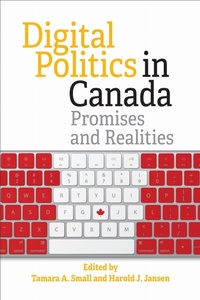
Digital Politics in Canada
Promises and Realities
Published on 20. December 2020
Book
Hardback
328 pages
978-1-4875-8759-8 (ISBN)
Description
Digital Politics in Canada addresses a significant gap in the scholarly literature on both media in Canada and Canadian political science. Using a comprehensive, multidisciplinary, historical, and focused analysis of Canadian digital politics, this book covers the full scope of actors in the Canadian political system, including traditional political institutions of the government, elected officials, political parties, and the mass media. At a time when issues of inclusion are central to political debate, this book features timely chapters on Indigenous people, women, and young people, and takes an in-depth look at key issues of online surveillance and internet voting. Ideal for a wide-ranging course on the impact of digital technology on the Canadian political system, this book encourages students to critically engage in discussions about the future of Canadian politics and democracy.
Reviews / Votes
"The pioneering research and insights in this book provide critical tools to understand and inform our response to digital politics. Such research enhances our capacity to unleash the potential for enhanced democratic participation and to comprehend and curtail practices that imperil it."- Lori Williams, Mount Royal University (Alberta Views)
More details
Language
English
Place of publication
Toronto
Canada
Target group
College/higher education
Professional and scholarly
Product notice
sewn/stitched
Cloth over boards
Illustrations
20 figures
Dimensions
Height: 231 mm
Width: 155 mm
Thickness: 23 mm
Weight
576 gr
ISBN-13
978-1-4875-8759-8 (9781487587598)
Copyright in bibliographic data and cover images is held by Nielsen Book Services Limited or by the publishers or by their respective licensors: all rights reserved.
Schweitzer Classification
Persons
Tamara A. Small is a professor in the Department of Political Science at the University of Guelph.
Harold J. Jansen is a professor in the Department of Political Science at University of Lethbridge.
Harold J. Jansen is a professor in the Department of Political Science at University of Lethbridge.
Content
Preface: The Politics of Disruption
David Taras
Introduction: Twenty Years of Digital Politics in Canada
Tamara A. Small and Harold J. Jansen
Section I: Political Institutions
1. Digital Representation: The Normalization of Social Media into Political Offices
Alex Marland and Stephen Power
2. Digital Government and Democratic Trust: From Online Service to Outward Engagement
Jeffrey Roy
3. Open Government: Was It Just a Moment?
Justin Longo
4. Internet Voting: Strengthening Canadian Democracy or Weakening It?
Nicole Goodman and Chelsea Gabel
5. Electronic Surveillance: The Growth of Digitally-Enabled Surveillance and Atrophy of Accountability in Law Enforcement and Security Agencies
Christopher Parsons
6. Political Parties: Political Communication in the Digital Age
Tamara A. Small and Thierry Giasson
7. Digital Journalism: The Canadian Media's Struggle for Relevance
Christopher Waddell
Section II: Political Digital Citizenship
8. Democratic Citizenship: How Do Canadians Engage with Politics Online?
Harold J. Jansen, Royce Koop, Tamara A. Small, Frederic Bastien, and Thierry Giasson
9. Young People: Politics and Digital Technologies
Allison Harell, Dietlind Stolle, Philippe Duguay, and Valerie-Anne Maheo
10. Online Mobilization: Tweeting Truth to Power in An Era of Revised Patterns of Mobilization 2.0 in Canada
Mireille Lalancette and Vincent Raynauld
11. Digital Indigenous Politics: "there's more than one political show in town"
Derek Antoine
12. Digital Feminism: Networks of Resistance, Neoliberalism, and New Contexts for Activism in Canada
Samantha C. Thrift
David Taras
Introduction: Twenty Years of Digital Politics in Canada
Tamara A. Small and Harold J. Jansen
Section I: Political Institutions
1. Digital Representation: The Normalization of Social Media into Political Offices
Alex Marland and Stephen Power
2. Digital Government and Democratic Trust: From Online Service to Outward Engagement
Jeffrey Roy
3. Open Government: Was It Just a Moment?
Justin Longo
4. Internet Voting: Strengthening Canadian Democracy or Weakening It?
Nicole Goodman and Chelsea Gabel
5. Electronic Surveillance: The Growth of Digitally-Enabled Surveillance and Atrophy of Accountability in Law Enforcement and Security Agencies
Christopher Parsons
6. Political Parties: Political Communication in the Digital Age
Tamara A. Small and Thierry Giasson
7. Digital Journalism: The Canadian Media's Struggle for Relevance
Christopher Waddell
Section II: Political Digital Citizenship
8. Democratic Citizenship: How Do Canadians Engage with Politics Online?
Harold J. Jansen, Royce Koop, Tamara A. Small, Frederic Bastien, and Thierry Giasson
9. Young People: Politics and Digital Technologies
Allison Harell, Dietlind Stolle, Philippe Duguay, and Valerie-Anne Maheo
10. Online Mobilization: Tweeting Truth to Power in An Era of Revised Patterns of Mobilization 2.0 in Canada
Mireille Lalancette and Vincent Raynauld
11. Digital Indigenous Politics: "there's more than one political show in town"
Derek Antoine
12. Digital Feminism: Networks of Resistance, Neoliberalism, and New Contexts for Activism in Canada
Samantha C. Thrift