

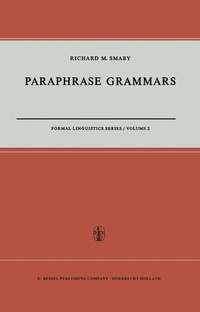
Paraphrase Grammars
Published on 12. October 2011
Book
Paperback/Softback
VIII, 145 pages
978-94-010-3340-4 (ISBN)
Description
The recent rapid development of transformational grammars has incorpo rated some strong claims in the areas of semantics and co-occurrence. The earlier structuralists relied on a minimum of information about the meaning of strings of a language. They asked only if strings of sounds were different in meaning - or simply were different words or phrases. Current transfor mational grammars, on the other hand, set as their goal the production of exactly the meaningful strings of a language. Stated slightly differently, they wish to specify exactly which strings of a language can occur together (meaningfully) in a given order. The present book purports to show that transformational grammar is in dependent of the current trends in semantics. I claim that exciting and sophisticated transformational grammars are required for describing when strings of a language mean the same, that is, for describing when strings of a language are paraphrases of each other. This task can be quite naturally limited to a project of much weaker semantic claims than those which are current in transformational linguistics.
More details
Series
Edition
1971
Language
English
Place of publication
Dordrecht
Netherlands
Target group
Professional and scholarly
Research
Illustrations
VIII, 145 p.
Dimensions
Height: 240 mm
Width: 160 mm
Thickness: 9 mm
Weight
261 gr
ISBN-13
978-94-010-3340-4 (9789401033404)
DOI
10.1007/978-94-010-3338-1
Schweitzer Classification
Other editions
Additional editions
R.M. Smaby
Paraphrase Grammars
Book
12/1970
Kluwer Academic Publishers
€106.99
Shipment within 15-20 days
Content
I: Introduction.- 1. The Transformational Approach.- 2. The Paraphrase Relation.- 3. Paraphrase Grammars.- 4. Compositional Grammars.- 5. Substitution.- 6. Admission Conditions.- 7. Equivalence.- 8. Functional Notation.- 9. Summary.- II: The Paraphrase Relation.- 1. The Study of the Paraphrase Relation.- 2. Collection of Data.- 3. Selection of Data.- 4. Generalization of the Paraphrastic Relationships.- 5. Systematization of the Paraphrase Relation.- 6. Summary.- III: Compositional Grammars.- 1. The Compositional Approach.- 2. A Simple Compositional Language: P.- 3. Compositional Grammars and the Co-Occurrence Problem.- 4. 'Projection Rules'.- 5. Summary.- IV: Substitution.- 1. The Substitution Concept.- 2. The Presence of Substitution.- 3. A Notation for Substitution.- 4. The Generality of Substitution.- 5. Operations and Transformations.- 6. Summary.- V: Admission and Equivalence.- 1. Admission Conditions.- 2. Ordering of Transformations.- 3. A Recursive Definition and an Admission Condition.- 4. Equivalence.- 5. Summary.- VI: Functional Representation.- 1. Functional Notation.- 2. Functions and Transformations.- 3. Functions and Phonology: the Relative Clause.- 4. Summary.- VII: The Structure of Paraphrase Grammars.- 1. The Recursive Enumerability of the Transformation Relation.- 2. Elementary Transformations.- 3. Summary.- Appendix: Recursive Enumerability.- Index of Subjects.