

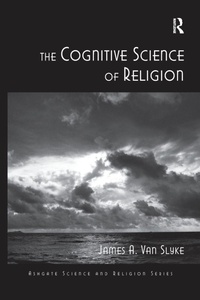
The Cognitive Science of Religion
1st Edition
Published on 28. November 2016
Book
Paperback/Softback
192 pages
978-1-138-27886-8 (ISBN)
Description
The cognitive science of religion is a relatively new academic field in the study of the origins and causes of religious belief and behaviour. The focal point of empirical research is the role of basic human cognitive functions in the formation and transmission of religious beliefs. However, many theologians and religious scholars are concerned that this perspective will reduce and replace explanations based in religious traditions, beliefs, and values. This book attempts to bridge the reductionist divide between science and religion through examination and critique of different aspects of the cognitive science of religion and offers a conciliatory approach that investigates the multiple causal factors involved in the emergence of religion.
Reviews / Votes
'In this important and timely book, James Van Slyke provides a sharp critique of much current work in the cognitive science of religion on the basis of its reductionist tendencies and its assumption that humans today still have minds shaped in the Stone Age. He then offers a more scientifically, philosophically, and theologically credible model of the formation of concepts of God, which, he argues, begins by transferring models of interpersonal relations formed by parent-child bonding.' - Nancey Murphy, Fuller Theological Seminary, USA'The field of study called the Cognitive Science of Religion provides interesting and informative theories about the cognitive and evolutionary origins of human religion. However, most of these theories include the unnecessary assumption that religion is "nothing but" the chance outcome of a random evolutionary walk. In this very useful book, James Van Slyke provides a thoughtful review of this field, while also arguing for a more balanced view of the human aspects of religion that takes seriously the embodiment of human nature and cognition, modern philosophy of mind, and theology.' - Warren S. Brown, Fuller Graduate School of Psychology, USA
'Slyke has produced a well written essay, with a neat and clear exposition of the limits of the 'standard model' and a constructive new model built on his perception of that model's inadequacies. The resultant extension of the dominant paradigm constitutes a healthy exercise in theory-building, and seems much more plausible in its heuristic power than the simplistic theoretical framework previously available.' - ESSSAT News & Reviews
'... Van Slyke's volume provides a handy guide to a variety of cognitive approaches and their limits.' - Journal of Religion
More details
Series
Language
English
Place of publication
London
United Kingdom
Publishing group
Taylor & Francis Ltd
Target group
College/higher education
Dimensions
Height: 234 mm
Width: 156 mm
Thickness: 11 mm
Weight
301 gr
ISBN-13
978-1-138-27886-8 (9781138278868)
Copyright in bibliographic data and cover images is held by Nielsen Book Services Limited or by the publishers or by their respective licensors: all rights reserved.
Schweitzer Classification
Other editions
Additional editions
James A. Van Slyke
The Cognitive Science of Religion
E-Book
03/2016
Routledge
€73.99
Available for download
James A. Van Slyke
The Cognitive Science of Religion
E-Book
03/2016
Routledge
€73.99
Available for download
James A. Van Slyke
The Cognitive Science of Religion
Book
11/2011
1st Edition
Routledge
€231.30
Shipment within 10-20 days
Person
James A. Van Slyke completed his Ph.D. from Fuller Theological Seminary in Philosophy of Religion with a minor in Cognitive Science. He currently serves as Assistant Research Professor in the Travis Research Institute in the Graduate School of Psychology at Fuller Theological Seminary. He is also an Adjunct Professor in the School of Theology at Fuller Theology Seminary and Adjunct Instructor at Azusa Pacific University where he teaches in the Department of Religion and Philosophy and the Department of Undergraduate Psychology.
Content
Contents: Introduction; The standard model and the problem of causal reductionism; Counterintuitive religious concepts and emergent cognition; Theological incorrectness and the causal relevance of religious beliefs and theological reasoning; Evolutionary psychology and the emergence of the symbolic mind; Evolution, cognition, and religion: toward a multi-level perspective on the emergence of religious beliefs; Postscript; Bibliography; Index.