

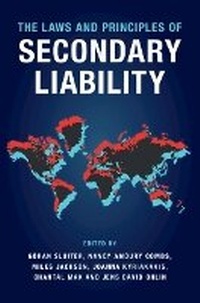
The Laws and Principles of Secondary Liability
Will be published approx. on 31. October 2026
Book
Paperback/Softback
949 pages
978-1-009-68595-5 (ISBN)
Description
In today's interconnected world, international crimes and serious human rights violations are rarely committed without the crucial support of secondary actors - be they individuals, corporations, or States. This is the first book to analyze how these secondary actors may be held legally responsible for contributing to such crimes. Drawing on a six-year international research collaboration, it brings together the work of 44 legal scholars to examine and compare diverse approaches to secondary liability across criminal law, civil law, human rights law, and State responsibility. Real-world examples - such as arms trading and financial support - illuminate the complex realities of complicity. The book stands out for its clear identification of legal concepts, its rigorous evaluation and comparison of existing laws against human rights and theoretical underpinnings, and its recommendations to recalibrate the law of secondary liability to bolster legal certainty and for the protection of human rights. This title is also available as open access on Cambridge Core.
More details
Language
English
Place of publication
Cambridge
United Kingdom
Product notice
Paperback (trade)
Illustrations
Worked examples or Exercises
ISBN-13
978-1-009-68595-5 (9781009685955)
Copyright in bibliographic data and cover images is held by Nielsen Book Services Limited or by the publishers or by their respective licensors: all rights reserved.
Schweitzer Classification
Other editions
Additional editions
Goeran Sluiter | Nancy Amoury Combs | Miles Jackson
The Laws and Principles of Secondary Liability
Book
approx. 10/2026
Cambridge University Press
€228.50
Not yet published
Persons
Goeran Sluiter is Professor of International Criminal Law at the University of Amsterdam and the Open University. He has served as a judge in the District Courts in The Hague and Utrecht and acted as defense counsel before international courts and tribunals. He has published extensively in the field. Nancy Amoury Combs is the Director of the Human Security Law Center at William & Mary Law School. She has published extensively on international criminal justice, including two books and dozens of articles. She has served as law clerk on the US Supreme Court and as adviser to the Iran-US Claims Tribunal. Miles Jackson is an Associate Professor at the University of Oxford and a Fellow of Jesus College, Oxford. Previous publications include the monograph, Complicity in International Law (2015). In 2017, he was awarded the Cassese Prize for International Criminal Law. Joanna Kyriakakis is an Associate Professor at Monash University. She researches business and human rights, international and transnational criminal law, tort law, and transitional justice. She has published widely in these areas and is the author of Corporations, Accountability and International Criminal Law: Industry and Atrocity (2021). Chantal Mak is Professor of Private law at the University of Amsterdam. As part of the Amsterdam Centre for Transformative Private Law at the University of Amsterdam, Professor Mak researches the intersection of fundamental rights and private law. She has published widely, was the recipient of an NWO Vidi grant and has held several academic leadership roles. Jens David Ohlin is the Allan R. Tessler Dean and Professor of Law at Cornell Law School. In his research, He focuses on the intersection of criminal law and procedure, public international law, and the laws of war. As Dean of Cornell Law School, lawyer, and philosopher, he has authored numerous articles, books, and treaties and received various prizes.
Content
Introduction; Part I. Theoretical Foundations of Secondary Liability: 1. Basic deontological conception of secondary liability; 2. Consequentialist foundations for secondary liability; 3. Critical moral theories; 4. Overall conclusions and guideposts; Part II. Secondary Liability under International Human Rights Law: 5. Introduction; 6. The obligation to hold complicit actors accountable under suppression conventions; 7. The obligation to hold complicit actors accountable under human rights conventions; 8. Regulating corporate conduct under IHRL; 9. Limits to accountability of complicit actors under human rights law?; 10. Overall conclusion and benchmarks; Part III. Secondary Liability in Criminal Law: 11. Introduction; 12. Argentina; 13. Canada; 14. China; 15. Egypt; 16. France; 17. Germany; 18. International criminal tribunals; 19. India; 20. Iraq; 21. Israel; 22. Japan; 23. The Netherlands; 24 Russia; 25. South Africa; 26. United Kingdom; 27. United States; 28. General principles of secondary liability in criminal law; 29. Overall conclusions and guideposts; Part IV. Secondary Liability in Civil Law: 30. Introduction to civil law and secondary liability; 31. Argentina; 32. Australia; 33. Canada; 34. China; 35. Egypt; 36. France; 37. Germany; 38. India; 39. Iraq; 40. Israel; 41. The Netherlands; 42. Russia; 43. South Africa; 44. United Kingdom; 45. United States; 46. Civil law and secondary liability: comparative reflections; Part V. State Responsibility and Secondary Liability: 47. State responsibility for complicity in the commission of international crimes, serious violations of human rights and mass atrocities; 48. State responsibility for contributions not qualifying as complicity and the role of due diligence; Part VI. Corporate Human Rights Due Diligence Legislation: 49. Introduction; 50. International history of due diligence: a north-south divide on the domain of legislation; 51. Canada; 52. Chile; 53. India; 54. Italy; 55. Nigeria; 56. The Netherlands; 57. United Kingdom; 58. Secondary liability and due diligence: comparative notes; Part VII. Conclusion: 59. Introduction; 60. Theoretical framework; 61 Human rights law framework; 62. Criminal law and secondary liability; 63. Civil law; 64. State responsibility; 65. Corporate human rights due diligence legislation.