

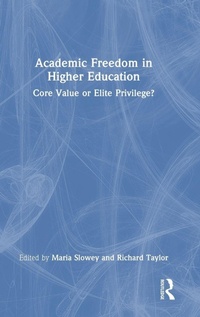
Academic Freedom in Higher Education
Core Value or Elite Privilege?
1st Edition
Published on 12. July 2024
Book
Hardback
212 pages
978-1-032-42550-4 (ISBN)
Description
This timely book explores the challenges facing universities and individual scholars through an examination of the history and theory underlying the concept of academic freedom.
Freedom of speech is widely viewed as a central attribute of contemporary liberal democracies in which - within limits - differing opinions have the right to be articulated in public without fear of reprisal. Academic freedom, long regarded as central to the idea of the university is, on the other hand, a right which must be earned through the acquisition of expert knowledge and the application of intellectual rigour in teaching and research. Both hard-won freedoms are argued by many to be under serious threat.
The expert contributors to this book, from different global regions, examine both the importance of academic freedom and the severe threats universities face in this context in the twenty-first century. With its interdisciplinary perspective and cross-national emphasis, central issues in this text are illustrated through detailed examination of case studies and consideration of wider developments in the academy. Adopting a longue duree approach, rather than discussing the details of fast moving controversies, the analyses offer insights for an educated public about an issue of pressing, contemporary significance.
This book will be of interest to researchers, policy makers, staff and students across higher education and to members of the general public, who are concerned about these important and contested matters.
Freedom of speech is widely viewed as a central attribute of contemporary liberal democracies in which - within limits - differing opinions have the right to be articulated in public without fear of reprisal. Academic freedom, long regarded as central to the idea of the university is, on the other hand, a right which must be earned through the acquisition of expert knowledge and the application of intellectual rigour in teaching and research. Both hard-won freedoms are argued by many to be under serious threat.
The expert contributors to this book, from different global regions, examine both the importance of academic freedom and the severe threats universities face in this context in the twenty-first century. With its interdisciplinary perspective and cross-national emphasis, central issues in this text are illustrated through detailed examination of case studies and consideration of wider developments in the academy. Adopting a longue duree approach, rather than discussing the details of fast moving controversies, the analyses offer insights for an educated public about an issue of pressing, contemporary significance.
This book will be of interest to researchers, policy makers, staff and students across higher education and to members of the general public, who are concerned about these important and contested matters.
More details
Language
English
Place of publication
London
United Kingdom
Publishing group
Taylor & Francis Ltd
Target group
College/higher education
Professional and scholarly
Academic and Postgraduate
Illustrations
1 s/w Zeichnung, 3 s/w Tabellen, 1 s/w Abbildung
3 Tables, black and white; 1 Line drawings, black and white; 1 Illustrations, black and white
Dimensions
Height: 240 mm
Width: 161 mm
Thickness: 17 mm
Weight
511 gr
ISBN-13
978-1-032-42550-4 (9781032425504)
Copyright in bibliographic data and cover images is held by Nielsen Book Services Limited or by the publishers or by their respective licensors: all rights reserved.
Schweitzer Classification
Other editions
Additional editions
Book
07/2024
1st Edition
Routledge
€60.50
Shipment within 10-20 days
E-Book
07/2024
1st Edition
Routledge
€52.99
Available for download
E-Book
07/2024
1st Edition
Routledge
€52.99
Available for download
Persons
Maria Slowey is Emeritus Professor, Higher Education Research Centre, Dublin City University, Ireland and Visiting Professor at the Universities of Florence, Italy, and Glasgow, UK.
Richard Taylor is Emeritus Professorial Fellow, Wolfson College, Cambridge University, UK.
Richard Taylor is Emeritus Professorial Fellow, Wolfson College, Cambridge University, UK.
Content
Part I: Academic freedom: the issues1. Introduction. Academic Freedom: core value or elite privilege?
2. Academic freedom and the dilemmas of the modern university
3. 'Free speech', academic freedom, and the Public Sphere: some reflections on principles
Part II: Academic freedom: case studies from British higher education (1945-1990)
4. Academic freedom, universities and the Left: a case study of British university adult education in the early years of the Cold War
5. The university as a contested space: 'no platforming' controversies at British universities, 1968-1990
Part III: Academic freedom: contrasting international experiences
6. Academic freedom under ideological attacks in Mexico
7. Beyond Western ideals: academic freedom, capabilities, and social knowledge
8. Selective academic freedom: the case of Hungary
Part IV: Academic freedom: contemporary themes and concluding reflections
9. Epistemic silences: the academic 'precariat' and academic freedom
10. Interrogating the implications of rankings, open science, and publishing for academic practice and academic freedom11. Concluding reflections on academic freedom
2. Academic freedom and the dilemmas of the modern university
3. 'Free speech', academic freedom, and the Public Sphere: some reflections on principles
Part II: Academic freedom: case studies from British higher education (1945-1990)
4. Academic freedom, universities and the Left: a case study of British university adult education in the early years of the Cold War
5. The university as a contested space: 'no platforming' controversies at British universities, 1968-1990
Part III: Academic freedom: contrasting international experiences
6. Academic freedom under ideological attacks in Mexico
7. Beyond Western ideals: academic freedom, capabilities, and social knowledge
8. Selective academic freedom: the case of Hungary
Part IV: Academic freedom: contemporary themes and concluding reflections
9. Epistemic silences: the academic 'precariat' and academic freedom
10. Interrogating the implications of rankings, open science, and publishing for academic practice and academic freedom11. Concluding reflections on academic freedom