

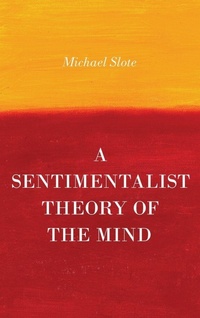
A Sentimentalist Theory of the Mind
Published on 29. May 2014
Book
Hardback
274 pages
978-0-19-937175-4 (ISBN)
Description
Michael Slote argues that emotion is involved in all human thought and action on conceptual grounds, rather than merely being causally connected with other aspects of the mind. This kind of general sentimentalism about the mind goes beyond that advocated by Hume, and the book's main arguments are only partially anticipated in German Romanticism and in the Chinese philosophical tendency to avoid rigid distinctions between thought and emotion. The new sentimentalist philosophy of mind Slote proposes can solve important problems about the nature of belief and action that other approaches -- including Pragmatism -- fail to address.
In arguing for the centrality of emotion within philosophy of the mind, A Sentimentalist Theory of the Mind continues the critique of rationalist philosophical views that began with Slote's Moral Sentimentalism (OUP, 2010) and continued in his From Enlightenment to Receptivity (OUP, 2013). This new book also delves into what is distinctive about human minds, arguing that there is a greater variety to ordinary human motives than has been recognized and that emotions play a central role in this complex psychology.
In arguing for the centrality of emotion within philosophy of the mind, A Sentimentalist Theory of the Mind continues the critique of rationalist philosophical views that began with Slote's Moral Sentimentalism (OUP, 2010) and continued in his From Enlightenment to Receptivity (OUP, 2013). This new book also delves into what is distinctive about human minds, arguing that there is a greater variety to ordinary human motives than has been recognized and that emotions play a central role in this complex psychology.
Reviews / Votes
Gracefully written in a conversational style, A Sentimentalist Theory of Mind can easily be read in a few days...The conversation here is between professional philosophers already deeply familiar with some touchstone figures (Hume, Kant, Frege), movements (rationalism, empiricism, moral sentimentalism), and technical notions (direction of fit, altruism, and many others). For those ready to join the conversation, though, the result is an...always interesting picture of the mind. * Timothy Schroeder, Mind * Slote's book, while not big in size, is great in significance, not only because he shares with us a plethora of important insights (only a small sample of which is summarized above), but also -- and more significantly -- because he develops a number of provocative ideas to stimulate our further thinking. * Yong Huang, Dao * To sum it up. Slote's book is important because of the balance it brings with its interpretation of the mind in terms of emotion/sentiment/feeling/affect. In this sense it fills a conceptual gap. More particularly, Slote offers us worthwhile remarks about feeling/emotion and particular emotions/feelings. Finally, his attempt at explaining the mind can be read in holistic light. The number of endnotes to this review reflect, I hope, how much Slote's book is a significant contribution for anyone interested in issues pertaining to affectivity. * Metapsychology Online Reviews *More details
Language
English
Place of publication
New York
United States
Target group
College/higher education
Dimensions
Height: 235 mm
Width: 157 mm
Thickness: 19 mm
Weight
549 gr
ISBN-13
978-0-19-937175-4 (9780199371754)
Copyright in bibliographic data and cover images is held by Nielsen Book Services Limited or by the publishers or by their respective licensors: all rights reserved.
Schweitzer Classification
Other editions
Additional editions
Michael Slote
A Sentimentalist Theory of the Mind
E-Book
04/2014
1st Edition
OUP eBook
€29.49
Available for download
Person
Michael Slote received his Ph.D. from Harvard University and is UST Professor of Ethics at the University of Miami. A member of the Royal Irish Academy and former Tanner Lecturer, he is the author of many books and articles in ethics, political philosophy, and moral psychology. His current research is on the implications of sentimentalism for virtue epistemology and philosophy of science, and also on the implications of social science for a philosophical understanding of human lives and human life.
Content
Preface ; Acknowledgements ; Introduction ; Chapter 1: Epistemology and Emotion ; Chapter 2: Belief in Action ; Chapter 3: The Emotional Unity of the Self ; Chapter 4: Egoism and Emotion ; Chapter 5: Empiricism and the Roots of Morality ; Chapter 6: Mind and Love ; Conclusion ; Appendix ; Index