

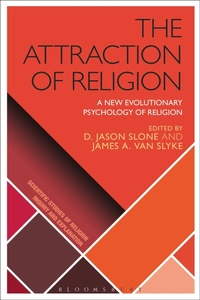
The Attraction of Religion
A New Evolutionary Psychology of Religion
Published on 26. February 2015
Book
Hardback
272 pages
978-1-4725-3462-0 (ISBN)
Description
Religion is an evolutionary puzzle. It involves beliefs in counterfactual worlds and engagement in costly rituals. Yet religion is widespread across all human cultures and eras. This begs the question, why are so many people attracted to religion?
In The Attraction of Religion, essays by leading scholars in evolutionary psychology, anthropology, and religious studies demonstrate how religion may be related to evolutionary adaptations because religious commitments involve fitness-enhancing behaviours that promote reproduction, kinship, and social solidarity. Could it be that religion is wide-spread, at least in the modern world, because it helps to facilitate cooperative breeding? International contributors explore the philosophical and theoretical arguments for and against the use of costly signalling, sexual selection, and related theories to explain religion, and empirical findings that support or disconfirm such claims. The first book-length treatment that focuses specifically on costly signalling, sexual selection, and related evolutionary theories to explain religion, The Attraction of Religion will be an important contribution to the field and will be of interest to researchers in the fields of evolutionary psychology, religion and science, the psychology of religion, and anthropology of religion.
In The Attraction of Religion, essays by leading scholars in evolutionary psychology, anthropology, and religious studies demonstrate how religion may be related to evolutionary adaptations because religious commitments involve fitness-enhancing behaviours that promote reproduction, kinship, and social solidarity. Could it be that religion is wide-spread, at least in the modern world, because it helps to facilitate cooperative breeding? International contributors explore the philosophical and theoretical arguments for and against the use of costly signalling, sexual selection, and related theories to explain religion, and empirical findings that support or disconfirm such claims. The first book-length treatment that focuses specifically on costly signalling, sexual selection, and related evolutionary theories to explain religion, The Attraction of Religion will be an important contribution to the field and will be of interest to researchers in the fields of evolutionary psychology, religion and science, the psychology of religion, and anthropology of religion.
Reviews / Votes
The Attraction of Religion daringly succeeds in presenting a scientific framework that will serve as a secure starting point and a useful reference for future, in-depth inquiries. * Science, Religion & Culture * Slone and Van Slyke have put together a treasure-trove, a much needed compendium that is not only a valuable source book for some of the most cogent hypotheses for the biological evolution of religion, but also the first coherent attempt to empirically assess the legitimacy of each. The Attraction of Religion delivers on its promise, and part of its attraction to serious researchers is that it marks the beginning of serious inquiry into an important human trait, bespeaking the degree to which even something so delicate and culture-bound as religion is also susceptible to the long reach of natural selection. An admirable and noteworthy achievement! -- David Barash, Professor of Psychology, University of Washington, USA and author of 'Buddhist Biology: Ancient Eastern Wisdom meets Modern Western Science' (2013) The Attraction of Religion, edited by D. Jason Slone and James A. Van Slyke, offers an exciting set of intellectual perspectives on the origins and nature of religion - a human universal that seems deeply embedded in who we are. Humans across the globe - and across recorded history - have practiced various forms of religion. And the evolutionary perspective on the human mind is poised to shed light on questions of why. Why do people practice religion? Why do religious practices vary in so many ways from one another? What are core features that are shared across religious practices? How does religious practice betray details of our evolutionary roots? With a set of contributors who comprise some of the top voices on the topic of evolutionary psychology, such as Craig Palmer and Todd Shackelford, writing on topics such as the interface of sexual selection and religiosity, this volume is sure to generate new understanding regarding the nature of the church-going ape. -- Glenn Geher, Director of Evolutionary Studies, Chair and Professor of Psychology, State University of New York at New Paltz, USAMore details
Series
Language
English
Place of publication
London
United Kingdom
Publishing group
Bloomsbury Publishing PLC
Target group
College/higher education
Illustrations
15 bw illus
Dimensions
Height: 240 mm
Width: 161 mm
Thickness: 19 mm
Weight
575 gr
ISBN-13
978-1-4725-3462-0 (9781472534620)
DOI
CBID181760
Copyright in bibliographic data and cover images is held by Nielsen Book Services Limited or by the publishers or by their respective licensors: all rights reserved.
Schweitzer Classification
Other editions
Additional editions
D. Jason Slone | James A. Van Slyke
The Attraction of Religion
A New Evolutionary Psychology of Religion
E-Book
02/2015
1st Edition
Bloomsbury Academic
€39.99
Available for download
D. Jason Slone | James A. Van Slyke
The Attraction of Religion
A New Evolutionary Psychology of Religion
E-Book
02/2015
1st Edition
Bloomsbury Academic
€39.99
Available for download
Persons
D. Jason Slone is Associate Professor of Psychology and Humanities at the School of Arts and Sciences, Tiffin University, USA.
James A. Van Slyke is Assistant Professor of Psychology at Fresno Pacific University, USA.
James A. Van Slyke is Assistant Professor of Psychology at Fresno Pacific University, USA.
Content
List of Figures
Acknowledgements
Introduction. Connecting Religion, Sex, and Evolution, Jason Slone (Professor of Cognition and Culture, School of Arts & Sciences, Tiffin University, USA) & James Van Slyke (Assistant Professor of Psychology, School of Humanities, Religion & Social Sciences, Fresno Pacific University, USA)
Chapter 1. Why Don't Abstinence Programs Work? (and other Puzzles), James Van Slyke (Assistant Professor of Psychology, School of Humanities, Religion & Social Sciences, Fresno Pacific University, USA)
Chapter 2. Religion and Parental Cooperation: An Empirical Test of Slone's Sexual Signaling Model, Joseph Bulbulia (Associate Professor, School of Art History, Classics and Religious Studies, Victoria University of Wellington, New Zealand), John Shaver (Postdoctoral Research Fellow, Laboratory for Experimental Research of Religion, Masaryk University, Czech Republic), Lara Greaves (NZAVS Lab Manager, School of Psychology, The University of Auckland, New Zealand), Richard Sosis (Professor of Anthropology, University of Connecticut, USA) & Chris Sibley (Associate Professor, School of Psychology, University of Auckland, New Zealand)
Chapter 3. How Is't With Thy Religion, Pray? Selection of Religion among Individuals and Groups, Michael Blume (Lecturer in Religious Studies, Friedrich Schiller University Jena, Germany)
Chapter 4. Losing My Religion: A Life-History Analysis of the Decline of Religious Attendance from Childhood, Jason Weeden (independent academic)
Chapter 5. Costly Signaling Theory, Sexual Selection, and the Influence of Ancestors on Religious Behavior, Craig T. Palmer (Associate Professor of Anthropology, University of Missouri, USA) & Ryan O. Begley (doctoral student in anthropology, University of Missouri, USA)
Chapter 6. When Religion Makes It Worse: Religiously Motivated Violence as a Sexual Selection Weapon, Yael Sela (doctoral student in psychology, Oakland University, USA), Todd K. Shackelford (Chair of Psychology, Oakland University, USA), & James R. Liddle (doctoral student in psychology, Florida Atlantic University, USA)
Chapter 7. The Dividends of Discounting Pain: Self-Inflicted Pain as a Reputational Commodity, Matthew Martinez (Researcher, Department of Anthropology, University of Nevada - Las Vegas, USA) & Pierre Lienard (Assistant Professor of Anthroplogy, University of Nevada - Las Vegas, USA)
Chapter 8. Religion and Marketing: The Attractiveness of Religion as a Moral Brand, Panagiotis Mitkidis (Researcher, Interacting Minds Center, Faculty of Arts, Aarhus University, Denmark) & Gabriel Levy (Associate Professor, Norwegian Univeristy of Science and Technology, Norway)
Chapter 9. Fathering, Rituals, and Mating: Exploring Paternal Stability and Sexual Strategies in Early Religion, David Bell (Lecturer, Department of Religious Studies, Georgia State University, USA)
Chapter 10. The Evolutionary Psychology of Theology, Andrew Mahoney (independent academic and Guest Lecturer, Victoria University, Australia)
Acknowledgements
Introduction. Connecting Religion, Sex, and Evolution, Jason Slone (Professor of Cognition and Culture, School of Arts & Sciences, Tiffin University, USA) & James Van Slyke (Assistant Professor of Psychology, School of Humanities, Religion & Social Sciences, Fresno Pacific University, USA)
Chapter 1. Why Don't Abstinence Programs Work? (and other Puzzles), James Van Slyke (Assistant Professor of Psychology, School of Humanities, Religion & Social Sciences, Fresno Pacific University, USA)
Chapter 2. Religion and Parental Cooperation: An Empirical Test of Slone's Sexual Signaling Model, Joseph Bulbulia (Associate Professor, School of Art History, Classics and Religious Studies, Victoria University of Wellington, New Zealand), John Shaver (Postdoctoral Research Fellow, Laboratory for Experimental Research of Religion, Masaryk University, Czech Republic), Lara Greaves (NZAVS Lab Manager, School of Psychology, The University of Auckland, New Zealand), Richard Sosis (Professor of Anthropology, University of Connecticut, USA) & Chris Sibley (Associate Professor, School of Psychology, University of Auckland, New Zealand)
Chapter 3. How Is't With Thy Religion, Pray? Selection of Religion among Individuals and Groups, Michael Blume (Lecturer in Religious Studies, Friedrich Schiller University Jena, Germany)
Chapter 4. Losing My Religion: A Life-History Analysis of the Decline of Religious Attendance from Childhood, Jason Weeden (independent academic)
Chapter 5. Costly Signaling Theory, Sexual Selection, and the Influence of Ancestors on Religious Behavior, Craig T. Palmer (Associate Professor of Anthropology, University of Missouri, USA) & Ryan O. Begley (doctoral student in anthropology, University of Missouri, USA)
Chapter 6. When Religion Makes It Worse: Religiously Motivated Violence as a Sexual Selection Weapon, Yael Sela (doctoral student in psychology, Oakland University, USA), Todd K. Shackelford (Chair of Psychology, Oakland University, USA), & James R. Liddle (doctoral student in psychology, Florida Atlantic University, USA)
Chapter 7. The Dividends of Discounting Pain: Self-Inflicted Pain as a Reputational Commodity, Matthew Martinez (Researcher, Department of Anthropology, University of Nevada - Las Vegas, USA) & Pierre Lienard (Assistant Professor of Anthroplogy, University of Nevada - Las Vegas, USA)
Chapter 8. Religion and Marketing: The Attractiveness of Religion as a Moral Brand, Panagiotis Mitkidis (Researcher, Interacting Minds Center, Faculty of Arts, Aarhus University, Denmark) & Gabriel Levy (Associate Professor, Norwegian Univeristy of Science and Technology, Norway)
Chapter 9. Fathering, Rituals, and Mating: Exploring Paternal Stability and Sexual Strategies in Early Religion, David Bell (Lecturer, Department of Religious Studies, Georgia State University, USA)
Chapter 10. The Evolutionary Psychology of Theology, Andrew Mahoney (independent academic and Guest Lecturer, Victoria University, Australia)