

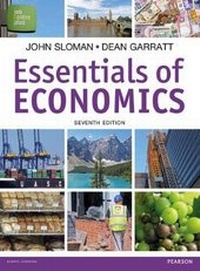
Essentials of Economics
7th Edition
Published on 16. February 2016
Book
Paperback/Softback
504 pages
978-1-292-08224-0 (ISBN)
Description
Were you looking for the book with access to MyEconLab? This product is the book alone and does NOT come with access to MyEconLab. Buy Essentials of Economics, 7th edition with MyEconLab access card (ISBN 9781292170121) if you need access to MyEconLab as well, and save money on this resource. You will also need a course ID from your instructor to access MyEconLab.
The market-leading concise text in introductory economics
Want to see economics in action? Visit the Sloman Economics News Site for a blog that's updated several times a week with current affairs and topical stories all linked to your textbook so you can explore the background to the issues more deeply.
This new edition of the market-leading Essentials of Economics has been updated with the most recent data and coverage of economic issues as the world tries to recover from global financial turmoil and looks at explanations of how consumers and firms really behave. Its classic features and clear and engaging writing style is complemented by strong theoretical coverage and a wealth of pedagogical features to support learning.
John Sloman was Director of the Economics Network from its foundation in 1999 until 2012, and is now Visiting Fellow at the University of Bristol where the Network is based. John is also Visiting Professor at the University of the West of England, Bristol.
Dean Garratt is Principal Teaching Fellow in the Department of Economics at the University of Warwick.
The market-leading concise text in introductory economics
Want to see economics in action? Visit the Sloman Economics News Site for a blog that's updated several times a week with current affairs and topical stories all linked to your textbook so you can explore the background to the issues more deeply.
This new edition of the market-leading Essentials of Economics has been updated with the most recent data and coverage of economic issues as the world tries to recover from global financial turmoil and looks at explanations of how consumers and firms really behave. Its classic features and clear and engaging writing style is complemented by strong theoretical coverage and a wealth of pedagogical features to support learning.
John Sloman was Director of the Economics Network from its foundation in 1999 until 2012, and is now Visiting Fellow at the University of Bristol where the Network is based. John is also Visiting Professor at the University of the West of England, Bristol.
Dean Garratt is Principal Teaching Fellow in the Department of Economics at the University of Warwick.
More details
Edition
7th edition
Language
English
Place of publication
Harlow
United Kingdom
Target group
College/higher education
Professional and scholarly
Dimensions
Height: 265 mm
Width: 195 mm
Thickness: 20 mm
Weight
952 gr
ISBN-13
978-1-292-08224-0 (9781292082240)
Copyright in bibliographic data and cover images is held by Nielsen Book Services Limited or by the publishers or by their respective licensors: all rights reserved.
Schweitzer Classification
Other editions
New editions
John Sloman | Dean Garratt
Essentials of Economics
Book
12/2018
8th Edition
Pearson Education Limited
€93.03
Shipment within 10-20 days
Previous edition
John Sloman | Dean Garratt
Essentials of Economics
Book
02/2013
6th Edition
Pearson Education Limited
€56.94
Article exhausted; check for reprint
Content
About the authors
Student and lecturer resources
Preface
Acknowledgements
Publisher's acknowledgements
Part A Introduction
1 Economic issues
1.1 Engaging with economics
An island economy
Economic puzzles and issues
1.2 The economic problem
The problem of scarcity
Demand and supply
1.3 Dividing up the subject
Macroeconomics
Microeconomics
1.4 Modelling economic relationships
The production possibility curve
The circular flow of goods and incomes
Techniques of analysis
1.5 Economic systems
The command economy
The free-market economy
The mixed market economy
Chapter 1 Boxes
1.1 Macroeconomic issues: An historical perspective
1.2 The opportunity costs of studying economics: What are you sacrificing?
1.3 Command economies: Rise and fall of planning
1.4 Affording the mixed economy: The sovereign debt crisis of the early 2010s
PART B MICROECONOMICS
2 Markets, demand and supply
2.1 Demand
The relationship between demand and price
The demand curve
Other determinants of demand
Movements along and shifts in the demand curve
Utility and the demand curve
2.2 Supply
Supply and price
The supply curve
Other determinants of supply
Movements along and shifts in the supply curve
2.3 The determination of price
Equilibrium price and output
Movement to a new equilibrium
2.4 The free-market economy
Advantages of a free-market economy
Problems with a free-market economy
2.5 Behavioural economics
What is behavioural economics?
Explaining 'irrational' consumer choices
Relevance to economic policy
Chapter 2 Boxes
2.1 Satisfaction and the rational consumer: Consumer surplus and 'benefit drivers'
2.2 UK house prices: From raising the roof to falling through the floor
2.3 Stock market prices: Demand and supply in action
2.4 Commodity prices: Riding the commodities Big Dipper?
2.5 Nudging people: How to change behaviour
3 Markets in action
3.1 Price elasticity of demand
Measuring the price elasticity of demand
Interpreting the figure for elasticity
Determinants of price elasticity of demand
3.2 Price elasticity of demand and consumer expenditure
3.3 Price elasticity of supply (PeS)
The determinants of price elasticity of supply
3.4 Other elasticities
Income elasticity of demand
3.5 Markets and adjustment over time
Short-run and long-run adjustment
Price expectations and speculation
3.6 Uncertainty and risk
Responding to risk and uncertainty
3.7 Markets where prices are controlled
Setting a minimum (high) price
Setting a maximum (low) price
Chapter 3 Boxes
3.1 &
Student and lecturer resources
Preface
Acknowledgements
Publisher's acknowledgements
Part A Introduction
1 Economic issues
1.1 Engaging with economics
An island economy
Economic puzzles and issues
1.2 The economic problem
The problem of scarcity
Demand and supply
1.3 Dividing up the subject
Macroeconomics
Microeconomics
1.4 Modelling economic relationships
The production possibility curve
The circular flow of goods and incomes
Techniques of analysis
1.5 Economic systems
The command economy
The free-market economy
The mixed market economy
Chapter 1 Boxes
1.1 Macroeconomic issues: An historical perspective
1.2 The opportunity costs of studying economics: What are you sacrificing?
1.3 Command economies: Rise and fall of planning
1.4 Affording the mixed economy: The sovereign debt crisis of the early 2010s
PART B MICROECONOMICS
2 Markets, demand and supply
2.1 Demand
The relationship between demand and price
The demand curve
Other determinants of demand
Movements along and shifts in the demand curve
Utility and the demand curve
2.2 Supply
Supply and price
The supply curve
Other determinants of supply
Movements along and shifts in the supply curve
2.3 The determination of price
Equilibrium price and output
Movement to a new equilibrium
2.4 The free-market economy
Advantages of a free-market economy
Problems with a free-market economy
2.5 Behavioural economics
What is behavioural economics?
Explaining 'irrational' consumer choices
Relevance to economic policy
Chapter 2 Boxes
2.1 Satisfaction and the rational consumer: Consumer surplus and 'benefit drivers'
2.2 UK house prices: From raising the roof to falling through the floor
2.3 Stock market prices: Demand and supply in action
2.4 Commodity prices: Riding the commodities Big Dipper?
2.5 Nudging people: How to change behaviour
3 Markets in action
3.1 Price elasticity of demand
Measuring the price elasticity of demand
Interpreting the figure for elasticity
Determinants of price elasticity of demand
3.2 Price elasticity of demand and consumer expenditure
3.3 Price elasticity of supply (PeS)
The determinants of price elasticity of supply
3.4 Other elasticities
Income elasticity of demand
3.5 Markets and adjustment over time
Short-run and long-run adjustment
Price expectations and speculation
3.6 Uncertainty and risk
Responding to risk and uncertainty
3.7 Markets where prices are controlled
Setting a minimum (high) price
Setting a maximum (low) price
Chapter 3 Boxes
3.1 &