

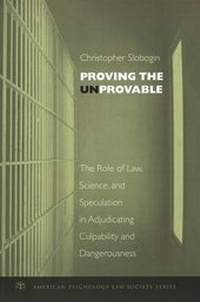
Proving the Unprovable
The Role of Law, Science, and Speculation in Adjudicating Culpability and Dangerousness
Published on 28. September 2006
Book
Hardback
208 pages
978-0-19-518995-7 (ISBN)
Description
It is hard enough in many cases simply figuring out whether a person has committed an antisocial act. It is harder still to determine the extent to which he or she intended the act, and why he or she committed it. And most difficult of all is divining whether a person will harm again. The law has increasingly turned to mental health professionals to help address these issues, particularly the last two. Because of their familiarity with and study of human behavior, psychiatrists, psychologists and other clinicians are thought to possess special expertise in assessing culpability and dangerousness. Members of these groups routinely furnish the courts with evaluations of insanity and other mental state at the time of the offense, and even more frequently proffer predictions about future behavior.
Both culpability and dangerousness are exceedingly difficult to gauge; even mental health professionals well-versed in the behavioral sciences cannot claim a high degree of reliability in their efforts to address these issues. Though the current trend in evidence law is to demand a rigorous demonstration of scientific validity from expert witnesses, especially when those experts are mental health professionals proffered by the defense, this book argues that this is a mistake. Such a position undermines the fairness of the process and could quite possibly even diminish its reliability, given the defense's constitutional entitlement to tell its story and the inscrutability of past and future mental states. At the same time, Professor Slobogin proposes a number of ways the courts can ensure that experts provide the best possible information about ultimately unknowable past mental states and future behavior.
Both culpability and dangerousness are exceedingly difficult to gauge; even mental health professionals well-versed in the behavioral sciences cannot claim a high degree of reliability in their efforts to address these issues. Though the current trend in evidence law is to demand a rigorous demonstration of scientific validity from expert witnesses, especially when those experts are mental health professionals proffered by the defense, this book argues that this is a mistake. Such a position undermines the fairness of the process and could quite possibly even diminish its reliability, given the defense's constitutional entitlement to tell its story and the inscrutability of past and future mental states. At the same time, Professor Slobogin proposes a number of ways the courts can ensure that experts provide the best possible information about ultimately unknowable past mental states and future behavior.
Reviews / Votes
"Should courts stop trying to answer unanswerable questions? In Proving the Unprovable, Professor Slobogin takes on this profoundly important question, and offers an insightful, readable, and persuasive argument for a liberal approach to clinical mental health testimony Proving the Unprovable is a major contribution to our understanding of the law of expert testimony."-- Richard J. Bonnie, John S. Battle Professor of Law, Professor of Psychiatric Medicine, Director, Institute of Law, Psychiatry and Public Policy, University of Virginia "In Proving the Unprovable, Professor Slobogin has done the undoable: he has produced a probing critique of the legal rules for admitting expert mental health testimony that had me turning the pages as if it were a suspense novel. After trenchantly analyzing current standards for admissibility, he suggests innovative approaches to protect the reasonable contributions that mental health experts can make. I doubt that any expert, no matter how experienced, who reads this book will view his or her task on the witness stand in quite the same way again."-- Paul S. Appelbaum, MD, Professor of Psychiatry, Director, Division of Psychiatry, Law and Ethics, Department of Psychiatry, Columbia University College of Physicians and Surgeons "Christopher Slobogin's new book on two of the most challenging questions the law poses for itself - the questions of culpability and dangerousness - and the role of mental health experts in trying to answer those question, is classic Slobogin: thoroughly informed, candid, complex and subtle, and yet exceptionally clear and cogent."-- Michael J. Saks, Professor of Law and Professor of Psychology, Arizona State UniversityMore details
Series
Language
English
Place of publication
New York
United States
Target group
Professional and scholarly
Dimensions
Height: 160 mm
Width: 236 mm
Thickness: 20 mm
Weight
465 gr
ISBN-13
978-0-19-518995-7 (9780195189957)
Copyright in bibliographic data and cover images is held by Nielsen Book Services Limited or by the publishers or by their respective licensors: all rights reserved.
Schweitzer Classification
Other editions
Additional editions
Christopher Slobogin
Proving the Unprovable
The Role of Law, Science, and Speculation in Adjudicating Culpability and Dangerousness
E-Book
09/2006
1st Edition
OUP eBook
€42.49
Available for download
Person
Christopher Slobogin, Milton Underwood Professor of Law, Vanderbilt University Law School.
Content
Part I: Introduction
Chapter One: The Need for Nuance
Part II: Culpability
Chapter Two: Diagnoses, Syndromes, and Criminal Responsibility
Chapter Three: The Case for Informed Speculation
Chapter Four: Redining Probative Value
Chapter Five: Beyond Relevance
Part III: Dangerousness
Chapter Six: The Current State of the Science and the Law
Chapter Seven: Are There "Experts" on Dangerousness?
Part IV: Conclusion
Chapter Eight: The Structure of Expertise
Chapter One: The Need for Nuance
Part II: Culpability
Chapter Two: Diagnoses, Syndromes, and Criminal Responsibility
Chapter Three: The Case for Informed Speculation
Chapter Four: Redining Probative Value
Chapter Five: Beyond Relevance
Part III: Dangerousness
Chapter Six: The Current State of the Science and the Law
Chapter Seven: Are There "Experts" on Dangerousness?
Part IV: Conclusion
Chapter Eight: The Structure of Expertise