


A Handbook of Integer Sequences
Published on 8. February 1974
Book
Hardback
220 pages
978-0-12-648550-9 (ISBN)
Description
A Handbook of Integer Sequences contains a main table of 2300 sequences of integers that are collected from all branches of mathematics and science. This handbook describes how to use the main table and provides methods for analyzing and describing unknown and important sequences. This compilation also serves as an index to the literature for locating references on a particular problem and quickly finds numbers such as 712, number of partitions of 30, 18th Catalan number, or expansion of ? to 60 decimal places. Other topics include the method of differences, self-generating sequences, polyominoes, permutations, and puzzle sequences. This publication is a good source for students and researchers who are confronted with strange and important sequences.
More details
Language
English
Place of publication
San Diego
United States
Publishing group
Elsevier Science Publishing Co Inc
Target group
College/higher education
Professional and scholarly
Weight
540 gr
ISBN-13
978-0-12-648550-9 (9780126485509)
Copyright in bibliographic data is held by Nielsen Book Services Limited or its licensors: all rights reserved.
Schweitzer Classification
Other editions
Additional editions
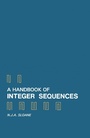
N. J. A. Sloane
A Handbook of Integer Sequences
E-Book
05/2014
Academic Press
€54.95
Available for download
Content
Preface
Acknowledgments
Abbreviations
Chapter 1 Description of the Book
1.1 Description of a Typical Entry
1.2 Arrangement
1.3 Number of Terms Given
1.4 References
1.5 What Sequences Are Included?
1.6 How Are Arrays of Numbers Treated?
1.7 Supplements
Chapter 2 How to Handle a Strange Sequence
2.1 How to See if a Sequence Is in the Table
2.2 If the Sequence Is Not in the Table
2.3 Finding the Next Term
2.4 Look for a Recurrence
2.4.1 Method of Differences
2.4.2 Other Methods of Attack
2.4.3 Factorizing
2.4.4 Self-Generating Sequences
Chapter 3 Illustrated Description of Some Important Sequences
3.1 Graphs and Trees
3.2 Relations
3.3 Geometries
3.4 Combinations and Figurate Numbers
3.5 Catalan Numbers and Dissections
3.6 Necklaces and Irreducible Polynomials
3.7 Knots
3.8 Stamps
3.9 Polyominoes
3.10 Boolean Functions
3.11 Poly a Counting Theory
3.12 Partitions
3.13 Permutations
3.14 Sequences from Number Theory
3.15 Puzzle Sequences
3.16 Sequences from Lattice Studies in Physics
The Main Table of Sequences
Bibliography
Index
Acknowledgments
Abbreviations
Chapter 1 Description of the Book
1.1 Description of a Typical Entry
1.2 Arrangement
1.3 Number of Terms Given
1.4 References
1.5 What Sequences Are Included?
1.6 How Are Arrays of Numbers Treated?
1.7 Supplements
Chapter 2 How to Handle a Strange Sequence
2.1 How to See if a Sequence Is in the Table
2.2 If the Sequence Is Not in the Table
2.3 Finding the Next Term
2.4 Look for a Recurrence
2.4.1 Method of Differences
2.4.2 Other Methods of Attack
2.4.3 Factorizing
2.4.4 Self-Generating Sequences
Chapter 3 Illustrated Description of Some Important Sequences
3.1 Graphs and Trees
3.2 Relations
3.3 Geometries
3.4 Combinations and Figurate Numbers
3.5 Catalan Numbers and Dissections
3.6 Necklaces and Irreducible Polynomials
3.7 Knots
3.8 Stamps
3.9 Polyominoes
3.10 Boolean Functions
3.11 Poly a Counting Theory
3.12 Partitions
3.13 Permutations
3.14 Sequences from Number Theory
3.15 Puzzle Sequences
3.16 Sequences from Lattice Studies in Physics
The Main Table of Sequences
Bibliography
Index