

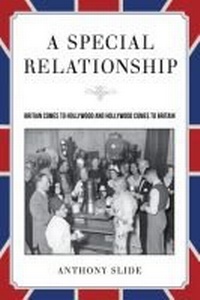
A Special Relationship
Britain Comes to Hollywood and Hollywood Comes to Britain
Published on 30. June 2015
Book
Hardback
322 pages
978-1-62846-087-2 (ISBN)
Description
A Special Relationship provides not only a historical overview of the British in Hollywood, but also a detailed study of the contributions made by American individuals and companies to British cinema from the beginning of the twentieth century onwards. The story begins with Ohio-born Charles Urban who came to London in 1898 and deserves credit for major involvement in the creation of a British film industry. While Ireland was still a part of Britain, the New York-based Kalem Company made films there from 1910 to 1913. British producers realized the importance of American stars, and many actors, beginning with Florence Turner (who was arguably also the first American star), made numerous British films. In the 1920s, such Hollywood stars as Mae Marsh, Betty Blythe, and Dorothy Gish remained active in Britain. In the 1930s, as their careers came to a halt, more than one hundred former American stars made the trip to England, partly as a vacation and partly in the hope of reenergizing their careers.
Chapters discuss American cinematographers at work in Britain in the 1920s and 1930s and the introduction of Technicolor to British films. Diversity is represented by African American performers (most notably Paul Robeson), the Chinese American star Anna May Wong, along with female filmmakers from Hollywood. With Britain's declaration of war on Germany, there were Americans who stayed, such as Bebe Daniels and Ben Lyon, contributing to the war effort. America became actively involved in British cinema after World War II, with many Hollywood studios producing films there. As the years progressed, the British film industry became an international film industry. The book concludes with the Harry Potter and James Bond series, indicative of a new international cinema, with financing and behind-the-camera talent coming from the United States, but with British locales and British stars.
Chapters discuss American cinematographers at work in Britain in the 1920s and 1930s and the introduction of Technicolor to British films. Diversity is represented by African American performers (most notably Paul Robeson), the Chinese American star Anna May Wong, along with female filmmakers from Hollywood. With Britain's declaration of war on Germany, there were Americans who stayed, such as Bebe Daniels and Ben Lyon, contributing to the war effort. America became actively involved in British cinema after World War II, with many Hollywood studios producing films there. As the years progressed, the British film industry became an international film industry. The book concludes with the Harry Potter and James Bond series, indicative of a new international cinema, with financing and behind-the-camera talent coming from the United States, but with British locales and British stars.
More details
Language
English
Place of publication
Jackson
United States
Target group
Professional and scholarly
Illustrations
91 black & white illustrations
Dimensions
Height: 254 mm
Width: 178 mm
Thickness: 20 mm
Weight
960 gr
ISBN-13
978-1-62846-087-2 (9781628460872)
Copyright in bibliographic data and cover images is held by Nielsen Book Services Limited or by the publishers or by their respective licensors: all rights reserved.
Schweitzer Classification
Other editions
Additional editions
E-Book
06/2015
Penguin Random House South Africa
€29.49
Available for download
Person
Anthony Slide, Studio City, California, is the author of some seventy-five books, including Hollywood Unknowns: A History of Extras, Bit Players, and Stand-Ins and Inside the Hollywood Fan Magazine: A History of Star Makers, Fabricators, and Gossip Mongers, both published by University Press of Mississippi. He is a renowned film scholar, who in 1990 was awarded an honorary doctorate of letters for his contributions to the history of popular culture. At that time, he was hailed by Lillian Gish as ""our pre-eminent silent film historian.""