

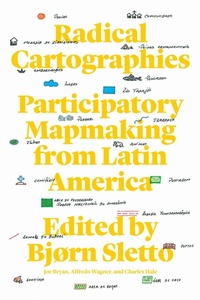
Radical Cartographies
Participatory Mapmaking from Latin America
Published on 15. September 2020
Book
Hardback
256 pages
978-1-4773-2088-4 (ISBN)
Description
Cartography has a troubled history as a technology of power. The production and distribution of maps, often understood to be ideological representations that support the interests of their developers, have served as tools of colonization, imperialism, and global development, advancing Western notions of space and place at the expense of Indigenous peoples and other marginalized communities. But over the past two decades, these marginalized populations have increasingly turned to participatory mapping practices to develop new, innovative maps that reassert local concepts of place and space, thus harnessing the power of cartography in their struggles for justice.
In twelve essays written by community leaders, activists, and scholars, Radical Cartographies critically explores the ways in which participatory mapping is being used by Indigenous, Afro-descendant, and other traditional groups in Latin America to preserve their territories and cultural identities. Through this pioneering volume, the authors fundamentally rethink the role of maps, with significant lessons for marginalized communities across the globe, and launch a unique dialogue about the radical edge of a new social cartography.
In twelve essays written by community leaders, activists, and scholars, Radical Cartographies critically explores the ways in which participatory mapping is being used by Indigenous, Afro-descendant, and other traditional groups in Latin America to preserve their territories and cultural identities. Through this pioneering volume, the authors fundamentally rethink the role of maps, with significant lessons for marginalized communities across the globe, and launch a unique dialogue about the radical edge of a new social cartography.
Reviews / Votes
[Radical Cartographies] succeeds magnificently...The stories are direct, clear, and well-translated, unfloriated by intellectual language...Community participatory mapping in the global South was first brought to wider academic attention in the 1990s. The 'decolonialised cartographies' in this book develop the vision: they demonstrate the authenticity of local authorship, the cultural authority, and the political framing. They deserve an attentive audience. (Society & Natural Resources) A highly welcomed volume...[Radical Cartographies] addresses participatory mapmaking as a means to preserve and strengthen indigenous knowledge about their past and present by reflecting on their landscapes, ancestral memories as well as ritual and agricultural practices...the book is a lesson on how others relate and interact with the world in a sustainable way by bridging space and time. (Anthropos) This book's work is a model of how community-based mobilizations can be connected with university spheres and how they can work together to lead necessary research that creates both scholarly and social, political, ethically-engaged contributions to complex issues on the ground...Those who guide each mapping project and share their rich and original insights with us are often under very direct threat. Their risks they face emphasize that consent and control over the research process and outcomes are crucial at every step. This book is a resounding affirmation of those principles and a real beacon for radical participatory mapmaking projects for social justice throughout the world. (Antipode) Timely and necessary...These case studies demonstrate across different countries and communities the intractable and interdependent problems of human rights and environmental rights. This is why [Radical Cartographies] seems so responsive to our moment. While the book is written to explain the maps and the work done there, it seems impossible to not respond from a place of empathy or outrage. Sletto's work and the work of his colleagues demonstrate that critical scholarship can offer public benefit on these issues, if we are willing to pay attention-for our own landscapes, for marginalized peoples, or indeed for the earth as a whole. (Society & Space) [Radical Cartographies] contains seminal research on how native and Afro-descendant peoples view and understand their geographic condition in several Latin American countries, a topic that remains underresearched in this region. Accordingly, this volume aims to fill this lacuna by providing critical analysis of how locals view their geographies. For the uninitiated, each of the 11 chapters provides unique perspectives of marginalized peoples' conceptual understanding of space. Complemented by several mostly black-and-white photos and maps, as well as a rich bibliography, this publication is a must read. (CHOICE) Several of the volume's authors are from the communities they write about while others are engaged intellectuals who have worked with the communities for years or decades...[Radical Cartographies] contains abundant samples of maps and photographs from each community mapping project...radical cartography repudiates the authoritarian practice since the colonial period of 'disappearing' indigenous and Black communities from maps. (Journal of Latin American Geography) The case studies [included in Radical Cartographies] showcase a rich variety of Indigenous and Afro-descendant practices that link together cartography and oral traditions and histories via the complex meanings embedded in landscape...each case study becomes a statement of sovereignty for each polity or community represented as they both document that territory in maps and use the maps to negotiate a relationship with the state that is founded in dispossession. (Journal of Latin American and Caribbean Anthropology)More details
Language
English
Place of publication
Austin, TX
United States
Target group
Professional and scholarly
Dimensions
Height: 236 mm
Width: 158 mm
Thickness: 30 mm
Weight
545 gr
ISBN-13
978-1-4773-2088-4 (9781477320884)
Copyright in bibliographic data and cover images is held by Nielsen Book Services Limited or by the publishers or by their respective licensors: all rights reserved.
Schweitzer Classification
Persons
BjOrn Sletto is an associate professor of community and regional planning at the University of Texas at Austin. His work on participatory mapping has been published in Environment and Planning, Cuadernos de GeografIa, and Current Anthropology, among other places.
Alfredo Wagner is a professor of graduate studies at the State University of MaranhAo and founder of the New Social Cartography Project of the Amazon.
Joe Bryan is an associate professor in geography at the University of Colorado, Boulder, and coauthor of Weaponizing Maps: Indigenous Peoples and Counterinsurgency in the Americas.
Charles Hale is the dean of the School of Social Sciences at the University of California, Santa Barbara, and author of MAs que un Indio: Racial Ambivalence and Neoliberal Multiculturalism in Guatemala.
Alfredo Wagner is a professor of graduate studies at the State University of MaranhAo and founder of the New Social Cartography Project of the Amazon.
Joe Bryan is an associate professor in geography at the University of Colorado, Boulder, and coauthor of Weaponizing Maps: Indigenous Peoples and Counterinsurgency in the Americas.
Charles Hale is the dean of the School of Social Sciences at the University of California, Santa Barbara, and author of MAs que un Indio: Racial Ambivalence and Neoliberal Multiculturalism in Guatemala.
Content
Introduction: Radical Social Cartographies (BjOrn Sletto)
Part I
1. Oral Narratives in the RincOn Zapoteco: A Cartography of Processes (Melquiades (Kiado) Cruz)
2. Social Polygraphy: Territory as a Living Memorial to Culture and Nature (Alvaro CEsar Velasco Alvarez)
3. Emulating Kuyujani: Boundary Making in the Caura River Basin, Venezuela (NalUa Rosa Silva Monterrey)
Part II
4. Revealing Territorial Illusions and Political Fictions through Participatory Cartography (Wendy Pineda)
5. Mapuche Cartography: Defending Ixofillmogen (Pablo Mansilla QuiNones and Miguel Melin Pehuen)
6. The Ethnocartography of Sumak Allpa: The Kichwa Indigenous Community of Pastaza, Ecuador (Alfredo Vitery and Alexandra LamiNa)
7. Social Cartography and Territorial Planning in Robles, Colombia (Carlos Alberto GonzAlez)
Part III
8. New Social Cartography and Ethnographic Practice (Alfredo Wagner Berno de Almeida)
9. Social Cartography and the Struggle for Multiethnic, Urban Indigenous Lands: The Case of the Beija-Flor Aldeia in Rio Preto da Eva, Brazil (Emmanuel de Almeida Farias JUnior)
10. Participatory Cultural Mapping in Nvwken, Mapuce Territory, Argentina: Exploring Other Forms of Territorial Representation (MarIa Laura Nahuel)
11. Political Appropriation of Social Cartography in Defense of Quilombola Territories in AlcAntara, MaranhAo, Brazil (Davi Pereira JUnior)
Commentary: What Sort of Territory? What Sort of Map? (Joe Bryan)
Afterword (Charles R. Hale)
Contributors
Index
Part I
1. Oral Narratives in the RincOn Zapoteco: A Cartography of Processes (Melquiades (Kiado) Cruz)
2. Social Polygraphy: Territory as a Living Memorial to Culture and Nature (Alvaro CEsar Velasco Alvarez)
3. Emulating Kuyujani: Boundary Making in the Caura River Basin, Venezuela (NalUa Rosa Silva Monterrey)
Part II
4. Revealing Territorial Illusions and Political Fictions through Participatory Cartography (Wendy Pineda)
5. Mapuche Cartography: Defending Ixofillmogen (Pablo Mansilla QuiNones and Miguel Melin Pehuen)
6. The Ethnocartography of Sumak Allpa: The Kichwa Indigenous Community of Pastaza, Ecuador (Alfredo Vitery and Alexandra LamiNa)
7. Social Cartography and Territorial Planning in Robles, Colombia (Carlos Alberto GonzAlez)
Part III
8. New Social Cartography and Ethnographic Practice (Alfredo Wagner Berno de Almeida)
9. Social Cartography and the Struggle for Multiethnic, Urban Indigenous Lands: The Case of the Beija-Flor Aldeia in Rio Preto da Eva, Brazil (Emmanuel de Almeida Farias JUnior)
10. Participatory Cultural Mapping in Nvwken, Mapuce Territory, Argentina: Exploring Other Forms of Territorial Representation (MarIa Laura Nahuel)
11. Political Appropriation of Social Cartography in Defense of Quilombola Territories in AlcAntara, MaranhAo, Brazil (Davi Pereira JUnior)
Commentary: What Sort of Territory? What Sort of Map? (Joe Bryan)
Afterword (Charles R. Hale)
Contributors
Index