

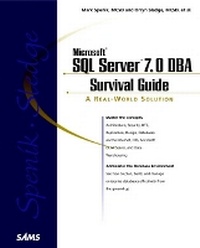
Microsoft SQL Server 7 DBA Survival Guide
3rd Edition
Published on 15. February 1999
Book
Mixed media product
1080 pages
978-0-672-31226-7 (ISBN)
Description
Microsoft SQL Server 7 DBA Survival Guide is organized into several parts that compromise the various jobs and tasks the DBA performs. Learn client/server computing and the role of the database administrator, how to plan and install/upgrading SQL Server, database operation, performance and tuning, and maintaining the shop. This book provides the knowledge and know-how to administer a SQL Server database. Through real-world insight and experience, you'll learn the tips, tricks, and suggestions you need to succeed as a DBA. Checklists and examples for SQL Server DBA tasks are provided, as well as conventions and naming standards. Also included is a section that looks into the tasks that make up a DBA's job description.
More details
Edition
3rd edition
Language
English
Place of publication
Indianapolis
United States
Publishing group
Pearson Education (US)
Target group
College/higher education
Dimensions
Height: 231 mm
Width: 187 mm
Thickness: 55 mm
Weight
1738 gr
ISBN-13
978-0-672-31226-7 (9780672312267)
Copyright in bibliographic data and cover images is held by Nielsen Book Services Limited or by the publishers or by their respective licensors: all rights reserved.
Schweitzer Classification
Other editions
Previous edition

Mark Spenik | Orryn Sledge
Microsoft SQL Server 6.5 DBA Survival Guide
Book
07/1996
2nd Edition
Sams Publishing
€59.40
Article exhausted; check for reprint
Persons
Mark Spenik is the manager of Client/Server Technologies at Keiter, Stephens Computer Services, Inc in VA. He is a Microsoft Certified Solution Developer and charter member, and is frequently invited to speak at Microsoft Developer Days. He is also an MCSE, certified in Microsoft SQL Server administration, SQL Server database implementation, and Windows NT. Orryn Sledge is a Client/Server Project Manager in metropolitan Pittsburgh PA. In early 1995, he was one of the first developers in the nation to complete the MCSD program. He is also a MCSE, certified by Microsoft in SQL Server Administration, Implementation, and Windows NT Server/Workstation, WOSA I and II, and Access.
Content
1. Introduction to Client/Server Database Computing. 2. The Role of the Database Administrator. II. THE WORLD OF MICROSOFTS SQL SERVER. 3. The Evolution Of SQL Server /Repository/06723/0672312263/conversion/html/0672312263/element_004.html/Repository/06723/0672312263/conversion/html/0672312263/element_004.html. 4. SQL Server Overview. III. INSTALLING AND UPGRADING SQL SERVER. 5. Planning an Installation or Upgrade. 6. Installing or Upgrading SQL Server. IV. DATABASE OPERATION. 7. Enterprise Management Processes. 8. Database Management. 9. Managing SQL Server Users and Security. 10. Backup and Restore. 11. Using BCP. 12. Distributed Transaction Coordinator. 13. Troubleshooting SQL Server. 14. Miscellaneous Topics and New SQL Server Utilities. V. REPLICATION. 15. Replication. 16. Transactional Replication. 17. Snapshot and Merge Replication. VI. PERFORMANCE AND TUNING. 18. SQL Server Internals - Changes and Enhancements. 19. Monitoring SQL Server. 20. Configuring and Tuning SQL Server. 21. Database Design Issues. 22. Understanding Indexes. 23. Query Optimization. 24. Multi-User Considerations. VII. ADVANCED DBA TOPICS. 25. SQL Essentials. 26. Using Stored Procedures and Cursors. 27. Using SQL-DMO (Distributed Management Objects). 28. SQL Server 7.0 and the Internet. VIII. Automating Maintenance And Administration Tasks. 29. Developing a SQL Server Maintenance Plan. 30. Automating Database Administration Tasks. IX. DATA WAREHOUSING. 31. Introduction to Data Warehousing. 32. Using Data Transformation Services (DTS). 33. Introduction to Microsoft SQL Server OLAP Services. X. APPENDIXES. Appendix A: Naming Conventions. Appendix B: DBCC Commands. Appendix C: SQL Server Resources.