

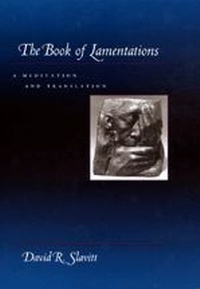
The Book of Lamentations
A Meditation and Translation
Published on 13. August 2001
Book
Paperback/Softback
104 pages
978-0-8018-6617-3 (ISBN)
Description
Distinguished poet and translator David R. Slavitt here provides a translation of and meditation upon the Book of Lamentations, the biblical account of the destruction of the Temple in Jerusalem in 587 B.C.,on the ninth day of the Jewish month of Av-Tish'a b'Av. (Six centuries later the Romans destroyed the second Temple on the same day.) Most of the Jewish population was deported to Babylon, and the ensuing period came to be known as the Babylonian Captivity. According to tradition, the Book of Lamentations was written in response to this political, social, and religious crisis. The five poems composing the book express Israel's sorrow, brokenness, and bewilderment before God. Tish'a b'Av is the day on which observant Jews fast and pray. And mourn. As Slavitt observes in his meditation:" It is forbidden on Tish'a b'Av even to study the Torah, except for the Book of Job and the Book of Lamentations. This is the day on which we grieve for every terrible thing that happens in this world. It is the worst day of the year."Slavitt's meditation provides a context for reading the scriptural text.
Cast in the same style as the Hebrew poetry, his meditation recounts how sorrow and catastrophe have characterized so much of the history of the Jewish people, from their enslavement in Egypt to the Holocaust of Nazi Germany. Few translations of this remarkable book of the Bible attempt to reproduce in English, as Slavitt does here, the Hebrew acrostics. In the original, each verse begins with a different letter of the Hebrew alphabet in sequential order; Slavitt elegantly reproduces this effect using the first 22 letters of the English alphabet. More than a structural or mnemonic device, Slavitt argues, the acrostics are "a serious assertion that the language itself is speaking, that the speech is inspired, and that there is, beyond all the disaster and pain the book recounts, an intricacy and an orderly coherence."
Cast in the same style as the Hebrew poetry, his meditation recounts how sorrow and catastrophe have characterized so much of the history of the Jewish people, from their enslavement in Egypt to the Holocaust of Nazi Germany. Few translations of this remarkable book of the Bible attempt to reproduce in English, as Slavitt does here, the Hebrew acrostics. In the original, each verse begins with a different letter of the Hebrew alphabet in sequential order; Slavitt elegantly reproduces this effect using the first 22 letters of the English alphabet. More than a structural or mnemonic device, Slavitt argues, the acrostics are "a serious assertion that the language itself is speaking, that the speech is inspired, and that there is, beyond all the disaster and pain the book recounts, an intricacy and an orderly coherence."
Reviews / Votes
He has produced a version of Lamentations that manages to be not only faithful to the structure of the original, respectful of the ashes-and-tears-drenched imagery of the Hebrew, while sacrificing none of the power of the biblical test... a masterpiece. -- George Robinson JBooks.com In the process of recounting the Jewish experience, this co-editor of the Johns Hopkins Complete Roman Drama in Translation, and poet, novelist, critic, and journalist, demonstrates his competence in this undertaking. As another reviewer has said, 'This is a powerful and moving convergence of a translator and his source'. Bible Editions and Versions In his extended meditation preceding his translation of the book, David Slavitt connects the Lamentations to other periods of violence and destruction, such as the Nazi Holocaust. As happens with many writings of great strength, Lamentations has taken on new meaning as it has moved through time and across geographies... This is a book that not only allows but demands rereading. -- Jerry Harp PleiadesMore details
Language
English
Place of publication
Baltimore, MD
United States
Target group
Professional and scholarly
Product notice
Paperback (trade)
Dimensions
Height: 216 mm
Width: 140 mm
Thickness: 9 mm
Weight
150 gr
ISBN-13
978-0-8018-6617-3 (9780801866173)
DOI
10.56021/9780801866173
Copyright in bibliographic data and cover images is held by Nielsen Book Services Limited or by the publishers or by their respective licensors: all rights reserved.
Schweitzer Classification
Other editions
Additional editions
E-Book
05/2003
Johns Hopkins University Press
€18.99
Available for download
Person
David R. Slavitt, poet, novelist, critic, and journalist, has published more than seventy books. He is coeditor of the Johns Hopkins Complete Roman Drama in Translation series and the Penn Greek Drama Series. His translations include the Metamorphoses of Ovid, The Fables of Avianus, and Seneca: The Tragedies, vols. 1 and 2 (all available from Johns Hopkins), and Sixty-one Psalms of David, The Book of the Twelve Prophets, and The Poem of Queen Esther of Joao Pinto Delgado.
Content
Contents: Preface Acknowledgements Notes on the Translation PART I Meditation PART I ILamentations Bibliographical Note