

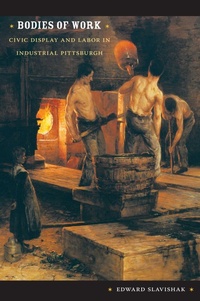
Bodies of Work
Civic Display and Labor in Industrial Pittsburgh
Will be published approx. on 16. September 2008
Book
Hardback
368 pages
978-0-8223-4206-9 (ISBN)
Description
By the end of the nineteenth century, Pittsburgh emerged as a major manufacturing center in the United States. Its rise as a leading producer of steel, glass, and coal was fueled by machine technology and mass immigration, developments that fundamentally changed the industrial workplace. Because Pittsburgh's major industries were almost exclusively male and renowned for their physical demands, the male working body came to symbolize multiple often contradictory narratives about strength and vulnerability, mastery and exploitation. In Bodies of Work, Edward Slavishak explores how Pittsburgh and the working body were symbolically linked in civic celebrations, the research of social scientists, the criticisms of labor reformers, advertisements, and workers' self-representations. Combining labor and cultural history with visual culture studies, he chronicles a heated contest to define Pittsburgh's essential character at the turn of the twentieth century, and he describes how that contest was conducted largely through the production of competing images.Slavishak focuses on the workers whose bodies came to epitomize Pittsburgh, the men engaged in the arduous physical labor demanded by the city's metals, glass, and coal industries. At the same time, he emphasizes how conceptions of Pittsburgh as quintessentially male limited representations of women in the industrial workplace. The threat of injury or violence loomed large for industrial workers at the turn of the twentieth century, and it recurs throughout Bodies of Work: in the marketing of artificial limbs, statistical assessments of the physical toll of industrial capitalism, clashes between labor and management, the introduction of workplace safety procedures, and the development of a statewide workmen's compensation system.
Reviews / Votes
"Following several decades of scholarship demonstrating the centrality of working-class men and women to the history of American industrial life, this study reminds us of the very powerful role of intellectual elites in the development of popular images of workers' bodies as both enhanced and broken by the industrial machine. Edward Slavishak challenges labor and working-class historians to demonstrate in even more certain terms than before the myriad ways that workers' portraits of themselves influenced popular perceptions of their bodies during the industrial age."-Joe William Trotter Jr., Giant Eagle Professor of History and Social Justice and Head of the Department of History, Carnegie Mellon University "In Bodies of Work, Edward Slavishak constructs a fascinating web of visual and textual evidence, interweaving various discourses on industrial labor, the male body, masculinity, and the city of Pittsburgh. From his creative new take on the Homestead strike and his subtle readings of visual culture to his startlingly original analyses of worker fatigue, the injured body, and the ubiquity of prosthetic limbs, he presents a broad new spectrum of ideas and approaches to the study of industrial labor."-Melissa Dabakis, author of Visualizing Labor in American Sculpture: Monuments, Manliness, and the Work EthicMore details
Series
Language
English
Place of publication
North Carolina
United States
Target group
College/higher education
Product notice
Cloth over boards
Illustrations
30 illustrations
Dimensions
Height: 229 mm
Width: 157 mm
Thickness: 33 mm
Weight
726 gr
ISBN-13
978-0-8223-4206-9 (9780822342069)
Copyright in bibliographic data and cover images is held by Nielsen Book Services Limited or by the publishers or by their respective licensors: all rights reserved.
Schweitzer Classification
Other editions
Additional editions
Edward Slavishak | Arjun Appadurai | Jean L. Comaroff
Bodies of Work
Civic Display and Labor in Industrial Pittsburgh
E-Book
09/2008
1st Edition
De Gruyter
€208.99
Available for download
Person
Edward Slavishak is Assistant Professor of History at Susquehanna University in Selinsgrove, Pennsylvania.
Content
Illustrations ix
Acknowledgments xi
Note on Usage xiii
Introduction 1
1. The Magic of the Nineteenth Century: Industrial Change and Work in Pittsburgh 17
2. Working-Class Muscle in the Battle of Homestead 64
3. The Working Body as Civic Image 89
4. The Pittsburgh Survey and the Body as Evidence 149
5. "Delicately Built": The "Problem" of Working Women in Pittsburgh 200
6. Hiding and Displaying the Broken Body 224
Epilogue: "That's Work, and That's What People Like to Watch!" 265
Notes 277
Bibliography 319
Index 345
Acknowledgments xi
Note on Usage xiii
Introduction 1
1. The Magic of the Nineteenth Century: Industrial Change and Work in Pittsburgh 17
2. Working-Class Muscle in the Battle of Homestead 64
3. The Working Body as Civic Image 89
4. The Pittsburgh Survey and the Body as Evidence 149
5. "Delicately Built": The "Problem" of Working Women in Pittsburgh 200
6. Hiding and Displaying the Broken Body 224
Epilogue: "That's Work, and That's What People Like to Watch!" 265
Notes 277
Bibliography 319
Index 345