

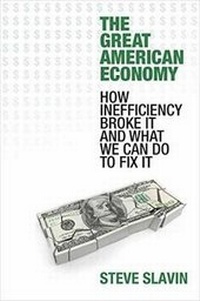
The Great American Economy
How Inefficiency Broke It and What We Can Do to Fix It
Published on 8. August 2017
Book
Hardback
414 pages
978-1-63388-305-5 (ISBN)
Description
Many Americans feel that the economy is no longer working for them and that "the American Dream" has become a sham. This book explains the underlying reasons for this gloomy outlook and lays out a clear plan for making the American economy work for everyone, not just the top 1 percent.
The heart of the problem, says economist Steve Slavin, is gross inefficiency. Since the end of World War II, America has been wasting vast amounts of its resources. As examples he cites the following key sectors:
?Healthcare--we spend nearly twice as much as other industrialized nations but achieve no better results;
?Education--just half of our eighteen-year-olds can function at an eighth-grade level, while many European and Asian countries do far better educating their young people;
?Transportation--by relying on cars instead of mass transit, we spend much more than comparable nations;
?The military--several decades after the Cold War our military budget continues to be almost 40 percent of the world's total military spending, while few politicians ever question the necessity for such massive outlays.
In these areas and other sectors of the economy, Slavin proposes sweeping changes to eliminate inefficiency. These would include a restructuring of our healthcare system to make it affordable for all, a major push toward public transportation, increased emphasis on quality results from our education system, ways to eliminate waste throughout our vast military-industrial complex, and a renewed emphasis on manufacturing.
Refreshingly clear and readable, The Great American Economy will appeal to readers who want to learn what went wrong with our economy and how to fix it.
The heart of the problem, says economist Steve Slavin, is gross inefficiency. Since the end of World War II, America has been wasting vast amounts of its resources. As examples he cites the following key sectors:
?Healthcare--we spend nearly twice as much as other industrialized nations but achieve no better results;
?Education--just half of our eighteen-year-olds can function at an eighth-grade level, while many European and Asian countries do far better educating their young people;
?Transportation--by relying on cars instead of mass transit, we spend much more than comparable nations;
?The military--several decades after the Cold War our military budget continues to be almost 40 percent of the world's total military spending, while few politicians ever question the necessity for such massive outlays.
In these areas and other sectors of the economy, Slavin proposes sweeping changes to eliminate inefficiency. These would include a restructuring of our healthcare system to make it affordable for all, a major push toward public transportation, increased emphasis on quality results from our education system, ways to eliminate waste throughout our vast military-industrial complex, and a renewed emphasis on manufacturing.
Refreshingly clear and readable, The Great American Economy will appeal to readers who want to learn what went wrong with our economy and how to fix it.
More details
Language
English
Place of publication
United States
Dimensions
Height: 236 mm
Width: 162 mm
Thickness: 35 mm
Weight
653 gr
ISBN-13
978-1-63388-305-5 (9781633883055)
Copyright in bibliographic data and cover images is held by Nielsen Book Services Limited or by the publishers or by their respective licensors: all rights reserved.
Schweitzer Classification
Other editions
Additional editions
E-Book
08/2017
Prometheus Books
€14.83
Available for download
Person
Steve Slavin, PhD, is the author of fifteen economics and math books, including two college texts, Economics (now in its eleventh edition), and Wiley Pathways Business Math (with Tere Stouffer), as well as the bestselling All the Math You'll Ever Need. He taught economics for thirty-one years at Union County College, Brooklyn College, and New York Institute of Technology.