

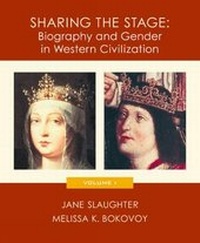
Sharing the Stage: v. 1
Biography and Gender in Western Civilization
Published on 3. March 2003
Book
Paperback/Softback
480 pages
978-0-618-01177-3 (ISBN)
Description
This chronologically arranged reader, designed as a supplement for the introductory western civilization course, centers on gender issues and women's history by including biographies of one man and one woman per chapter. Each chapter also includes background on the political and social climate of the period. The reader addresses three major teaching problems often found in the Western Civilization course: how to integrate women's history into traditional political and social narratives; how to explain to students that gender operates historically and that gender norms and constructs apply to both men and women; and how to capture and maintain student interest in distant events that seem to have little relevance to their lives.
Reviews / Votes
I. Ancient and Classical Worlds 1. The Challenges of Rule in New Kingdom: Hatshepsut (1479-1458 B.C.E.) and Thutmose III (1479-1425 B.C.E.) 2. Politics and Private Life in Classical Athens: Pericles (?494-429 B.C.E.) and Aspasia (?470-410 B.C.E.) 3. A Roman Matron and Her Revolutionary Sons: Cornelia (Second Century B.C.E.), Tiberius Gracchus (163-133 B.C.E.), and Gaius Gracchus (154-121 B.C.E.) 4. The Imperial Model: August ne Gaius Octavius (63 B.C.E.-14 C.E.) and Livia Drusilla (58 B.C.E.-29 C.E.) II. Christianity and the Heirs to the Roman Empire 5. Spritual Partners in Christian Asceticism: Jerome (?346-420 C.E.) and Paula (347-404 C.E.) 6. The Franks and the Transformation of the Roman World: Clotild of Burgundy (475-548) and Clovis I (466?-511) 7. The Byzantine Empire: Justinian (483?-565) and Theodora (497-548) 8. Public Power in Private Hands: Eleanor of Aquitaine (ca. 1122-1204) and Henry II (1133-1189) III. An Emerging European Civilization in the West 9. New Culture of Learning: Peter Abelard (1079-1142) and Heloise (1100/1101-1163/1164) 10. Politics and Sanctity in Fourteenth-Century Europe: Gregory XI (1330-1378) and Catherine of Sienna (1347-1380) 11. Renaissance Possibilities: Leon Battista Alberti (1404-1472) and Isotta Nagarola (1418-1466) 12.Catholic Monarchs in the Old and New Worlds: Ferdinand of Aragon (1452-1516) and Isabella of Castile (1451-1504) 13. The Protestant Reformation in Germany: Martin Luther (1483-1546) and Katharina von Bora (1499-1552) 14. The Scientific Revolution: Galileo Galilei (1564-1642) and Sister Maria Celeste (nee Virginia Galilei (1600-1634))More details
Language
Spanish
Place of publication
Boston
United States
Publishing group
Cengage Learning, Inc
Target group
College/higher education
Dimensions
Height: 230 mm
Width: 189 mm
Thickness: 16 mm
Weight
724 gr
ISBN-13
978-0-618-01177-3 (9780618011773)
Copyright in bibliographic data and cover images is held by Nielsen Book Services Limited or by the publishers or by their respective licensors: all rights reserved.
Schweitzer Classification
Persons
Jane Slaughter received her Ph.D. in 1972 from the University of New Mexico, where she is currently a professor of history and chaiman of the department. Her training is in Modern European history, with a focus on women's history and modern Italy. She has published extensively in scholarly collections and has edited several journals in history and women's studies. Melissa K. Bokovoy received her Ph.D. in 1991 from Indiana University. Her training is in Eastern European history since 1453. She is an associate professor of history at the University of New Mexico. She has published two books on modern Yugoslavia, and has contributed numerous articles and chapters to scholarly collections on Eastern Europe.
Content
I. Ancient and Classical Worlds 1. The Challenges of Rule in New Kingdom: Hatshepsut (1479-1458 B.C.E.) and Thutmose III (1479-1425 B.C.E.) 2. Politics and Private Life in Classical Athens: Pericles (?494-429 B.C.E.) and Aspasia (?470-410 B.C.E.) 3. A Roman Matron and Her Revolutionary Sons: Cornelia (Second Century B.C.E.), Tiberius Gracchus (163-133 B.C.E.), and Gaius Gracchus (154-121 B.C.E.) 4. The Imperial Model: August ne Gaius Octavius (63 B.C.E.-14 C.E.) and Livia Drusilla (58 B.C.E.-29 C.E.) II. Christianity and the Heirs to the Roman Empire 5. Spritual Partners in Christian Asceticism: Jerome (?346-420 C.E.) and Paula (347-404 C.E.) 6. The Franks and the Transformation of the Roman World: Clotild of Burgundy (475-548) and Clovis I (466?-511) 7. The Byzantine Empire: Justinian (483?-565) and Theodora (497-548) 8. Public Power in Private Hands: Eleanor of Aquitaine (ca. 1122-1204) and Henry II (1133-1189) III. An Emerging European Civilization in the West 9. New Culture of Learning: Peter Abelard (1079-1142) and Heloise (1100/1101-1163/1164) 10. Politics and Sanctity in Fourteenth-Century Europe: Gregory XI (1330-1378) and Catherine of Sienna (1347-1380) 11. Renaissance Possibilities: Leon Battista Alberti (1404-1472) and Isotta Nagarola (1418-1466) 12.Catholic Monarchs in the Old and New Worlds: Ferdinand of Aragon (1452-1516) and Isabella of Castile (1451-1504) 13. The Protestant Reformation in Germany: Martin Luther (1483-1546) and Katharina von Bora (1499-1552) 14. The Scientific Revolution: Galileo Galilei (1564-1642) and Sister Maria Celeste (nee Virginia Galilei (1600-1634))