

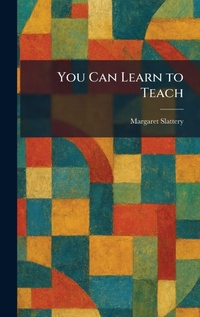
You Can Learn to Teach
Description
"You Can Learn to Teach" is a practical and inspiring guide designed to empower individuals with the skills and confidence necessary to educate others. Margaret Slattery, a prominent figure in early twentieth-century pedagogy, breaks down the art of teaching into accessible principles, emphasizing that effective instruction is a craft that can be cultivated through dedication, empathy, and careful observation.
The work explores the psychological foundations of learning, the importance of understanding the student's perspective, and the various methods for engaging a classroom effectively. While particularly influential in the context of religious and community education, the insights provided in this volume transcend specific subjects, offering timeless advice on storytelling, lesson planning, and the personal influence of the teacher. "You Can Learn to Teach" serves as a foundational text for those entering the teaching profession or volunteering in educational roles, highlighting the profound impact a dedicated educator can have on the development of their students. This classic guide remains a testament to the belief that every individual possesses the potential to share knowledge and inspire growth in others through the mastery of educational fundamentals.
This work has been selected by scholars as being culturally important, and is part of the knowledge base of civilization as we know it. This work was reproduced from the original artifact, and remains as true to the original work as possible. Therefore, you may see the original copyright references, library stamps (as most of these works have been housed in our most important libraries around the world), and other notations in the work.
This work is in the public domain in the United States of America, and possibly other nations. Within the United States, you may freely copy and distribute this work, as no entity (individual or corporate) has a copyright on the body of the work.
As a reproduction of a historical artifact, this work may contain missing or blurred pages, poor pictures, errant marks, etc. Scholars believe, and we concur, that this work is important enough to be preserved, reproduced, and made generally available to the public. We appreciate your support of the preservation process, and thank you for being an important part of keeping this knowledge alive and relevant.