

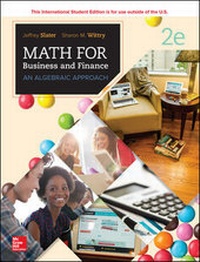
MATH FOR BUSINESS AND FINANCE: AN ALGEBRAIC APPROACH
2nd Edition
Published on 18. July 2018
Book
Paperback/Softback
768 pages
978-1-260-09251-6 (ISBN)
Description
Math for Business & Finance: An Algebraic Approach provides modern examples for students to understand business mathematics and make connections with real-world applications. The course covers mathematical concepts from an algebraic approach, combined with Business applications. Every chapter is devoted to a Personal Finance theme, with topics that include Payroll and the Cost of Purchasing a Home. There is also extensive integration of scientific calculator notation, and also has the Wall Street Journal and Kiplinger news clips that have been widely popular in Jeffrey Slater's other two Business Math texts.Connect is the only integrated learning system that empowers students by continuously adapting to deliver precisely what they need, when they need it, and how they need it, so that your class time is more engaging and effective.
More details
Edition
2nd edition
Language
English
Place of publication
OH
United States
Target group
College/higher education
US School Grade: From College Freshman to College Graduate Student
Illustrations
379 Illustrations
Weight
1586 gr
ISBN-13
978-1-260-09251-6 (9781260092516)
Copyright in bibliographic data and cover images is held by Nielsen Book Services Limited or by the publishers or by their respective licensors: all rights reserved.
Schweitzer Classification
Other editions
New editions
Jeffrey Slater | Sharon Wittry
Math For Business And Finance: An Algebraic Approach ISE
Book
06/2023
3rd Edition
McGraw-Hill Education
€93.15
Shipment within 15-20 days
Persons
Jeff Slater has been teaching 30 years at North Shore Community College. He has acted as a consultant for the office of personnel management in Boston and New York. Jeff tours the country giving speeches on student retention at colleges as well as national conventions.
Sharon has been teaching Business Math at Pikes Peak Community College for almost 20 years. Technological enhancements providing students with around-the-clock learning tools through the use of Smartbook and Connect have become important parts of both her face-to-face and online courses. Making content easy to understand and applicable to students' lives continues to be Sharon's focus.
Sharon has been teaching Business Math at Pikes Peak Community College for almost 20 years. Technological enhancements providing students with around-the-clock learning tools through the use of Smartbook and Connect have become important parts of both her face-to-face and online courses. Making content easy to understand and applicable to students' lives continues to be Sharon's focus.
Content
CHAPTER 1 Problem Solving with Math
CHAPTER 2 Fractions
CHAPTER 3 Percents and Their Applications
CHAPTER 4 Solving for the Unknown
CHAPTER 5 Business Statistics
CHAPTER 6 Banking and Budgeting
CHAPTER 7 Payroll and Income Tax
CHAPTER 8 Sales, Excise, and Property Taxes
CHAPTER 9 Risk Management
CHAPTER 10 Installment Buying and Revolving Charge Credit Cards
CHAPTER 11 Discounts: Trade and Cash
CHAPTER 12 Markups and Markdowns: Perishables and Breakeven Analysis
CHAPTER 13 How to Read, Analyze, and Interpret Financial Reports
CHAPTER 14 Depreciation
CHAPTER 15 Inventory and Overhead
CHAPTER 16 Simple Interest
CHAPTER 17 Promissory Notes, Simple Discount Notes, and the Discount Process
CHAPTER 18 The Cost of Home Ownership
CHAPTER 19 Compound Interest and Present Value
CHAPTER 20 Annuities and Sinking Funds
CHAPTER 21 Stocks, Bonds, and Mutual Funds
CHAPTER 2 Fractions
CHAPTER 3 Percents and Their Applications
CHAPTER 4 Solving for the Unknown
CHAPTER 5 Business Statistics
CHAPTER 6 Banking and Budgeting
CHAPTER 7 Payroll and Income Tax
CHAPTER 8 Sales, Excise, and Property Taxes
CHAPTER 9 Risk Management
CHAPTER 10 Installment Buying and Revolving Charge Credit Cards
CHAPTER 11 Discounts: Trade and Cash
CHAPTER 12 Markups and Markdowns: Perishables and Breakeven Analysis
CHAPTER 13 How to Read, Analyze, and Interpret Financial Reports
CHAPTER 14 Depreciation
CHAPTER 15 Inventory and Overhead
CHAPTER 16 Simple Interest
CHAPTER 17 Promissory Notes, Simple Discount Notes, and the Discount Process
CHAPTER 18 The Cost of Home Ownership
CHAPTER 19 Compound Interest and Present Value
CHAPTER 20 Annuities and Sinking Funds
CHAPTER 21 Stocks, Bonds, and Mutual Funds