

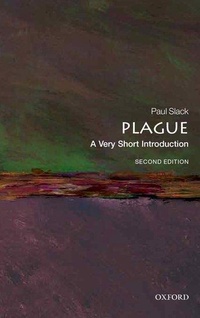
Plague
A Very Short Introduction
2nd Edition
Published on 24. June 2021
Book
Paperback/Softback
160 pages
978-0-19-887111-8 (ISBN)
Description
Very Short Introductions: Brilliant, Sharp, Inspiring
Throughout history plague has been the cause of many major catastrophes. It was responsible for the 'Plague of Justinian' in 542, the Black Death of 1348, and the Great Plague of London in 1665, as well as for devastating epidemics in China and India between the 1890s and 1920s. In the 21st century Coronavirus pandemics have served as a powerful reminder that we have not escaped the global impact of epidemic diseases.
In this Very Short Introduction, Paul Slack takes a global approach to explore the historical and social impact of plague over the centuries, looking at the ways in which it has been interpreted, and the powerful images it has left behind in art and literature. Examining what plague meant for those who suffered from it, and how governments began to fight against it, he demonstrates the impact plague has had on modern notions of public health, and how it has shaped our history. This new edition also includes evidence on the nature of plague taken from recent discoveries in ancient DNA as well as new research on plague in the Middle East.
ABOUT THE SERIES: The Very Short Introductions series from Oxford University Press contains hundreds of titles in almost every subject area. These pocket-sized books are the perfect way to get ahead in a new subject quickly. Our expert authors combine facts, analysis, perspective, new ideas, and enthusiasm to make interesting and challenging topics highly readable.
Throughout history plague has been the cause of many major catastrophes. It was responsible for the 'Plague of Justinian' in 542, the Black Death of 1348, and the Great Plague of London in 1665, as well as for devastating epidemics in China and India between the 1890s and 1920s. In the 21st century Coronavirus pandemics have served as a powerful reminder that we have not escaped the global impact of epidemic diseases.
In this Very Short Introduction, Paul Slack takes a global approach to explore the historical and social impact of plague over the centuries, looking at the ways in which it has been interpreted, and the powerful images it has left behind in art and literature. Examining what plague meant for those who suffered from it, and how governments began to fight against it, he demonstrates the impact plague has had on modern notions of public health, and how it has shaped our history. This new edition also includes evidence on the nature of plague taken from recent discoveries in ancient DNA as well as new research on plague in the Middle East.
ABOUT THE SERIES: The Very Short Introductions series from Oxford University Press contains hundreds of titles in almost every subject area. These pocket-sized books are the perfect way to get ahead in a new subject quickly. Our expert authors combine facts, analysis, perspective, new ideas, and enthusiasm to make interesting and challenging topics highly readable.
Reviews / Votes
Review from previous edition Slack takes a thematic approach to the global and comparative history of plague that provides a wonderful survey for the newcomer to the topic, while still providing food for thought to readers already well versed in the literature. * Patrick Wallis, LPS * This book is not a textbook on Pasteurella pestis. Rather, using the disease it causes as a link, the text has the potential to attract the interest and attention of a wide range of readers, encompassing historical, social, geographical and economic factors and the role they played in changing European and wider social development. In these days of internet access, soundbites and the decline of text on paper, this book presents an excellent opportunity for those who wish for an absorbing and educational narrative, contained within an extremely portable package and with no risk of the battery losing its charge at an inconvenient moment. * The Bulletin of The Royal College of Pathologists, April 2013 *More details
Series
Edition
2nd Revised edition
Language
English
Place of publication
Oxford
United Kingdom
Edition type
Revised edition
Product notice
Paperback (trade)
Unsewn / adhesive bound
Illustrations
19 black and white images
Dimensions
Height: 174 mm
Width: 115 mm
Thickness: 15 mm
Weight
124 gr
ISBN-13
978-0-19-887111-8 (9780198871118)
Copyright in bibliographic data and cover images is held by Nielsen Book Services Limited or by the publishers or by their respective licensors: all rights reserved.
Schweitzer Classification
Other editions
Additional editions
E-Book
06/2021
2nd Edition
OUP eBook
€5.49
Available for download
E-Book
06/2021
2nd Edition
OUP eBook
€5.49
Available for download
Previous edition
Paul Slack
Plague: A Very Short Introduction
Book
03/2012
Oxford University Press
€11.13
Article exhausted; check for reprint
Person
Paul Slack is Emeritus Professor of Early Modern Social History at Oxford University. He is the author of The Impact of Plague in Tudor and Stuart England, (OUP , 1990), and The Invention of Improvement: Information and Material Progress in Seventeenth-Century England, (OUP 2015), which won the Samuel Pepys Prize for 2015. He has been the Editor of the journal Past and Present, is a Fellow of the British Academy, and was Principal of Linacre College, Oxford, until 2010.
Content
Acknowledgements List of Illustrations Introduction 1: Plague: what's in a name?? 2: Pandemics and epidemics 3: Big impacts: the Black Death 4: Private horrors 5: Public health 6: Enduring images 7: The lessons of histories References Further Reading Index