

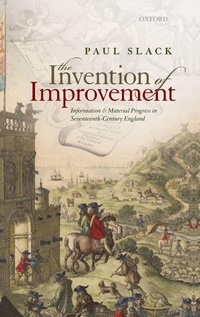
The Invention of Improvement
Information and Material Progress in Seventeenth-Century England
Published on 6. November 2014
Book
Hardback
336 pages
978-0-19-964591-6 (ISBN)
Description
Improvement was a new concept in seventeenth-century England; only then did it become usual for people to think that the most effective way to change things for the better was not a revolution or a return to the past, but the persistent application of human ingenuity to the challenge of increasing the country's wealth and general wellbeing. Improvements in agriculture and industry, commerce and social welfare, would bring infinite prosperity and happiness. The word improvement was itself a recent coinage. It was useful as a slogan summarising all these goals, and since it had no equivalent in other languages, it gave the English a distinctive culture of improvement that they took with them to Ireland and Scotland, and to their possessions overseas. It made them different from everyone else.
The Invention of Improvement explains how this culture of improvement came about. Paul Slack explores the political and economic circumstances which allowed notions of improvement to take root, and the changes in habits of mind which improvement accelerated. It encouraged innovation, industriousness, and the acquisition of consumer goods which delivered comfort and pleasure. There was a new appreciation of material progress as a process that could be measured, and its impact was publicised by the circulation of information about it. It had made the country richer and many of its citizens more prosperous, if not always happier. Drawing on a rich variety of contemporary literature, The Invention of Improvement situates improvement at the centre of momentous changes in how people thought and behaved, how they conceived of their environment and their collective prospects, and how they cooperated in order to change them.
The Invention of Improvement explains how this culture of improvement came about. Paul Slack explores the political and economic circumstances which allowed notions of improvement to take root, and the changes in habits of mind which improvement accelerated. It encouraged innovation, industriousness, and the acquisition of consumer goods which delivered comfort and pleasure. There was a new appreciation of material progress as a process that could be measured, and its impact was publicised by the circulation of information about it. It had made the country richer and many of its citizens more prosperous, if not always happier. Drawing on a rich variety of contemporary literature, The Invention of Improvement situates improvement at the centre of momentous changes in how people thought and behaved, how they conceived of their environment and their collective prospects, and how they cooperated in order to change them.
Reviews / Votes
The Invention of Improvement combines sophisticated synthesis of recent scholarship with extensive research on the printed literature of the period. It deftly weaves together macro-analysis of England's changing fortunes with illuminating vignettes of the activities of particular visionaries and the texts that enshrined their ambitions. * Alexandra Walsham, The Times Literary Supplement * This is a mature work of scholarship which describes and analyses the development of economic theory in the early modern period and its impact on economic and social policy in the time of Pepys. Thought provoking and readable, it raises fundamental issues of economic policy which are still relevant today. * Julian Amey, chair of the 2015 judging panel for the Samuel Pepys Award * The historical sweep of this book is in fact vast, from the Reformation of the Sixteenth Century through to the Enlightenment of the 1700s and beyond. Its subject encompasses the entire socio-economic development of that period. It is therefore a challenging book but also a very rewarding one. * Sue Nicholson, Pepys Diary * This book extends the chronological breadth and analytical depth of this research agenda and employs a novel analytical framework for interpreting it: the culture of improvement. * S. J. Thompson, Continuity and Change * Its conceptualization and massively detailed content deserve the highest praise ... Slack's magnum opus crowns a career in the field of early modern economic history of quite exceptional achievement. * Anthony Fletcher, History * this book offers the most detailed examination to date of the development of this concept in English print culture from c.1570 to c.1730 ... Slack's argument is informed by years of painstaking research and extraordinarily wide reading. * Brodie Waddell, English Historical Review *More details
Language
English
Place of publication
Oxford
United Kingdom
Target group
College/higher education
Illustrations
5 black and white figures/illustrations
Dimensions
Height: 240 mm
Width: 161 mm
Thickness: 23 mm
Weight
669 gr
ISBN-13
978-0-19-964591-6 (9780199645916)
Copyright in bibliographic data and cover images is held by Nielsen Book Services Limited or by the publishers or by their respective licensors: all rights reserved.
Schweitzer Classification
Other editions
Additional editions
Paul Slack
The Invention of Improvement
Information and Material Progress in Seventeenth-Century England
E-Book
11/2014
1st Edition
OUP eBook
€33.99
Available for download
Person
Paul Slack is Emeritus Professor of Early Modern Social History at Oxford University. He is the author of The Impact of Plague in Tudor and Stuart England (1990), From Reformation to Improvement: Public welfare in early modern England (1999) and books on urban history and poverty in the sixteenth and seventeenth centuries. He has been editor of the journal Past and Present, is a Fellow of the British Academy, and was Principal of Linacre College, Oxford, until 2010.
Content
List of illustrations ; Abbreviations and Conventions ; 1. Introduction: Varieties of Improvement ; 2. The Discovery of England ; 3. Elizabethan Foundations 1570-1640 ; 4. Revolutions 1640-1670 ; 5. Wealth and Happiness 1670-1690 ; 6. Challenges to Affluence 1690-1730 ; 7. England's Improvement ; 8. Conclusion ; Bibliography ; Index