

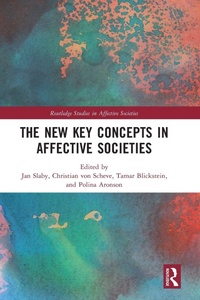
The New Key Concepts in Affective Societies
1st Edition
Will be published approx. on 16. December 2025
Book
Hardback
296 pages
978-1-041-07497-7 (ISBN)
Description
This volume offers a comprehensive rethinking of how affect and emotion shape contemporary social and political life. Against the backdrop of global crises, polarized publics, and media-saturated environments, this book positions affect not as a mere supplement to reason or discourse, but as the connective tissue between self and society, the intimate and the institutional.
Drawing on over a decade of interdisciplinary research at the Berlin-based Collaborative Research Center Affective Societies, the contributors develop a rich conceptual toolbox to understand the affective dynamics at play in governance, media, care, protest, and everyday life. From affective polarization and outrage politics to infrastructures of feeling and institutional affect, this collection identifies new key concepts that serve as both diagnostic tools and theoretical interventions.
Bridging affect theory with empirical inquiry, it demonstrates how affect and emotion are central to how we relate, resist, dwell, and imagine. This is a carefully curated volume that will appeal to scholars and students interested in the affective and emotional foundations of contemporary societies from a range of fields: sociology, cultural studies, psycho-social studies, anthropology, political science, media studies, religious and theological studies, philosophy, and performance studies.
Drawing on over a decade of interdisciplinary research at the Berlin-based Collaborative Research Center Affective Societies, the contributors develop a rich conceptual toolbox to understand the affective dynamics at play in governance, media, care, protest, and everyday life. From affective polarization and outrage politics to infrastructures of feeling and institutional affect, this collection identifies new key concepts that serve as both diagnostic tools and theoretical interventions.
Bridging affect theory with empirical inquiry, it demonstrates how affect and emotion are central to how we relate, resist, dwell, and imagine. This is a carefully curated volume that will appeal to scholars and students interested in the affective and emotional foundations of contemporary societies from a range of fields: sociology, cultural studies, psycho-social studies, anthropology, political science, media studies, religious and theological studies, philosophy, and performance studies.
More details
Series
Language
English
Place of publication
London
United Kingdom
Publishing group
Taylor & Francis Ltd
Target group
College/higher education
Professional and scholarly
Academic, Postgraduate, and Undergraduate Advanced
Illustrations
1 s/w Abbildung, 1 s/w Photographie bzw. Rasterbild
1 Halftones, black and white; 1 Illustrations, black and white
Dimensions
Height: 260 mm
Width: 183 mm
Thickness: 21 mm
Weight
788 gr
ISBN-13
978-1-041-07497-7 (9781041074977)
Copyright in bibliographic data and cover images is held by Nielsen Book Services Limited or by the publishers or by their respective licensors: all rights reserved.
Schweitzer Classification
Other editions
Additional editions
Jan Slaby | Christian von Scheve | Tamar Blickstein
The New Key Concepts in Affective Societies
Book
approx. 12/2025
1st Edition
Routledge
€62.80
Not yet published
Jan Slaby | Christian von Scheve | Tamar Blickstein
The New Key Concepts in Affective Societies
E-Book
12/2025
Routledge
€55.49
Available for download
Jan Slaby | Christian von Scheve | Tamar Blickstein
The New Key Concepts in Affective Societies
E-Book
12/2025
Routledge
€55.49
Available for download
Persons
Jan Slaby is Professor of Philosophy at Freie Universitaet Berlin, Germany. His research interests include philosophy of mind, social philosophy, philosophy of science, and, in particular, affect and emotion theory with a focus on subject formation, social interaction, and political affect. With Suparna Choudhury, he was co-editor of Critical Neuroscience (2012). With Christian von Scheve, he co-edited Affective Societies: Key Concepts (2019).
Christian von Scheve is Professor of Sociology at Freie Universitaet Berlin and Research Fellow at the German Institute for Economic Research (DIW) Berlin, Germany. His research focuses on the Sociology of Affect and Emotion, Cultural Sociology, Economic Sociology, and Social Psychology. With Mikko Salmela, he was co-editor of Collective Emotions (2013). With Jan Slaby, he co-edited Affective Societies: Key Concepts (2019).
Tamar Blickstein is a postdoctoral researcher at the CRC Affective Societies at Freie Universitaet Berlin in Germany, trained in social and cultural anthropology. She is an affiliated researcher at Ca' Foscari University of Venice, where she recently completed a Marie Slodowska Curie Fellowship on the affective experience of deforestation in South America. She has researched and published on colonialism, memory, racialization, and ecology in Europe and Latin America. She wrote the chapter "Affects of Racialization" for the first Affective Societies: Key Concepts (2019) volume.
Polina Aronson is a sociologist and journalist working at the CRC Affective Societies at Freie Universitaet Berlin in Germany, as a public relations officer and an editor. Her research interests include post-socialist emotional regimes, cultural translations of the therapeutic turn, and, especially, transformations of ideas about love and intimacy. Polina's journalistic publications appeared in international and independent Russian-language media, such as Aeon, Deutsche Welle, openDemocracy, and many others.
Christian von Scheve is Professor of Sociology at Freie Universitaet Berlin and Research Fellow at the German Institute for Economic Research (DIW) Berlin, Germany. His research focuses on the Sociology of Affect and Emotion, Cultural Sociology, Economic Sociology, and Social Psychology. With Mikko Salmela, he was co-editor of Collective Emotions (2013). With Jan Slaby, he co-edited Affective Societies: Key Concepts (2019).
Tamar Blickstein is a postdoctoral researcher at the CRC Affective Societies at Freie Universitaet Berlin in Germany, trained in social and cultural anthropology. She is an affiliated researcher at Ca' Foscari University of Venice, where she recently completed a Marie Slodowska Curie Fellowship on the affective experience of deforestation in South America. She has researched and published on colonialism, memory, racialization, and ecology in Europe and Latin America. She wrote the chapter "Affects of Racialization" for the first Affective Societies: Key Concepts (2019) volume.
Polina Aronson is a sociologist and journalist working at the CRC Affective Societies at Freie Universitaet Berlin in Germany, as a public relations officer and an editor. Her research interests include post-socialist emotional regimes, cultural translations of the therapeutic turn, and, especially, transformations of ideas about love and intimacy. Polina's journalistic publications appeared in international and independent Russian-language media, such as Aeon, Deutsche Welle, openDemocracy, and many others.
Content
1. Affect and emotion: Social theory for the 21st century; Part I: Governance, Reflexivity, Contestation; 2. Emotional reflexivity; 3. Contested emotions; 4. Emotional politics; 5. Outrage politics; 6. Affective mobilization; 7. Reading relations; Part II: Senses, Belonging, Care; 8. Olfactory affect; 9. Sensory care; 10. Affective treatment; 11. Home feelings; Part III: Institutions, Economy, Media; 12. Institutional affect; 13. Property as affect; 14. Market affects; 15. Affective media; 16. Infrastructures of feeling; 17. Affective archive; Part IV: Echoes, Hauntings, Prefigurations; 18. Affective contemporaneity; 19. Haunting; 20. Prefigurative aesthetics; 21. Colonialism as affect; Part V: Friction, Stasis, Suppression; 22. Affective engagements; 23. Affects of critique; 24. Affective stasis; 25. Unfeeling; Part VI: Perspectives; 26. Affect as method: Against the numb view of embodiment; 27. Studying (neo-)emotion practices in affect and emotion research; 28. Qadma': Ecology and the ends of affect