

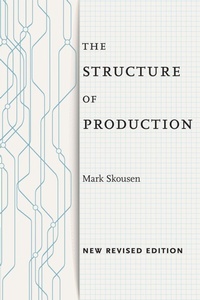
The Structure of Production
New Revised Edition
Published on 25. September 2015
Book
Paperback/Softback
417 pages
978-1-4798-4852-2 (ISBN)
Description
In 2014, the U. S. government adopted a new quarterly statistic called gross output (GO), the most significance advance in national income accounting since gross domestic product (GDP) was developed in the 1940s. The announcement came as a triumph for Mark Skousen, who advocated GO nearly 25 years ago as an essential macroeconomic tool and a better way to measure the economy and the business cycle. Now it has become an official statistic issued quarterly by the Bureau of Economic Analysis at the U. S. Department of Commerce.
In this new revised edition of Structure of Production, Skousen shows why GO is a more accurate and comprehensive measure of the economy because it includes business-to-business transactions that move the supply chain along to final use. (GDP measures the value of finished goods and services only, and omits B-to-B activity.) GO is an attempt to measure spending at all stages of production. Using GO, Skousen demonstrates that the supply-side of the business spending is far more important than consumer spending, is more consistent with economic growth theory, and a better measure of the business cycle.
In this new revised edition of Structure of Production, Skousen shows why GO is a more accurate and comprehensive measure of the economy because it includes business-to-business transactions that move the supply chain along to final use. (GDP measures the value of finished goods and services only, and omits B-to-B activity.) GO is an attempt to measure spending at all stages of production. Using GO, Skousen demonstrates that the supply-side of the business spending is far more important than consumer spending, is more consistent with economic growth theory, and a better measure of the business cycle.
Reviews / Votes
"Skousens Structure of Production should be a required text at our leading universities. The book masterfully juxtaposes the ideas of the 'Austrians' against mainstream economics yet it is balanced, fair, well written and clearly illustrated. It is an important book for students of economics and a treasure for academics." - John O. Whitney,Emeritus Professor in Management Practice at Columbia University "The next economics will have to be centered on supply and the factors of production rather than being functions of demand. I've read Mark Skousens book twice, and it comes the closest to achieving this goal." - Peter F. Drucker,Claremont Graduate UniversityMore details
Language
English
Place of publication
New York
United States
Target group
College/higher education
Product notice
Paperback (trade)
Dimensions
Height: 228 mm
Width: 153 mm
Thickness: 38 mm
Weight
652 gr
ISBN-13
978-1-4798-4852-2 (9781479848522)
Copyright in bibliographic data and cover images is held by Nielsen Book Services Limited or by the publishers or by their respective licensors: all rights reserved.
Schweitzer Classification
Other editions
Additional editions
E-Book
09/2015
New York University Press
€27.49
Available for download
E-Book
09/2015
New York University Press
€36.99
Available for download
Person
Mark Skousen is a Presidential Fellow at Chapman University in California. Since 1980, Skousen has been editor in chief of Forecasts & Strategies, a popular award-winning investment newsletter. He has written for the Wall Street Journal, Forbes, the Christian Science Monitor, and the Journal of Economic Perspectives. His economics works include The Structure of Production (NYU Press), The Making of Modern Economics (ME Sharpe), Economic Logic (Capital Press), and EconoPower (Wiley &Sons). His investment books include Investing in One Lesson (Capital Press), and The Maxims of Wall Street (Eagle Publishing). His latest book is A Viennese Waltz Down Wall Street: Austrian Economics for Investors (LFB Publishers).
Content
CONTENTS Introduction to the Paperback Edition xi Preface xxxix 1. Introduction: The Case for a New Macroeconomics 1 PART I THE STRUCTURE OF PRODUCTION: A HISTORICAL SURVEY 2. The Theory of Production in Classical Economics 13 3. Hayek and the 1930s: A New Vision of Macroeconomics 43 4. Time and Production in the Post-Keynesian Era 84 PART 2 THE THEORETICAL FRAMEWORK 5. The Structure of Production: The Building Blocks 133 6. Time and the Aggregate Production Structure 184 7. Savings, Technology, and Economic Growth 215 8. The Theory of Commodity Money: Economics of a Pure Gold Standard 265 9. Economics of a Fiat Money Standard: A Theory of the Business Cycle 282 ix PART 3 APPLICATIONS 10. Implications for Government Economic Policy 335 11. Conclusions: The Future of Economic Theory and Research 363 References 3 79 Index 401 About the Author 417