

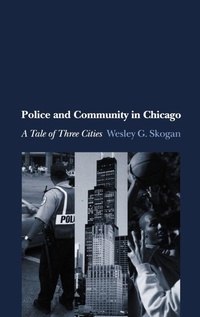
Police and Community in Chicago
A Tale of Three Cities
Published on 31. August 2006
Book
Hardback
360 pages
978-0-19-515458-0 (ISBN)
Description
In the early 1990s, Chicago, the nation's third largest city, instituted the nation's largest community policing initiative. Wesley G. Skogan here provides the first comprehensive evaluation of that citywide program, examining its impact on crime, neighborhood residents, and the police. Based on the results of a thirteen-year study, including interviews, citywide surveys, and sophisticated statistical analyses, Police and Community in Chicago reveals a city divided among African-Americans, Whites, and Latinos. Each faced distinctive problems when community policing came to Chicago in 1993, and during the next decade the three communities took different routes. There were tremendous improvements in the citys predominately African-American districts, where crime and fear dropped the most. The city's largely white neighborhoods were already solidly behind the police, yet they too registered significant gains. Under pressure from immigration, the Latino population cleaved in two with predominately Spanish-speaking areas falling behind on multiple measures of crime, disorder and neighborhood decay. Immigration will only continue to grow both in Chicago and around the world. Skogan thus concludes his pathbreaking work with a challenge for the future: more effective ways of responding to the problems facing the city's newest immigrants must now be found.
Reviews / Votes
"A landmark study of the social, political and institutional contexts of Chicago's community policing initiative. Skogan identifies critical challenges facing city leaders to democratize policing while confronting widening racial breaches in public confidence in the police. A must-read for big city mayors and police chiefs."--Jeffrey Fagan, Columbia University "Fortunately, when Chicago unveiled the country's most ambitious community policing experiment, Wesley Skogan and his team launched an equally ambitious evaluation. The result is a rich, rigorous and provocative analysis, carefully constructed over a decade, that sheds light on the profound challenges facing policing in America--how to simultaneously build public trust, reduce crime, and support urban renewal, while confronting deep racial divides and powerful demographic forces. This elegant and insightful account will stand as a landmark in the literature of police reform, with lessons for police leaders and elected officials alike."--Jeremy Travis, John Jay College of Criminal Justice "In a time when public sector innovation is either excessively hyped or cynically rejected, Skogan brings a refreshing balance and candor to his assessment of Chicago's extraordinary efforts to implement community policing. The book provides essential insights into what worked, what didn't, and why, and offers valuable lessons to be learned from Chicago's experience."--Stephen Mastrofski, George Mason UniversityMore details
Series
Language
English
Place of publication
New York
United States
Target group
Professional and scholarly
Illustrations
45 line illus.
Dimensions
Height: 240 mm
Width: 161 mm
Thickness: 24 mm
Weight
702 gr
ISBN-13
978-0-19-515458-0 (9780195154580)
Copyright in bibliographic data and cover images is held by Nielsen Book Services Limited or by the publishers or by their respective licensors: all rights reserved.
Schweitzer Classification
Other editions
Additional editions
Book
01/2010
1st Edition
Oxford University Press Inc
€50.50
Shipment within 15-20 days
E-Book
12/2009
1st Edition
OUP eBook
€22.99
Available for download
Person
Wesley G. Skogan is Professor of Political Science and Faculty Fellow of the Institute for Policy Research at Northwestern University. An expert on crime and policing, he is author of Community Policing, Chicago Style and On the Beat: Police and Community Problem Solving , two books based on his years of studying Chicago's Alternative Policing Strategy (CAPS). His research focuses on the interface between the public and the criminal justice system.
Content
List of Figures and Tables ; Acknowledgments ; 1. Community Policing ; 2. Crime, Police and the Three Chicagos ; 3. Reengineering the Police ; 4. Involving the Community ; 5. Representing the Community ; 6. Tackling Neighborhood Problems ; 7. Trends in Neighborhood Problems ; 8. Trends in Crime and Fear ; 9. Police and the Public ; 10. How did Chicago Do? ; Bibliography ; Index