

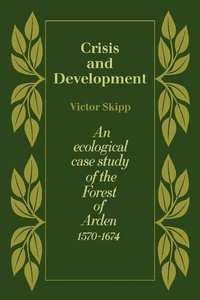
Crisis and Development
An Ecological Case Study of the Forest of Arden 1570-1674
Published on 30. October 2008
Book
Paperback/Softback
148 pages
978-0-521-08850-3 (ISBN)
Description
During the Tudor and Stuart periods the population of England doubled, increasing from perhaps 2.5 to 5 million. When the total had last reached the 4-5 million mark, in the early fourteenth century, there had been a sharp Malthusian cut-back. How then did the country manage to break through this crucial barrier at its second attempt? Victor Skipp throws light on this question by constructing a detailed model of demographic, economic and social change for a sample group of English communities. After examing the effect of the ecological adjustments on social structure, domestic and cultural life, Mr Skipp turns to the wider implications of his model, considering the possibilities of adapting it to the analysis of sixteenth and seventeenth century developments in other English communities; how it might be related to the 'general European crisis', particularly as expounded in the regional studies of French historians; and to the political alignment of local inhabitants during the English civil war.
More details
Language
English
Place of publication
Cambridge
United Kingdom
Target group
Professional and scholarly
Product notice
Paperback (trade)
Illustrations
Worked examples or Exercises
Dimensions
Height: 229 mm
Width: 152 mm
Thickness: 9 mm
Weight
226 gr
ISBN-13
978-0-521-08850-3 (9780521088503)
Copyright in bibliographic data and cover images is held by Nielsen Book Services Limited or by the publishers or by their respective licensors: all rights reserved.
Schweitzer Classification
Other editions
Additional editions

Book
06/1978
Cambridge University Press
€13.58
Article exhausted; check for reprint
Previous edition
Book
06/1978
Cambridge University Press
€13.58
Article exhausted; check for reprint
Content
List of figures; List of tables; Acknowledgements; Part I. The Context: 1. The national background; 2. The local setting; 3. The ecological approach; Part II. The Case Study: 4. The demographic crisis of 1613-19; 5. Negative responses; 6. The ecological problem; 7. Positive responses: agrarian change; 8. Positive responses: new employment openings; 9. Model of demographic, economic and social developments, 1575-1649; 10. The new ecological regime, 1625-74; 11. The social cost; Part III. Implications: 12. General propositions; 13. The 'General European Crisis'; 14. The Civil War alignment; Appendix I: the practice of birth control; Appendix II: estimates of population size; Notes; Index.