

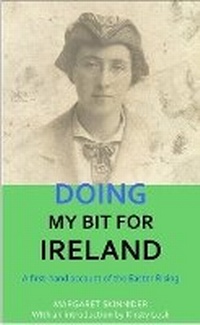
Doing My Bit For Ireland
Published on 10. October 2016
Book
Hardback
176 pages
978-1-910745-50-2 (ISBN)
Description
Doing my Bit for Ireland is Margaret Skinnider's autobiography, focusing mostly on the time period shortly before and after the 1916 Easter Rising in Ireland. In it, she details her activities and motivations, along with her observations of the quality and nature of Irish life under English rule. This is a detailed, colourful account of a complex and highly controversial series of events, provided by an eyewitness to and participant in this vital part of Ireland's history.
Reviews / Votes
.More details
Language
English
Place of publication
Edinburgh
United Kingdom
Product notice
Unsewn / adhesive bound
Dimensions
Height: 198 mm
Width: 135 mm
Thickness: 18 mm
Weight
260 gr
ISBN-13
978-1-910745-50-2 (9781910745502)
Copyright in bibliographic data and cover images is held by Nielsen Book Services Limited or by the publishers or by their respective licensors: all rights reserved.
Schweitzer Classification
Other editions
Additional editions
E-Book
01/2017
Luath Press
€8.39
Available for download
Persons
MARGARET SKINNIDER was born in Coatbridge, Lanarkshire, in 1893. She trained as a maths teacher and moved to Glasgow. While there, she became involved with Cumann na mBan, a women's organization founded in Dublin in 1914, and the women's suffrage movement. She also learned to shoot at a rifle club. She made many trips to Ireland, sometimes smuggling detonators and wires for bombs under her clothes. During the rising Skinnider performed various roles, including scout, messenger, and sniper. She was ultimately shot while attempting to burn down some houses to cut off the British retreat. She was arrested, but due to her injuries was permitted to stay in hospital, from which she escaped and fled to Scotland. Later that year, she left for New York, where she wrote this book as well as touring and fundraising for the republican cause. She later returned to Ireland, where she spent some time in prison during the War of Independence. Her later life was spent teaching, and she never stopped fighting for the rights of women. She died in Glenageary in 1971.