

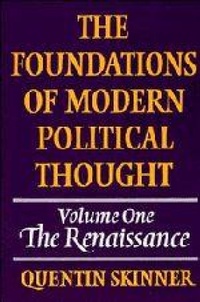
The Foundations of Modern Political Thought: Volume 1, The Renaissance
Volume 1, the Renaissance
Published on 30. November 1978
Book
Hardback
332 pages
978-0-521-22023-1 (ISBN)
Description
A two-volume study of political thought from the late thirteenth to the end of the sixteenth century, the decisive period of transition from medieval to modern political theory. The work is intended to be both an introduction to the period for students, and a presentation and justification of a particular approach to the interpretation of historical texts. Quentin Skinner gives an outline account of all the principal texts of the period, discussing in turn the chief political writings of Dante, Marsiglio, Bartolus, Machiavelli, Erasmus and more, Luther and Calvin, Bodin and the Calvinist revolutionaries. But he also examines a very large number of lesser writers in order to explain the general social and intellectual context in which these leading theorists worked. He thus presents the history not as a procession of 'classic texts' but are more readily intelligible. He traces by this means the gradual emergence of the vocabulary of modern political thought, and in particular the crucial concept of the State.
More details
Language
English
Place of publication
Cambridge
United Kingdom
Target group
Professional and scholarly
Dimensions
Height: 235 mm
Width: 157 mm
Thickness: 24 mm
Weight
691 gr
ISBN-13
978-0-521-22023-1 (9780521220231)
Copyright in bibliographic data and cover images is held by Nielsen Book Services Limited or by the publishers or by their respective licensors: all rights reserved.
Schweitzer Classification
Other editions
Additional editions
E-Book
10/2013
1st Edition
Cambridge University Press
€29.49
Available for download
Book
11/1978
Cambridge University Press
€38.00
Shipment within 15-20 days
E-Book
11/1978
Cambridge University Press
€25.49
Available for download
Person
Content
Preface; Acknowledgements; Notes on the text; Part I. The Origins of the Renaissance: 1. The ideal of liberty; 2. Rhetoric and liberty; 3. Scholasticism and liberty; Part II. The Italian Renaissance: 4. The Florentine renaissance; 5. The age of princes; 6. The survival of republican values; Part III. The Northern Renaissance: 7. The diffusion of humanist scholarship; 8. The reception of humanist political thought; 9. The humanist critique of humanism; Bibliography of primary sources; Bibliography of secondary sources; Index.