

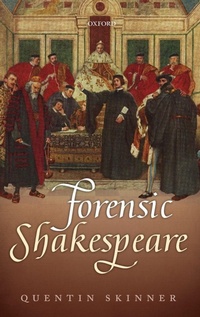
Forensic Shakespeare
Published on 30. October 2014
Book
Hardback
368 pages
978-0-19-955824-7 (ISBN)
Description
Forensic Shakespeare illustrates Shakespeare's creative processes by revealing some of the intellectual materials out of which some of his most famous works were composed. Focusing on the narrative poem Lucrece, on four of his late Elizabethan plays -- Romeo and Juliet, The Merchant of Venice, Julius Caesar and Hamlet -- and on three early Jacobean dramas, Othello, Measure for Measure and All's Well That Ends Well, Quentin Skinner argues that there are major speeches, and sometimes sequences of scenes, that are crafted according to a set of rhetorical precepts about how to develop a persuasive judicial case, either in accusation or defence. Some of these works have traditionally been grouped together as 'problem plays', but here Skinner offers a different explanation for their frequent similarities of tone. There have been many studies of Shakespeare's rhetoric, but they have generally concentrated on his wordplay and use of figures and tropes. By contrast, this study concentrates on Shakespeare's use of judicial rhetoric as a method of argument. By approaching the plays from this perspective, Skinner is able to account for some distinctive features of Shakespeare's vocabulary, and also help to explain why certain scenes follow a recurrent pattern and arrangement.
Reviews / Votes
Forensic Shakespeare has all the qualities of erudition and lucidity one would expect from Quentin Skinner * Around the Globe, Neil Rhodes * This generous, helpful guide goes a long way towards explaining how Shakespeare's literary genius works * Irish Times, Andrew Hadfield * A magisterial, loving study of Shakespeare's infinitely varied use of the handbooks of judicial rhetoric shaping the thought of any Elizabethan (and us too, come to that). * Fred Inglis, Books of the year 2014, Times Higher Education * a brilliant study of the teachings of classical legal rhetoric as used and misused by Shakespeare's speakers. * Brian Vickers, Book of the Year 2014, Times Literary Supplement * clear and convincing ... It's doubly impressive to imagine the book's own oratorical origins, since its later chapters now work so well as something so textual as an index of Shakespeare's uses of the five parts of a judicial speech. * Matthew Ritger, Los Angeles Review of Books * exemplary scholarship. * David Womersley, Standpoint * a genuinely illuminating book and should be required reading for every serious student of [Shakespeare]. * Brian Vickers, Common Knowledge * explores the idea that the Bard skilfully employed judicial rhetoric in the poem Lucrece and in some half-dozen of his most famous plays. A good one for Lawyers, Law students and anyone keen to sprinkle their dinner party conversation with some judiciously selected pearls of Shakespearean legalese. * Shakespeare Magazine * the book is at its best on rhetoric and there is nobody better informed or more articulate on the subject of classical rhetoric than Skinner ... Skinner presents very engaging and detailed accounts of how judicial rhetoric develops through vernacular translations into a comprehensive language of performance and persuasion. There is no doubt that one of the greatest gifts of this book is the attention to the rhetorical texts themselves and their vigourous and learned analysis. * Charlotte Scott, The Year's Contribution to Shakespeare Studies * Skinner's book is a fascinating read, rich with instruction, analysis and suggestions for further study. * B. J. Sokol, Notes and Queries *More details
Series
Language
English
Place of publication
Oxford
United Kingdom
Target group
College/higher education
Dimensions
Height: 240 mm
Width: 161 mm
Thickness: 26 mm
Weight
787 gr
ISBN-13
978-0-19-955824-7 (9780199558247)
Copyright in bibliographic data and cover images is held by Nielsen Book Services Limited or by the publishers or by their respective licensors: all rights reserved.
Schweitzer Classification
Other editions
Additional editions
Person
Quentin Skinner was born in 1940 and educated at Bedford School and at Gonville and Caius College Cambridge. He was elected a Fellow of Christ's College in 1962 and appointed to a Lectureship in the Faculty of History at Cambridge in 1965. Between 1974 and 1979 he was based at the Institute for Advanced Study at Princeton. Returning to Cambridge, he served successively as Professor of Political Science (1979-1996) and as Regius Professor of History (1996-2008).
Content
Introduction ; 1. Classical rhetoric in Shakespeare's England ; 2. Shakespeare's forensic plays ; 3. The open beginning ; 4. The insinuative beginning ; 5. The failed beginning ; 6. The judicial narrative ; 7. Confirmation: juridical and legal issues ; 8. Confirmation: the conjectural issue ; 9. Refutation and non-artificial proofs ; 10. The peroration and appeal to commonplaces ; Appendix: The date of All's Well That Ends Well