

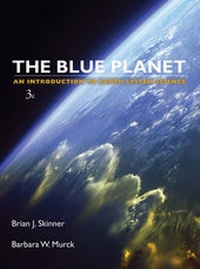
The Blue Planet
An Introduction to Earth System Science
3rd Edition
Will be published approx. on 4. March 2011
Book
Hardback
672 pages
978-0-471-23643-6 (ISBN)
Description
The Third Edition of Blue Planet: An Introduction to Earth System Science treats earth science from a systems perspective, showing how the four spheres (lithosphere, hydrosphere, atmosphere, biosphere) are interrelated. In this edition, significant emphasis is placed on cycling of materials and energy, and interactions among the spheres. The text also places much clearer emphasis on basic science, which can be seen in the reorganization of topics into Energy and Matter chapters, as well as a new "The Basics" feature in each chapter. This edition is also more systematic about documenting human impacts on the various spheres of the Earth system.
More details
Product info
gebunden
Edition
3. Auflage
Language
English
Place of publication
New York
United States
Target group
College/higher education
Professional and scholarly
Edition type
New edition
Product notice
sewn/stitched
Paper over boards
Dimensions
Height: 287 mm
Width: 225 mm
Thickness: 29 mm
Weight
1495 gr
ISBN-13
978-0-471-23643-6 (9780471236436)
Schweitzer Classification
Other editions
Previous edition
Brian J. Skinner | Stephen C. Porter | Daniel B. Botkin
The Blue Planet
An Introduction to Earth System Science
Book
02/1999
2nd Edition
Wiley
€57.90
Article exhausted; check for reprint
Persons
Brian Skinner was born and raised in Australia, studied at the University of Adelaide in South Australia, worked in the mining industry in Tasmania, and in 1951 entered the Graduate School of Arts and Sciences, Harvard University, from which he obtained his Ph.D. in 1954. Following a period as a research scientist in the United States Geological Survey in Washington D.C., he joined the faculty at Yale in 1966, where he continues his teaching and research as the Eugene Higgins Professor of Geology and Geophysics. Brian Skinner has been president of the Geochemical Society, the Geological Society of America, and the Society of Economic Geologists, He holds an honorary Doctor of Science from Toronto University, and an honorary Doctor of Engineering from the Colorado School of Mines.
Barbara Murck is a geologist and senior lecturer in environmental science at the University of Toronto Mississauga. She completed her undergraduate degree in Geological and Geophysical Sciences at Princeton University and then spent two years in the Peace Corps in West Africa, before returning to Ph.D. studies at the University of Toronto. Her subsequent teaching and research has involved an interesting combination of geology, natural hazards, environmental science, and environmental issues in the developing world, primarily in Africa and Asia. She also carries out practical research on pedagogy. She is an award-winning lecturer who has co-authored a number of books, including several with Brian Skinner.
Barbara Murck is a geologist and senior lecturer in environmental science at the University of Toronto Mississauga. She completed her undergraduate degree in Geological and Geophysical Sciences at Princeton University and then spent two years in the Peace Corps in West Africa, before returning to Ph.D. studies at the University of Toronto. Her subsequent teaching and research has involved an interesting combination of geology, natural hazards, environmental science, and environmental issues in the developing world, primarily in Africa and Asia. She also carries out practical research on pedagogy. She is an award-winning lecturer who has co-authored a number of books, including several with Brian Skinner.
Content
Chapter 1: The Earth System
Chapter 2: Matter
Chapter 3: Energy
Chapter 4: The Solar System
Chapter 5: The Dynamic Geosphere
Chapter 6: Earthquakes and Volcanoes
Chapter 7: The Rock Cycle
Chapter 8: The Hydrologic Cycle
Chapter 9: The Frozen Hydrosphere
Chapter 10: The World Ocean
Chapter 11: The Atmosphere
Chapter 12: Wind and Weather Systems
Chapter 13: The Climate System
Chapter 14: Life, Death, and Evolution
Chapter 15: Energy and Matter in Life Systems
Chapter 16: Earth's Major Ecosystems
Chapter 17: Habitat, Interactions, and Diversity
Chapter 18: Earth's Resources
Chapter 19: The Changing Earth System