

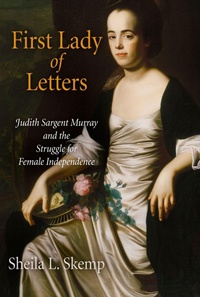
First Lady of Letters
Judith Sargent Murray and the Struggle for Female Independence
Published on 22. March 2013
Book
Paperback/Softback
512 pages
978-0-8122-2248-7 (ISBN)
Description
Judith Sargent Murray (1751-1820), poet, essayist, playwright, and one of the most thoroughgoing advocates of women's rights in early America, was as well known in her own day as Abigail Adams or Martha Washington. Her name, though, has virtually disappeared from the public consciousness. Thanks to the recent discovery of Murray's papers-including some 2,500 personal letters-historian Sheila L. Skemp has documented the compelling story of this talented and most unusual eighteenth-century woman.
Born in Gloucester, Massachussetts, Murray moved to Boston in 1793 with her second husband, Universalist minister John Murray. There she became part of the city's literary scene. Two of her plays were performed at Federal Street Theater, making her the first American woman to have a play produced in Boston. There as well she wrote and published her magnum opus, The Gleaner, a three-volume "miscellany" that included poems, essays, and the novel-like story "Margaretta." After 1800, Murray's output diminished and her hopes for literary renown faded. Suffering from the backlash against women's rights that had begun to permeate American society, struggling with economic difficulties, and concerned about providing the best possible education for her daughter, she devoted little time to writing. But while her efforts diminished, they never ceased.
Murray was determined to transcend the boundaries that limited women of her era and worked tirelessly to have women granted the same right to the "pursuit of happiness" immortalized in the Declaration of Independence. She questioned the meaning of gender itself, emphasizing the human qualities men and women shared, arguing that the apparent distinctions were the consequence of nurture, not nature. Although she was disappointed in the results of her efforts, Murray nevertheless left a rich intellectual and literary legacy, in which she challenged the new nation to fulfill its promise of equality to all citizens.
Born in Gloucester, Massachussetts, Murray moved to Boston in 1793 with her second husband, Universalist minister John Murray. There she became part of the city's literary scene. Two of her plays were performed at Federal Street Theater, making her the first American woman to have a play produced in Boston. There as well she wrote and published her magnum opus, The Gleaner, a three-volume "miscellany" that included poems, essays, and the novel-like story "Margaretta." After 1800, Murray's output diminished and her hopes for literary renown faded. Suffering from the backlash against women's rights that had begun to permeate American society, struggling with economic difficulties, and concerned about providing the best possible education for her daughter, she devoted little time to writing. But while her efforts diminished, they never ceased.
Murray was determined to transcend the boundaries that limited women of her era and worked tirelessly to have women granted the same right to the "pursuit of happiness" immortalized in the Declaration of Independence. She questioned the meaning of gender itself, emphasizing the human qualities men and women shared, arguing that the apparent distinctions were the consequence of nurture, not nature. Although she was disappointed in the results of her efforts, Murray nevertheless left a rich intellectual and literary legacy, in which she challenged the new nation to fulfill its promise of equality to all citizens.
Reviews / Votes
"First Lady of Letters is an admirable history of this all-but-forgotten Federalist-era women's rights advocate, who argued powerfully that girls could shine as brightly as boys if only they were given the benefits of a classical education and parents who encouraged them to 'reverence themselves.'" (Wall Street Journal) "Accessibly written, and with contextual material involving both Murray's times and up-to-date historical thinking about Enlightenment women and the early republic, the book will become the starting point for all future work about Murray and women writers before the Jacksonian period." (American Historical Review) "A very fine biography, one that is not only an excellent work of scholarship but also highly readable and engaging. In mining and analyzing new materials, Skemp has turned the historical spotlight on an author and critic worthy of ongoing consideration." (New England Quarterly) "I am deeply grateful to Skemp for providing us with such a comprehensive perspective on Murray and for helping bring her out of the shadows and into the limelight shared by contemporaries such as Abigail Adams and Mercy Otis Warren. . . . What is most valuable about this book, however, is Skemp's wonderful depiction of the transition in the early Republic as old New England families were forced to share power and authority with the rising classes." (William and Mary Quarterly) "Sheila Skemp gives readers unprecedented access to Murray's private writing, shared almost exclusively with family members and close friends, at these and other momentous occasions in her exceptional new biography. Skemp takes us beyond Murray's more familiar published work to her richly descriptive thoughts on the terrors of childbirth; travels; visits with the likes of Washington and John Adams; and the travails of educating her daughter, two girls also under her stewardship, and the boisterous sons of her brother, who had been sent north from Natchez with Harvard in their sights." (Eighteenth-Century Studies) "Skemp's nimble selection of the details. . . reveal in stunning, sad, and human detail the mind and life of a brilliant woman who advocated for women's equality well before Mary Wollstonecraft." (Resources for American Literary Study)More details
Series
Language
English
Place of publication
Pennsylvania
United States
Product notice
Paperback (trade)
Illustrations
10 illus.
Dimensions
Height: 234 mm
Width: 155 mm
Thickness: 33 mm
Weight
771 gr
ISBN-13
978-0-8122-2248-7 (9780812222487)
Copyright in bibliographic data and cover images is held by Nielsen Book Services Limited or by the publishers or by their respective licensors: all rights reserved.
Schweitzer Classification
Other editions
Additional editions

E-Book
08/2011
1st Edition
University of Pennsylvania Press
€38.99
Available for download
Person
Sheila L. Skemp is Clare Leslie Marquette Professor of History at the University of Mississippi.
Content
Preface
PART I. REBELLIONS: 1769-1784
Chapter 1. "This Remote Spot"
Chapter 2. Universal Salvation
Chapter 3. Independence
Chapter 4 Creating a Genteel Nation
PART II. REPUBLIC OF LETTERS: 1783-1798
Chapter 5. "Sweet Peace"
Chapter 6. A Belle Passion
Chapter 7. A Wider World
Chapter 8. A Career of Fame
Chapter 9. "A School of Virtue"
Chapter 10. Federalist Muse
PART III. RETREAT: 1798-1820
Chapter 11. "We Are Fallen on Evil Times"
Chapter 12. Republican Daughters, Republican Sons
Epilogue
Afterword
List of Archival Sources
Notes
Index
Acknowledgments
PART I. REBELLIONS: 1769-1784
Chapter 1. "This Remote Spot"
Chapter 2. Universal Salvation
Chapter 3. Independence
Chapter 4 Creating a Genteel Nation
PART II. REPUBLIC OF LETTERS: 1783-1798
Chapter 5. "Sweet Peace"
Chapter 6. A Belle Passion
Chapter 7. A Wider World
Chapter 8. A Career of Fame
Chapter 9. "A School of Virtue"
Chapter 10. Federalist Muse
PART III. RETREAT: 1798-1820
Chapter 11. "We Are Fallen on Evil Times"
Chapter 12. Republican Daughters, Republican Sons
Epilogue
Afterword
List of Archival Sources
Notes
Index
Acknowledgments